Showing posts with label interactive notebooks. Show all posts

Wednesday, August 23, 2017

Eclipse Mania

Like most of the country, we were swept up in Eclipse Mania this week.  (Funny how we don't doubt scientists about the eclipse, but attack them on everything else....hmmm....)

 The Thursday before the eclipse, I sent home permission slips from the school in regards to watching the eclipse (with proper eye wear of course).  Not all of the permission slips were returned by Monday, which caused some tears from my third graders.

Another member of my grade level managed to acquire 29 pairs of viewing glasses, so my class got to go out in smaller chunks.  I must say I love being part of a team that shares and values collaboration.

Las Vegas weather (rain, go figure) made viewing the eclipse rather difficult, so we live streamed from NASA instead.


My students loved seeing scientists of all genders, races, and ethnic backgrounds.  I didn't point it out, but it was heart warming to hear "hey, he looks like me!".  Diverse role models are important. 


We did have specials at 10:15, so I simply paused the live stream and we continued when they were back from music (thanks You Tube!).


We acted out the earth and moon's rotation around the sun, discussed important science vocabulary words, and set up our science notebooks.  We practiced making diagrams like scientists:


I didn't plan to devote two hours of my teaching day to the eclipse, but I'm glad I did.  By the time the next eclipse rolls around, my sweet third graders will be high school seniors.  That's a little terrifying to think about.

Saturday, August 15, 2015

Embracing the Doodle

One of the break out sessions from DENSI 2015 was on doodling as a strategy for note taking and I had the opportunity to try it out yesterday at my {math training}.

Before attending this training, I was skeptical.  I love note taking, but was worried students might be drawing and zoning out instead of doodling as a way to itemize what was important.  


Tracy, a fellow DEN member, shared two books on visual literacy that are pending in my Amazon cart.  

She mentioned that children start out as visual learners (pictures) and those pictures slowly fade away.  The argument is made (both by her and in a TED talk) about bringing back these doodles.

She shared that there are three distinct benefits:
1) Power:  Students feel in control with their doodles and take ownership over their notes.  I'd even have them share their doodles with one another.

2) Performance:  Connections are made between the brain's hemispheres during doodling, thus storing information in long term memory and leading to higher recall and understanding, which leads to higher performance.

3) Pleasure: It's fun to doodle.

(Example of a doodle from a TED talk)


For setting this up in the classroom, she focuses on stressing that this isn't drawing, it's doodling (so there is less pressure).

Here is her ice breaker to introduce doodling:

1) A pair of students share one piece of paper that is folded in half.
2) One student begins the drawing on the folded line by adding a simple shape.
3) For two minutes, students do not speak but build off of the picture.
4) After the timer, students share their work with their table team.

We'll be doing this activity during the first week of school!  Not only does it aid in team building, but also retention, helps students focus, and builds creative problem solving.  I'll also use it to discuss strengths and challenges, focusing on the next time it's done, it will be more comfortable because learning is a process.

She said the timer is set for two minutes, but not displayed to students.  Students should focus on each other, not how much time is left.

I gave doodling a try at my math training and enjoyed it. I am excited to give this a try with my students.  I think we'll start with doodling in pencil, then slowly add colored pencils as well.  Since my students share classroom supplies, I don't want the doodling to become a fight over specific colors. 

This is one of the new changes I'm trying this school year.  

What new strategies are you trying?

Thursday, July 23, 2015

DENSI 2015 Overview

I'll start off with saying that I believe all professional development should be like DENSI.  It was a purposefully crafted week that allowed for whole group sessions, hands-on exploration, discussion, collaboration, and smaller break-out sessions that were dictated by teacher's choices (unconference).  

Here was the overview:

Sunday

We took arrived at American University and I was already exhausted.  I left Las Vegas at 12:30 am, landed in Philly around 8 am, then landed in DC at 11.  DENSI doesn't start until 3, but my suite mate was awesome and picked me up from the airport and let me drop my bags off in my room.  She had been there since Friday because she is on the Leadership Council.  I then found two newbies from Chicago and we went off in search of food.  We must have found the DENSI hotspot because I saw my roommate there (along with a good three dozen other hungry teachers).  After lunch (and gelato), we headed back to officially begin DENSI.

After getting our lanyards and fighting for the elevator, we took our press photos, unpacked, and had dinner.  DE brought in food trucks and then we did a gift swap and scavenger hunt.  Part of our packing instructions were to bring a gift that represented our home town, so I brought a mug, playing cards, and a poker chip key chain for my mystery person.  I got some peanuts from Virginia (lucky B!) and my person was super friendly.  We also got our DENSI swag, which included a Shark Week hat (I love Shark Week) and a selfie stick.


We then had our opening session, went over the schedule, and had some guest speakers.  We broke off into our smaller team meetings.  Since all of our team was female, we named ourselves the Estro-DEN.  One of the ladies on my team was also my suite mate, so that was a fun coincidence.

Monday

We spent the morning site seeing and the afternoon on our own.  I chose to spend the afternoon in the Natural History museum, including an accidental nap during an Imax movie on oceans.  (To be fair, it was a very soothing and calming movie.)

We saw the Thomas Jefferson, FDR, Martin Luther King Jr, Lincoln, Vietnam, and Korean war monuments.  We drove by Embassy row, the Washington monument, and the White House.

Snapshots from Monday:


(Inside and outside of the Jefferson Memorial)


Dr. King
(Fun fact: His position means he's staring at Lincoln's monument, where he gave his I have a Dream Speech)


President FDR's memorial
(We were told not to sit on his lap. I'm disturbed that the tour guide deemed it necessary to tell us that in the first place.)


Washington's monument 
(Fun fact, you can see the different layers because of construction issues about 1/3 of the way up!)

Korean War Memorial


President Lincoln (Notice the hands are A and L in American Sign Language)


(Added to the Lincoln memorial steps to honor Dr. King)

The White House


After site seeing and dinner, my roommie and I crashed.  We'd been up for a while and both were on West Coast time, so the 6 am alarm seemed very early.

Tuesday

I immediately began to hate my alarm clock.  We had to get to the dining hall early to compete for food with hundreds of enthusiastic children.  I'm pretty sure the future leaders of America (or a similar spin off) were there, so there were lots of sixteen year olds in business attire trying to navigate the campus in heels.  We didn't even bother attempting Starbucks when we saw the line out the door. 

On the bright side, this was a site we saw every morning:


(As a Nevadan, I enjoyed the greenery.)

After breakfast was our morning session, then break out mini-sessions (which I'll reflect upon later) with lunch in between.  I took notes on my pink memo pad, which is ironic considering I'm at a tech conference, but that's how I process information the best.


(On a completely unrelated note, I also process learning best when I have Starbucks and chocolate...)

I attended: PBL in the media rich classroom (project/problem based learning), doodling in the classroom (as a means of note taking), showing what you know (projects), and library and digital resources (to share with my librarian).  All my sessions were amazing.

Dinner followed, then the DENmazing race (the Amazing Race, Discovery Style).  My team was not competitive (hence the name the Frolicking Unicorns) but we had a great time.  As an added bonus, I found some new team builder games to use next year with Sunshine committee.


We had to jog through the hoops and then crawl through the tunnel before throwing a football through another hoop at the end of the station.  There were at least eight different embarrassing games.  

After the DENmazing race, we did an escape room.  This was my first time participating in one and it was awesome.  It was 1985 themed and our team escaped the room the fastest.  We had to work together to solve clues and figure out puzzles to enter different rooms within the escape room (there were six rooms total, so I guess it was the escape suite).  

Wednesday

Again, the alarm clock came too soon as did the fight for the omelet line with the children.  The day was again broken into smaller mini-sessions.  

I attended: Coding (which I definitely need to investigate more), app smashing (combining different apps into a project), portable presentations (a good dozen things to use besides Prezi), and took the last session off to process everything I'd learned so far.

I also had some time with the DENSI gnome. 


He is not to be left alone and enjoys meeting all the DENSI participants.

We then did another team builder that focused on mini-debates that could be used in the classroom, had a team meeting, (had a post-dinner nap), and then had a DENovator (craft) fair.  I made a shark week coaster (because obviously), a few other small craft projects, and had a great time chatting with others.  


I don't know how, but I want to do something like this for our wedding.  The craft wheels in my mind are spinning!

I also snagged this iron-on to use on a future project:


Next time I attend, I'll definitely plan a craft to share :)

Thursday

Thursday is both my favorite and least favorite day of DENSI.

It's my favorite because it's unconference day, which means the sessions are all created based on what we as educators want.  It's loosely structured and meant to allow for glorious amounts of collaboration.  

I attended information on utilizing twitter and instagram in the classroom (teaching_with_avice if you choose to follow), classroom dojo, mystery skyping, and more.  There was so much wonderful information that I can't wait to share (both here and with my school).

Thursday evening brought our history-themed closing session.  Being the only delegate from my state, it was a little sad to see all the group themed costumes and not have anyone to collaborate with.  I represented the West with Annie Oakley because I already owned all of my costume components.  Some of the other states went as cave women, Egyptian pharaohs, and history bees (yes, bees).

Friday 

We cleaned our room, headed to breakfast, and then to our tear-filled final session.  I headed to the airport to meet Erika and then began our best friend filled weekend.  

I returned home late Monday evening and have been slowly processing the week since then.  I'm a little frustrated in my delay at getting out DENSI notes, but I've also had eye doc appointments and the puppy is interested in chewing on everything but her toys, so she requires constant vigilance.  Good thing she's cute.

Stay tuned for more in depth session notes!

Monday, September 1, 2014

Day 5

I made it to Friday!  


I did start my morning with duty...I'm not a fan of the gate.  I picked up my kiddos, took them off to Art, then planned math with another teacher in my grade level.  We had a grade level meeting yesterday and split up who is planning what subject.  This is an adjustment for me. Instead of planning everything, I'm planning one subject, writing up super explicit lesson plans, and making the copies for the grade level.  So far, I'm liking it!  I still read over their lesson plans and put my own flair on them, but it's nice that collaboration and team work is the norm for my grade level.

After I picked my kiddos up from specials, we jumped right into math.  For our number talk, it's "fact Fridays" where I gave them their first timed multiplication test.  

Last year my grade level split up multiplication and division facts into "easy", "medium", and "hard" facts.  We made 3 different versions of each test and would give them a chance every other week.  Today they had 3 minutes to do the easy multiplication ones.

Easy facts: 1, 2, 5, 10
Medium: 3, 4, 9, 11
Hard: 6, 7, 8, 12

Of those, about 6 of my students passed their easy facts on the first round.  I'll be making a tracker to glue in their notebooks and a brag wall similar to this:


For them to sign off when they pass each level.  Granted, this is a third grade standard, but many of my students don't have these facts mastered (yet!).  We'll alternate testing and practice weeks.

From there, I had them compare notes on what a good mathematician is before adding their thoughts (on post-its) to our chart:

 
'

We also went over the first math practice (make sense of problems and persevere in solving them).  I had them record it in their math notebooks with sticky labels and added the chart to the wall.  I didn't want to put up all 8 without going over them because then students have no connection to what's on the wall.


I also raided another teacher's classroom and found the rods I was looking for!  I modeled that the rods and units represent tens and ones in this case, but made it clear this won't always be the situation.


I had the table teams model 43-29 for me using the manipulatives and they did a pretty good job.  I think most of our math this year will be hands-on because there are some major gaps to fill.  However, after talking with my grade level, I'm not the only one who feels this way so that's nice we're all wanting to give them meaningful practice to help make sense of numbers.


In science, they finished exploring the mystery bags and we had a conversation about all the skills they practiced.  They did a really good job with their team building task.

In writing, they finished their final drafts (which I accidentally left at school...Wednesday problem).  In reading, they took their STAR test to place them for AR and worked on building their stamina in silent reading until everyone was done with writing.

From there, I modeled the importance of previewing a text, again using The Lightning Thief as my mentor text.  I jumped right in and read, without modeling metacognition or stopping to think aloud parts.  A few pages in, they were confused (as they're supposed to be).

We talked about strategies that good readers use, one of them being to preview the text.  What this means is they need to look at the front and back covers, as well as the table of contents, to formulate an idea of what the text is about.  

I then had them practice with a book of their choosing, modeling on a post-it.

We reviewed phrasing and went over rate, adding to our charts in our notebooks.  We'll go over expression and accuracy next week.  We'll also go over buddy coaching and have some fluency practice before we take our beginning of the year Aimsweb benchmarks.

With the bell approaching, they did their classroom jobs and I sent them on their way with this:


They o-fish-ally survived their first week! It's Labor Day weekend and we have a staff development day Tuesday, so I won't see them again until Wednesday.  

One week down!

(On a side note, I did have to write my first citations and lock myself out of my room on Friday. I also forgot to send home last year's CRT scores, so I stapled apology notes to parents and those scores will go home Wednesday.  There were definitely moments of frustration on Friday, mainly due to me forgetting things...so a nice relaxing birthday dinner with B at Red Robin was so deserved!)


Friday, August 8, 2014

Notebooking idea: types of sentences

While this activity does take a large amount of post-its, I do think it's useful for going over types of topic sentences:


I know my fifth graders struggle with openings and having this in their notebooks helped them with peer revising.

Students would write the definition of each type of topic sentence, put my example, then generate their own examples with their table teams or partners.

Declarative Statement:
Introduces the topic, usually with facts or a rhetorical question.

Situation/Stance:
Gives the author's perspective and sets the tone.

Number Statement:
Uses numbers

List:
Creates a list with related topics to generate interest

FANBOYS
Conjunctions: For, And, Nor, But, Or, Yet, So

Good luck!

Friday, July 18, 2014

Simplicity, part 4 (ideas 11-13)

Continuing the new ideas, simplicity trend, here are three more ideas for next year.  I'm excited for small tweaks to make a huge, positive differences.

Idea 11: Beginning of the Year "I am" statement for writing notebooks


This would be such a cute first page in their writing notebooks.  It'd be great for students to see themselves as multidimensional people and an easy way for them to get to know each other!

Idea Twelve: Clothespin revival

I've tried the push pin strategy with clothes pins, but I like this one for more permanent places:


Since I moved recently, I seem to have a plethora of extra command strips!  I could easily decorate the clothespins to match my classroom colors (once I you know, determine those).  Thanks Fifth in the Middle for the idea!

Idea Thirteen: Morning Memes

 To be fair, this isn't entirely a new idea for next year.  Last February, I started doing a morning meme to add some positivity in the morning.  They were a great way to connect with students and reinforce various topics (rules, grammar, being nice, etc).  The memes would inspire my students to talk with one another and start our day on a positive note.


I've been pinning ideas to my Pinterest morning meme board, which you can follow here!

What new ideas are you excited to try?

Tuesday, July 15, 2014

Co-teaching

For the past few years, I've participated in co-teaching with a fairly high degree of success.  Co-teaching is when two teachers (one usually being a special education teacher) are both in the classroom.  There are many models of co-teaching, all of which I've used.

1) One teach, one observe

I use this model least frequently.  We usually did this to provide lesson feedback for the instructing teacher or to model a lesson for the observing teacher.

2) Station teaching

We used this model for math groups.  I would teach the new lesson at the smart board, my co-teacher would be at the kidney table pulling another group to review, work on word problems, etc while the rest of the class was on the computers, doing partner work, or at a math station.  Each teacher was doing a separate lesson.

3) Parallel Teaching

We used this for reading and writing.  The class was divided in half and all the students were given the same lesson.  This style lended itself well to writing because each group would have a different perspective.  

4) One teach, one assist

This model was used most frequently.  One teacher, usually myself, would be giving the lesson while the other would be walking around clarifying for students or pulling conferences.

5) Team teaching

During this model, both teachers are giving instruction.  This worked quite well for think alouds where we would model accountable talk and show what partner discussions should look like.

6) Alternative Teaching

During this model of co-teaching, one teacher would pull aside a small group and deliver remedial or extension activities.

I'm not sure if I will be doing any co-teaching this year, but it definitely has it's strengths and weaknesses.  For me, it was difficult to give up control of instruction to another teacher.  Trust also comes into play because you have to trust that the other teacher is doing his or her job.  Planning can also be a struggle, as can work ethics.  I know that as an educator, I tend to overplan which is beneficial but also meant I was doing more than my fair share of the preparation for co-teaching, which wasn't always fair.

Today I had the opportunity to co-teach:


I'm not sure which model the one teach, one naps on the material best aligns with...

On the bright side, tutoring is going well!  Look at her go in that notebook.

Monday, July 14, 2014

Simplicity, part 3

As previously mentioned, I'm committed to small, simple tweaks this year to make my classroom a more organized and positive place.  Today I present ideas eight through ten!

Idea Eight: Notebook Bookmarks


One of the things my students seem to struggle with when using notebooks is finding the page they left off on.  For some reason unknown to teachers, they love to skip pages.  At the beginning of the year when we set up our notebooks with our table of contents, page numbers, and color coded markers to distinguish subjects, I go over the norms of not skipping pages and using the backsides.  However, by November, this is usually forgotten.

Not this year!

No, this year will be different with the help of this ribbon and duct tape combination!  After journaling, they will simply put the book mark in their notebooks to indicate where they left off and then put their notebooks away.

Idea Nine: The Great Pencil Challenge

Could it be? Can washi and/or duct tape can solve the mystery of the disappearing pencils?


I could have cute prizes for the students who have their assigned pencils at the end of the day, then a few days, then a week.  

When the pencil gets down to basically nothing, I'd give them a new pencil with the same number but different tape (so I could keep them straight). 

Idea Ten: Table Organizers

The great bucket idea of last year failed.  Yes, these shower organizers that were so meticulously color coded by table and had so much hope...didn't work.  


By May, all of the buckets had been stepped on and cracked beyond repair without so much as a simple apology.  Part of this was my fault because the buckets didn't have their own space to rest on when not in use. See, the buckets would rest on someone's desk (if he or she was absent) or on the floor, where the buckets were inevitably and frequently stepped on.

However, I could have eliminated the problem with this set up:


I was already planning on placing my students in Kagan groups of 4-6 (depending on class size), so I could arrange the desks around these organizers.  I know they are at Target, I just need to wait for them to go on sale or be in my cartwheel ap (or both!).  

I'm getting excited to get into my classroom and begin setting up! 

Thursday, July 10, 2014

Ms. Vice's boot camp, day 1

I had my first tutoring session with my third grader today.  She's adorable and loves learning, which is a nice change.  Her mom brought me data from her last report card and talked about what books they should get from the library.  It was so nice to see a positive family focused on school!

We read two passages on Helen Keller and set up her reading notebook.  We made a graphic organizer and talked about strategies.  She did really well!

We are going to meet on Mondays, Wednesdays, and Fridays for an hour and a half.  It's time to dig into my very unorganized guest bedroom (teacher closet) and find some fluency activities and reading games!

Monday, July 7, 2014

Simplicity, part 2

As I blogged about last week, I'm excited to try some new, simple tricks in my classroom.  Last week I chronicled ideas 1-3, so today you can find the next four gems! I'm all for small, simple tweaks to make my classroom run a little more efficiently.

Idea Four: "Partners" Poster

In the past, I've used a handmade version of this poster for groups to set norms:


This groups one works pretty well.  I found this "partners" one earlier this week and can't wait to use it as well!


I like that this poster goes more in depth with expectations.  I also like the "explain your answer" part because students need frequent reminders to do so!


Idea Five: The Ten Commandments of Math

I may need to tweak this idea so it's not so overtly religious, but I like this anchor chart:


I think laying down some ground rules for math would be a great thing! It might be cute to make it like a constitution and have my students all sign our declaration of math.

Idea Six: Additional Rewards for the Mystery Walker

I already implemented the mystery walker idea last year but I like this extension idea.  All I'd need to do is recreate this with my favorite fonts (we don't have time for cutesy clip art in fifth grade!) and dedicate a bucket to collect raffle tickets.


Idea Seven: Color Coding Notebooks

In a perfectly coordinated, OCD controlled world, all my students would have the same color notebooks for each subject.  I'm aware that won't happen.  But this could be a good back up plan:


The original pin was about text books, but we don't really use those in my classroom.  When we set up our notebooks at the beginning of the year, I could have each subject be a different color.  Having students search for their blue math notebook would definitely help with the desk organization and help struggling students with staying focused.  I know that it's tough for fifth graders to use a different notebook for each subject, but it's definitely necessary for middle school!  I'd rather they struggle with me and enter middle school prepared to switch classes and stay organized.

I'm committing to small, simple steps toward a better, more organized and positive classroom!  Who is with me?

Thursday, July 3, 2014

Interactive Notebooks

A few days ago, a fellow teacher and former colleague reached out to ask about interactive notebooks.  I've used notebooks for a few years now, each year with more student success, so I figured I'd offer some tips and tricks about implementing notebooks in the classroom.  Hope it helps Mrs. A! (Since this would have been way too long for an email!)

First, what is interactive notebooking?

Basically it's a notebook that students record their thoughts in.  They simply don't copy down information like mindless robots, but rather interact with the material.  They reflect upon it, analyze it, deconstruct it, edit and revise it, modify it, and so forth.  They record their thinking as they work with the material. There are things that are glued in.  There are lots of graphic organizers.  There is probably a combination of pencil, pen, marker, highlighter, tape, glue, and post-its within the pages.  It's a student-built resource that holds the record of their educational journey...and it can become a hot mess if not dealt with using structures and consistency.

Second, why?

You also might want to think about what your end goal is with the notebooks.  Are you using them because it's a school mandate?  Did your site get a huge donation of them and it's now a surprise expectation that these notebooks will be used?  Did notebooking become a buzz word and make its way into your site's school improvement plan?

Hopefully you're using notebooks in your classroom because you want to...but if you're forced to, hopefully this post makes the process a little bit easier.

Is it a place for them to only write down what you say?  Is it a completely free space for them?  Chances are, it's somewhat of both.

For me, notebooks have been a place for them to record their educational journey through different subjects.  The notebooks aren't for me, I've mastered fifth grade content.  The notebooks are for students.  It's a place for them to not only record the "big ideas," but make meaning as well.  It's a place for them to build a glossary of terms and record how characters change over time.  It's a place for them to model math strategies and show a problem several ways.  It's a place for them to write their thoughts and peer edit on drafts.  It's a place for them to annotate their thinking on close reads for poems and write their reactions to specific events in their novels.

It's their place to show their learning.  Like young minds, notebooks are best when used frequently.

Before using notebooks, some things to consider:

1) How many notebooks will you want your students to use?  

I recommend one per subject because I think it prepares my students for middle school, but it's ultimately it's a teacher decision that should be made prior to implementing notebooks in the classroom.  While I like one subject per notebook, I know other teachers have used the multi-subject notebooks.  Others have done two subjects in one notebook, starting one subject at the beginning and the other from the end and working forward.

2)  What type of notebooks do you want your students to use?

While you don't have complete control over what families bring in, you can ask for different types of notebooks for different subjects.  Last year we asked for both spiral and composition notebooks for different subjects.  

If possible, have the whole class use the same type of notebook for each subject.  In a perfect world, they'd all have the same color too...a teacher can dream!

Spiral notebooks: We used these for math, writing, and small group reading.

We used these because math problems or writing prompts frequently span more than one page and spiral is easier for students to flip to the next page and keep going.  The pages also easily rip out if students need to turn in work or collaborate with peers.

**teaching tip** Make sure students know the pages will be ripped out for an assignment prior to starting the task, that way they don't accidentally rip out something they needed to keep.

Floppy journals (usually provided by the school): We used these for word study (phonics, syllable types, Greek and Latin roots, etc).  If floppy ones aren't available, I'd use a composition notebook for this subject.

I cut these in half using the paper cutter at school but rumor has it Staples, Lowes, or a hardware store will cut them in half for you!


Composition notebooks: We used these for (whole group) reading and science.  

We used these because they were larger (we took more notes in these subjects) and the pages didn't rip out as easily.  They also held up better to gluing in graphic organizers such as these:


My inserts can be anything from FCRR character charts to closed notes for science to a poem we are going to use for a close read.  My general rule of thumb is if there is a precise drawing or copying the information will take them more then 5 minutes, I type it up and prepare it myself.  I usually prepare these on 1/2 size sheets so there's no overlap, but for some of my special ed students, I make a full size sheet and have them fold it in half to glue in.

I do go over my gluing procedures with them the first week of school because even fifth graders need reminders.  I expect them to put a large X in the middle and trace the edges of the paper before passing along the glue stick.  I have them show me with their fingers how we glue before they even touch glue sticks.  This does help eliminate their innate desires to coat the entire backside of the paper with globs of glue.  Hey, I'm not made of money to continually buy glue sticks! 


3) Organization of the notebooks

Before implementing notebooks, you'll want to decide how you want them organized.  I usually spend time the first week setting up notebooks with my students, modeling under the ELMO (document camera).  Whenever I have students take notes, I model in my own teacher notebook.  While this is time consuming, it's nice to have an accurate model for students who are absent.  Plus it's nice to have to reflect upon lessons to make the necessary tweaks!

Questions to ask yourself:
 
Are you going to have students number pages?  Does each side have its own page number or will both sides of the page have one number?  Will they use both sides of the page?  It's best to have this figured out before you model setting up notebooks with students.

Are you going to have your students keep a table of contents?


How often will they update the table of contents?  Will they do it as part of a lesson closure or during the opening?  I recommend writing the topic in together and acknowledging that the students' page numbers will not all be identical.

Will you have them color code their notebooks? Read more about this idea here


4) Model, model, model

I model writing in my notebook whenever I have students copying notes.  I do a lot of T charts where I have my notes (teacher input) on one side and students record their thinking (student input) on the other.  I model writing in the table of contents, I model making sure I'm on the right page, I model making sure I'm in the right notebook.  I then have them check in with their shoulder or face partner and give me a thumbs up to ensure that everyone is where he or she needs to be.

Frustrating and redundant? Absolutely at times, but it's worth taking a few extra moments to make sure everyone is on the same page (literally).

I prepare a lot of my lessons on smart notebook and I don't necessarily want my students copying down every single word I've typed.  To help them learn to decipher the important information, I will highlight the "must have's" that go on the teacher side.  We then discuss the information and I let them "chew" or "talk it out" with their table teams.  I then allow them reflection time to record their thoughts on the right hand side of their notebook (student input side).  From there, we'll come back together and I'll ask for volunteers to share what they put on the right hand side, thus allowing me to do a quick check for understanding and gauge the room.  After 1-2 students have shared, I'll do an informal check for understanding with hand signals (based on the student's response):

Thumbs up: We wrote basically the same things.

Thumbs sideways: We were close but I had a few things different.

Thumbs down: We didn't really have anything similar.

During this time we also talk a lot about how this notebook is their resource.  They might need to write down a lot of information for them to make meaning of concepts and that's okay.  They might need to draw diagrams. That's okay.   I make sure to model different strategies to help them determine how they like to take notes.


5) Procedures 

Before starting notebooks, you'll want to think through procedures and "what if?" situations.

What will you do if students leave their notebooks at home?

I usually have them copy on a blank piece of paper to glue or staple into their notebooks later.


What if a student is absent?  

I have a peer write for them.  Since I use Kagan groupings, there is (ideally) a higher student in each table group.  That student usually writes pretty quickly, so when he or she is done with his/her notebook, I have that student copy for the absent peer.  

Since my students don't all write at the same speed, I usually have them discuss the ideas in a whisper while their classmates are finishing up writing.

What if a student is in the restroom?

I try not to have more than 2 students out at a time, but I'll have them pass their notebooks to a peer to write for them while they're gone.  After a few weeks, students are pretty good at realizing which of their peers can write legibly and quickly for them.  I do have them pass their notebook to a peer at their same group to save time.  (You know, the looking around the room for their best friend, the slow walking to the best friend, the not-so-silent giggles with the best friend, then the same process on the return from the restroom...no one has time for that!  Pass it to a neighbor and go do your thing kiddo!)

The inevitable "what if I run out of room?" question from the students will occur.  I must have answered this on a weekly basis for my fifth graders, but I simply have them turn to the backside or next page and keep going.

6) What goes in the notebook?

You've thought about what type of notebooks you want and how they'll be used in the classroom.  Now comes the fun part...what the heck goes in them.

Well, the content naturally varies by subject matter and age.  Having only taught fifth grade, I can speak about elementary notebooks with much more authority then high school ones.

Reading

For our reading block, we separated into three sections: phonics/word study, whole group (skill/strategy) and small groups (differentiation).  

Phonics: (5-10 minutes a day)
We started the year going over what makes a syllable, going into the six types of syllables, reviewing long and short vowel sounds, reviewing verb tenses, irregular words, and going over the nuances of the English language (when Y becomes I and so forth) before moving into affixes (prefixes and suffixes) and Greek and Latin roots.  At my previous school, almost all of our students were English Language Learners (ELL) and I had an inclusion classroom, so several of my students were special ed.  We couldn't start with fifth grade standards (affixes and roots) because we needed to fill in their knowledge gaps.  So we reviewed K-4 phonics content during the first twelve weeks.  Did my previous administration agree with this choice? No.  Did we have great growth in Aimsweb because the students were getting daily practice on strategies to read multisyllabic words? Yes.  That did get them off our backs. 

For phonics, we introduced the skill on Monday, did a closed sort Tuesday, did an open sort Wednesday, used fill in the blanks on Thursday and did a quick check on Friday.  We read aloud words with the skill both in isolation and in paragraphs daily.  This phonics time was our warm-up.

In their notebooks, they'd record the skill name, the rule(s) and examples/non-examples.   For ELL students, the non-examples are extremely important.  They'd also write down their sorts and do their quick checks.  

Whole Group Reading (30 minutes)

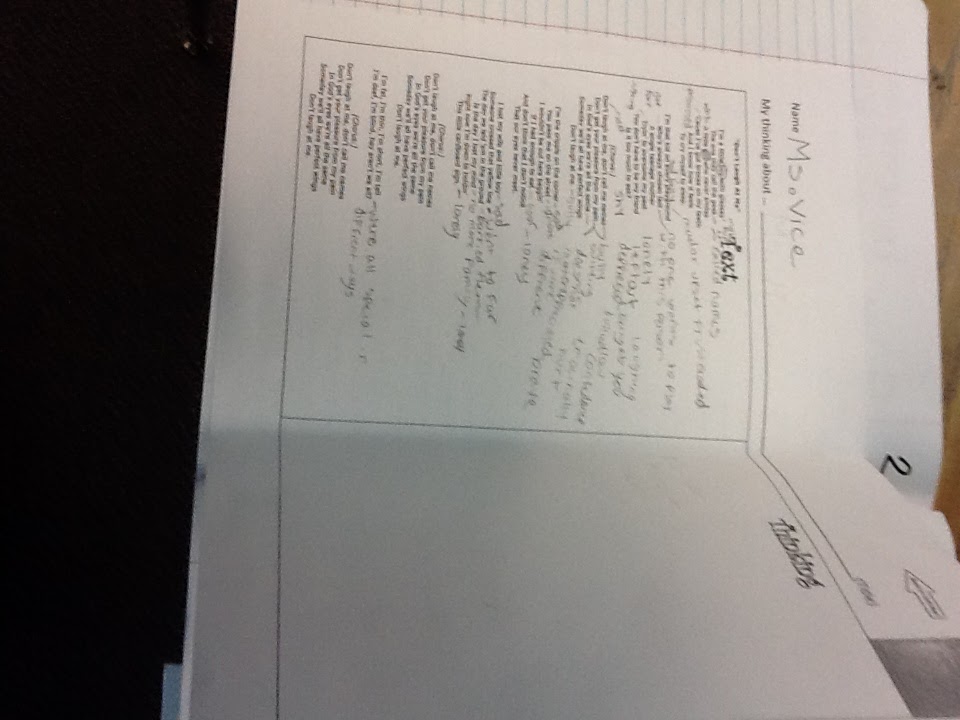
We glued in mentor texts (usually poems), graphic organizers, table of contents, copies of chapters, scanned reader's theater pages, etc.  We wrote over the mentor texts, a lot, taking note of character changes and author's word choice.  Here are some snap shots:


Theme reference chart 

\

New Colossus mentor text 


Example from phonics notebook 


Example of reader's theater script (they were learning the components) 


K/W/L (know, want to know, learned) chart and circle map all about components of literature


mentor text with student thoughts underneath  


 what makes a reader (making meaning and internalizing goals for the year)


 Keeping track of characters in our novel The Lightning Thief 


Table of contents for The Lightning Thief 
 

Phrasing activity (left) and overview of Greek gods (right)
 

Leaving space underneath a poem to record additional thoughts


mentor text (poem) that can be flipped up to record thoughts


Table of Contents to help students organize their notebooks


Steps for comparing and contrasting settings, so students can refer back during guided practice


 Text and places for them to record their thoughts


Example of an FCRR foldable 


Fluency guides


homework ideas


modeling what should be recorded


Creating T-charts for debates


Annotating their thinking


Graphic organizers (brightly colored so they can easily be found) with places for students to put their own examples

Small group reading: (1 hour)
We glued in fluency rubrics and character charts.  Much of their SG notebooks were dedicated to written responses about their characters.  I'd assign the groups chapters and their homework would be to respond to these questions by our next meeting date.  I had the higher half of the grade level, so they were able to handle this task.  They also did a lot of their must do activities in their notebooks.


Math

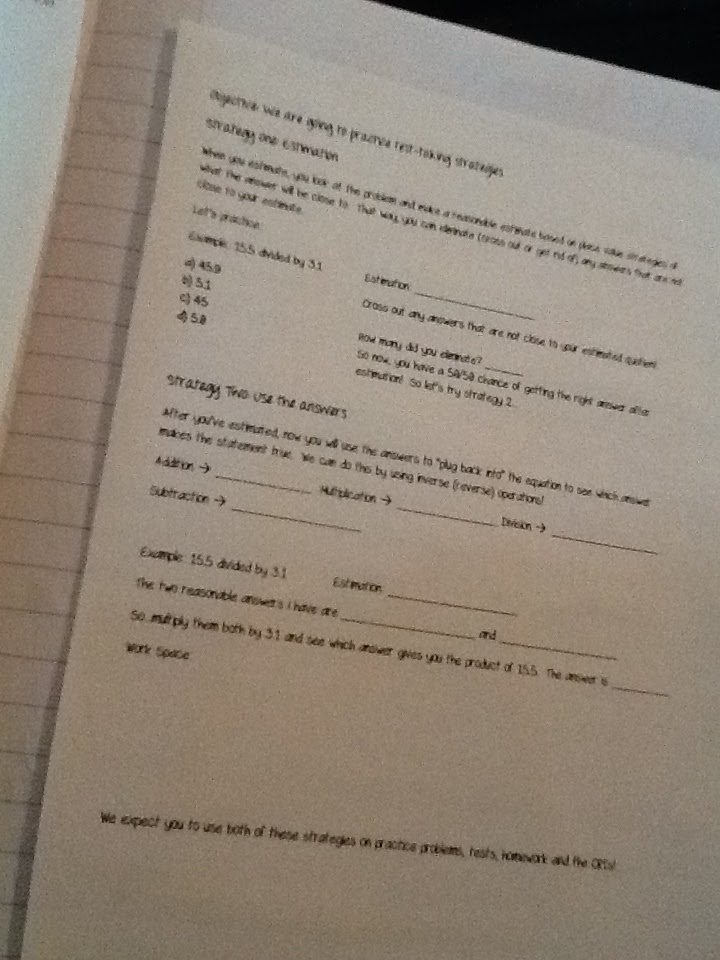
For math, this is where they'd copy down the vocabulary and work through problems with me.  I like to print problems on sticky labels for them to work on collaboratively.  We also made foldables for vocabulary.


Note taking guide for students to explain their thinking 


Science

We glued in glossaries for our science notebooks and diagrams, which students labeled and explained.  I made them a graphic organizer for their wonderings so they could eventually create their own science inquiry questions.

 
Making maps of our classroom

Writing

We made a FANBOYS foldable and did some sorts (revising vs. editing) in their notebooks, but these were mostly for their quick writes and drafts.  We used post-its with peer editing and different colored pencils when revising and editing.


Notebooks can be a daunting task but when taken slowly and used daily with students, they are a great place for students to make meaning of their learning.  As a teacher, you are guiding them to create their own reference materials and take charge of their understanding of the topics.  You are providing them with a place to navigate the content and challenge their previously held conceptions.  Yes, notebooks can be a lot of work...but it's worth it.

Any other tips and tricks fellow teachers?  Mrs. A, I hope this helps!

Good luck!