I love reading Diane's blog posts on {Fifth in the Middle} and {Fancy Free in Fourth}.
This week's blog challenge is about curriculum must-haves.
Our district, perhaps like most, is in a state of turmoil. We've adopted the Common Core State Standards without curriculum to match, expect teachers to make due with out dated text books (seriously, the books are older than my students), and expect teachers to do more with less...including less money. Yup, we took a pay cut and an insurance hike, so double whammy to the bank account! To make matters worse, new to state teachers are given a several thousand dollar hiring bonus and to make up for the teacher shortage, retired teachers are invited back. I have no issue with (qualified) retired teachers returning to the district, but I do have a problem that they receive both a salary and their retirement accounts. Yup, they're allowed to double dip into funds, yet current teachers all took a pay cut.
We also adopted the standards (which I have no problem with), but then rebranded them the Nevada Academic Content Standards (NVACS). Why? To deal with the critics who are outspoken against the Common Core.
From what I've read of the Common Core (which is not the whole thing, just the elementary portion), I don't really see a problem. Are the standards perfect? No, of course not. But the depth of what is expected of our students is much deeper then previous standards, Seeing how Nevada is consistently at the bottom in terms of educational testing for a wide variety of reasons, I think challenging our students is a good thing. When you're close to the bottom, you can only go up!
Long story short, we have no provided curriculum and have to rely on collaboration to create our lesson plans. There are lots of inconsistencies across the district, but at least everyone in my grade level (and school) are pretty much on the same page.
So let's dive into this week's blog challenge and look at some curriculum must haves:
I can't say enough good things about this book. We start each math lesson with a warm up that focuses on building number sense.
We've tweaked it a little to roughly follow this format:
Mental Math Monday: The focus is on decomposing and composing numbers for computation.
Ten Minute Tuesday: The focus is on logic puzzles and brain teasers.
Word Problem Wednesday: The focus is on multi-step word problems and making sense of the problems.
Thinking Thursday: More logic puzzles and "tricky" problems.
Fast Facts Friday: Timed tests to focus on multiplication and division facts mastery.
Must haves:
Teachers pay Teachers products!
My novel guides are a life saver! I'm trying to keep track of several different novels at once with my small groups, so it's nice to have all my notes and homework questions in a nice, organized fashion.
I've also founds tons of free stations that are great for independent and partner practice during RTI time!
As an added bonus, most stores are having their back to school sale right now! I know everything in my store is currently 20% off! Go get inspired.
This book was truly a life saver. I struggled with knowing how to teach phonics, phonemic awareness, and fluency. I felt pretty good about my comprehension strategies but struggled with foundation skills. This had great strategies and graphic organizers. My copy is well loved:
Finally, one of my go to websites: FCRR (Florida Center for Reading Research)
This site has graphic organizers, centers, and games broken into grade level bands (K-1, 2-3, and 4-5). They've recently added the Common Core State Standards to the center activities so it makes it even easier to find what your students need.
What would you add? Join the conversation!
Showing posts with label standards. Show all posts
Monday, August 3, 2015
Thursday, July 9, 2015
A Year in Reading Anchor Charts
I was *really* bad at uploading pictures of anchor charts this year (sorry guys).
As a result, y'all get the mega post with all of them! I took pictures so I'd remember for next year. We make the charts with the students, so we don't reuse them over and over again. I'll also upload the images to the "anchor charts" page with the blog.
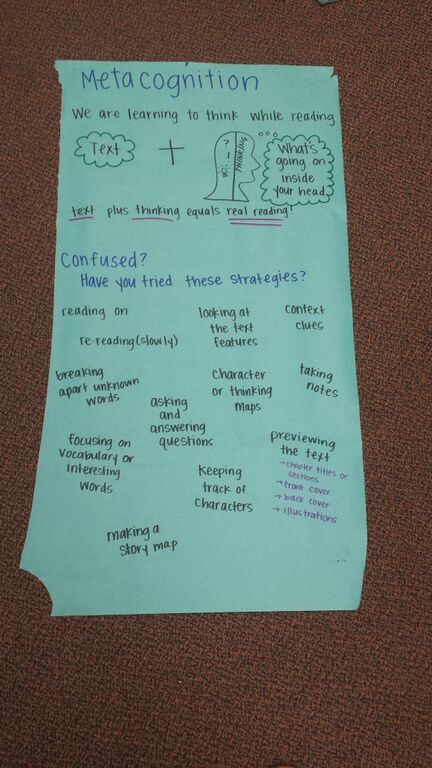
Most of my anchor charts use multiple colors. The black part is the part I read during a choral review on the carpet, the colorful words (key words) are what students read. It's too overwhelming for them to read the whole poster together, but it's too boring if I read all of it. It's our compromise!
Also, for the most part, my anchor charts are color coded. This strategy helped my ELL students.
My reading ones are blue.
Metacognition and Annotating for Close Reads
RI 5.2
RI 5.3
This standard focuses on relationships between people, events, and ideas. We modeled with Dr. King, Rosa Parks, civil rights, and the bus boycotts. They had a lot of fun with this standard!
RI 5.5
The large poster in the middle is a copy of the graphic organizer that was in their notebooks.
RI 5.6
RI 5.8
This standard focuses on evidence, so I like the acronym.
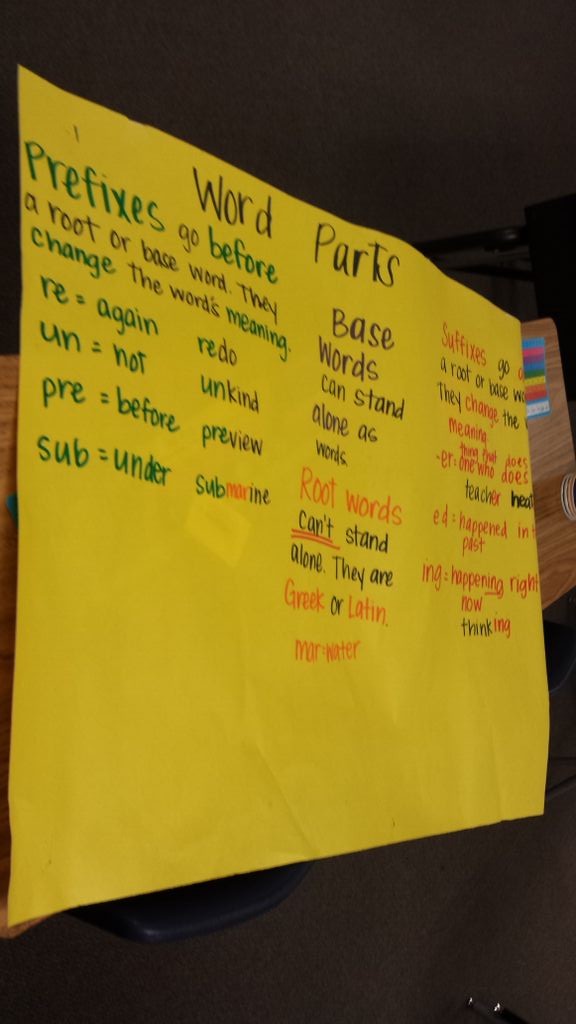
Word Parts
This technically fall sunder reading, but I chose to make all my RF (Reading Foundation) standards yellow.
I made this with my RTI group. We also used magnetic word parts to compose and decompose words.
Oreo Reader
One of our strategies was teaching kiddos to be an "oreo" reader. Basically we spent a lot of time modeling what it means to savor the text and really examine all the parts of a tasty book.
As a result, y'all get the mega post with all of them! I took pictures so I'd remember for next year. We make the charts with the students, so we don't reuse them over and over again. I'll also upload the images to the "anchor charts" page with the blog.
Most of my anchor charts use multiple colors. The black part is the part I read during a choral review on the carpet, the colorful words (key words) are what students read. It's too overwhelming for them to read the whole poster together, but it's too boring if I read all of it. It's our compromise!
Also, for the most part, my anchor charts are color coded. This strategy helped my ELL students.
My reading ones are blue.
Metacognition and Annotating for Close Reads
RI 5.2
RI 5.3
This standard focuses on relationships between people, events, and ideas. We modeled with Dr. King, Rosa Parks, civil rights, and the bus boycotts. They had a lot of fun with this standard!
RI 5.5
The large poster in the middle is a copy of the graphic organizer that was in their notebooks.
RI 5.6
RI 5.8
This standard focuses on evidence, so I like the acronym.
Writing
Narrative Writing
Some of these ideas are borrowed from Being a Writer, which is one of the resources at our school site.
Expository Writing
Word Parts
This technically fall sunder reading, but I chose to make all my RF (Reading Foundation) standards yellow.
I made this with my RTI group. We also used magnetic word parts to compose and decompose words.
Oreo Reader
One of our strategies was teaching kiddos to be an "oreo" reader. Basically we spent a lot of time modeling what it means to savor the text and really examine all the parts of a tasty book.
Inferences
Enjoy!
Wednesday, December 31, 2014
Teaser Tuesday
Sometimes my insomnia is beyond frustrating, but sometimes it yields exciting new classroom ideas. I'm thankful it's the middle of winter break and I don't really have anywhere to be until around noon tomorrow because my brain simply will not shut off.
I have a million ideas bouncing around in my head for the new year.
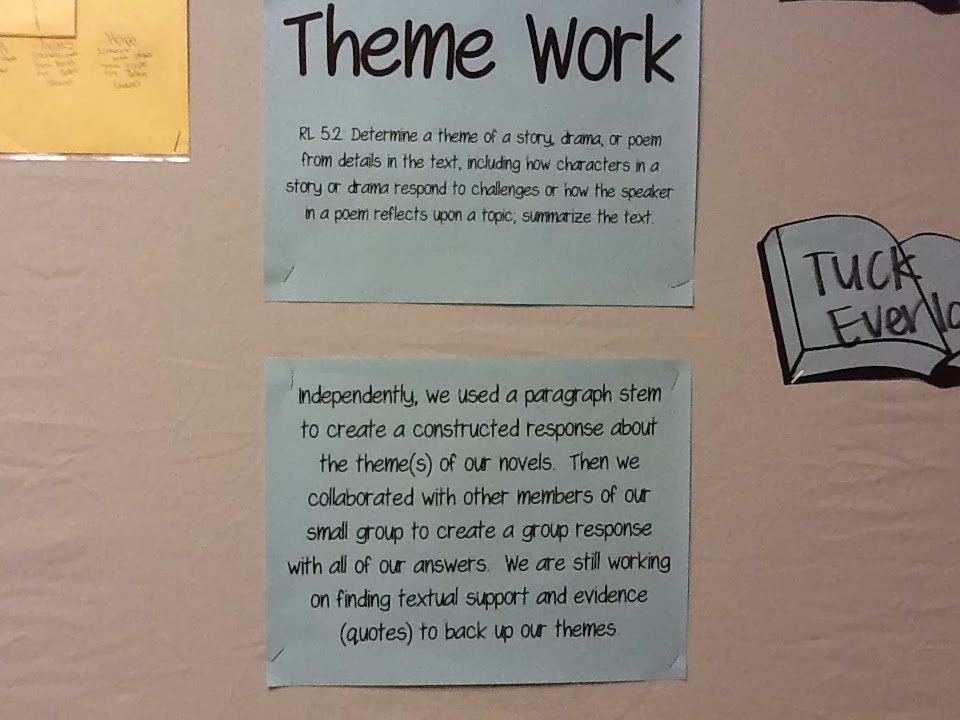
I have my next bulletin board picked out. They're going to write constructed responses about the themes in their latest novel. We're going to type these responses, thus giving extra computer practice for those who need it.
I will then take the two novels that we've read as a class (Esperanza Rising and The Lightning Thief) to model comparing and contrasting how the authors arrive at similar themes (family, loyalty, bravery) using the characters. (CCSS/NVACS RL 5.9. Yes, we've renamed the Common Core Standards the Nevada Academic Content Standards for well, in my humble opinion, ridiculous reasons.)
I'm excited to start using music for transitions in my classroom, especially at the end of the day.
I'm excited to start teaching more mapping skills, geography, earth science, and most importantly, the return of the map:
Oh yes, we'll build it up again from scratch. There was a disagreement within my grade level about how to approach maps. I understand the idea of starting with the 13 colonies, but I also stand by my approach of teaching regions.
We're going to start with what they know: Nevada. From there, we'll do the surrounding southwestern states. We'll talk about things these states all have in common and I'll introduce the concept of a region. From there, we'll explore the other states in a quasi-reverse Westward Expansion kind of way. We can also connect the map with the settings from Esperanza Rising and The Lightning Thief, which will bring in an exciting literary aspect.
But perhaps the idea I'm most excited about shall be called Teaser Tuesday.
I'll take fifteen minutes or so after lunch to read aloud the first chapter or two of a book. Read alouds are a pretty common thing in my fifth grade classroom, but here's the new twist: It'll be a mystery. I'll have the book cover and title hidden. I'll read just enough to get them interested and of course, stop at a good part. From there, I'll have them do a written reflection on whether or not they'll want to continue that novel independently.
I've already brainstormed using the following novels:
Tuck Everlasting
The Giver
Number the Stars
Hatchet
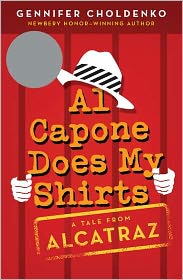
Al Capone Shines My Shoes
The Bad Beginning
Steal Away Home
The Red Pyramid
Any other ideas fellow teachers? Must read novels that are super interesting to ten year olds within the first few pages or chapters?
Thursday, August 7, 2014
Bulletin Board Ideas for next year
I get to be creative again with my bulletin boards!
In high school, I was class vice president. (Vice for Vice, see how well that campaign worked out?) At Arizona State, I was a RA/CA (community assistant) with Residential Life. This month marks year six of teaching.
So I've spent a lot of time with bulletin boards over the past decade(s). This is a good thing...because I love them. I love making them cute and showing off student work.
I'm at a new school, which means I can recycle old bulletin board ideas for a new audience! This minimizes my prep work and well, who doesn't love that?
(I've also included the Common Core State Standards that I'll be teaching/assessing with each bulletin board. You can read more about the standards here)
September
I was thinking some sort of Harry Potter themed "word wizards" display with types of syllables. I don't know how much phonics instruction has been given in the past, but I like to start phonics instruction with going over the six types of syllables. By knowing how to break apart words, students will get to practice reading those larger multisyllabic words. They'll also get practice looking for affixes and roots, which aids in their comprehension. I'm thinking some sort of foldable where they break apart their own names and justify the syllable types underneath. I'll add a written component about how this helps them as readers, so they have to justify their thinking. I'll also have them find words from their own novels to break apart as well, thus giving them some ownership.
CCSS RF 5.3a, L54b
October
By this point, we should be editing and revising our written pieces with Being a Writer. I will do a mini-lesson on dead (zombie) words. For those not in the know, these awful words like to pop up in fifth grade writing samples. These words belong in primary writing samples, but have no business in upper elementary! Zombie words include transitions such as first, next, last. Zombie words are dead words that just keep reappearing. I'm sick of said. I'm sick of reading "good" and "bad". We need more alive words!
So I'll reuse this idea (mainly the drawings...those took a while!):
To make this bulletin board more rigorous, I'll display their final drafts with copies of their rough drafts underneath. That way, viewers can see that writing (like learning) is a process. They'll be able to see authentic student work that has been revised and edited with the purpose of eliminating dead (zombie) words.
CCSS W52d, W53c, W54, W510, L52e, L56
November
By this point, my students have hopefully finished several novels, making my theme work bulletin board an appropriate choice. Given that November is full of three day weeks, this would be an easy writing/reading project that students could finish at home.
I'd have them compare two novels within the same genre, focusing on how the author reveals the theme through characters' actions. This would be guided at first, but then students would write independently. Since I don't think I'll be doing full novel read alouds, I'd probably model this with poetry and have them practice with novels. I'm hoping to have students that have read the same books so they can bounce ideas off of one another. I'm also fully aware they might not be ready for this yet and my November bulletin board will become March's instead.
RL 5.9, RL 5.2
December
I haven't made my long range plans yet, but I can safely assume that by December, we've covered figurative language. Most likely several times.
Which means a bulletin board all about idioms!
Since I assume many of my students will be English Language Learners, explicitly teaching figurative language is crucial. I can even have them find examples of figurative language in their text, thus allowing for an opportunity to not only practice quoting accurately but also justify their thinking with a written response. (Or a typed response, we'll incorporate technology as well!)
RL 5.1, L5.5a, L5.5b
January
"What's Your Problem?"
Yes, time for a math bulletin board. I will give them a solution and they have to come up with appropriate, reasonable questions that would yield my answer(s). This ties in with the eight mathematical practices and would have students use a variety of models and strategies to defend their questions. This would be easily differentiated and I could have those fast finishers come up with a second problem. This could easily be a spiral review of concepts where I could strategically differentiate based on which domain students need the extra practice.
CCSS: most of the math ones :)
SMP: 1, 2, 3, 4, 5, 6
(Rigorous math activities should use most, if not all, of the 8 math practices...just an FYI!)
February
I'm torn. I have two ideas for February, both holiday-related...ish.
The first: book crushes
Students would use a Venn Diagram to compare and contrast two characters (their book crushes). They would write a written response about both characters, using evidence from the text(s).
RL 5.3, RL 5.1, W59a
The second idea: persuasive letters to George
By now, I hope we've covered both persuasive writing and the American revolution. I'd have students examine a historical view point and write a letter to either King George or General George Washington. Students can choose to be loyalists or patriots and choose which leader they're writing to. I'd push the higher kids to pick a less popular perspective or to write from a neutral perspective. This would incorporate informational texts, quoting accurately, persuasive writing, perspective of the narrator, and a bit of research.
CCSS RI 5.1, RI 5.3, RI 5.4, RI 5.6, RI 5.7, RI 5.8, RI 5.9, W51 (plus history & civics/government standards)
March
Mad Scientist March has a nice ring to it...
I know we are rolling out the Next Generation Science Standards (NGSS), so I'm not entirely sure what this will look like. I know my new coaches mentioned going to lots of trainings and researching our school's science options before picking these green boxes. I'm excited to learn more about NGSS and STEM :)
Perhaps this is where they could display their own inquiry projects and scientific proposals?
April and May...TBD.
Maybe bookopoly again?
I planned out eight months worth of bulletin boards...I think my brain can safely shut down for the evening.
What are your bulletin board ideas for next year?
In high school, I was class vice president. (Vice for Vice, see how well that campaign worked out?) At Arizona State, I was a RA/CA (community assistant) with Residential Life. This month marks year six of teaching.
So I've spent a lot of time with bulletin boards over the past decade(s). This is a good thing...because I love them. I love making them cute and showing off student work.
I'm at a new school, which means I can recycle old bulletin board ideas for a new audience! This minimizes my prep work and well, who doesn't love that?
(I've also included the Common Core State Standards that I'll be teaching/assessing with each bulletin board. You can read more about the standards here)
September
I was thinking some sort of Harry Potter themed "word wizards" display with types of syllables. I don't know how much phonics instruction has been given in the past, but I like to start phonics instruction with going over the six types of syllables. By knowing how to break apart words, students will get to practice reading those larger multisyllabic words. They'll also get practice looking for affixes and roots, which aids in their comprehension. I'm thinking some sort of foldable where they break apart their own names and justify the syllable types underneath. I'll add a written component about how this helps them as readers, so they have to justify their thinking. I'll also have them find words from their own novels to break apart as well, thus giving them some ownership.
CCSS RF 5.3a, L54b
October
By this point, we should be editing and revising our written pieces with Being a Writer. I will do a mini-lesson on dead (zombie) words. For those not in the know, these awful words like to pop up in fifth grade writing samples. These words belong in primary writing samples, but have no business in upper elementary! Zombie words include transitions such as first, next, last. Zombie words are dead words that just keep reappearing. I'm sick of said. I'm sick of reading "good" and "bad". We need more alive words!
So I'll reuse this idea (mainly the drawings...those took a while!):
To make this bulletin board more rigorous, I'll display their final drafts with copies of their rough drafts underneath. That way, viewers can see that writing (like learning) is a process. They'll be able to see authentic student work that has been revised and edited with the purpose of eliminating dead (zombie) words.
CCSS W52d, W53c, W54, W510, L52e, L56
November
By this point, my students have hopefully finished several novels, making my theme work bulletin board an appropriate choice. Given that November is full of three day weeks, this would be an easy writing/reading project that students could finish at home.
I'd have them compare two novels within the same genre, focusing on how the author reveals the theme through characters' actions. This would be guided at first, but then students would write independently. Since I don't think I'll be doing full novel read alouds, I'd probably model this with poetry and have them practice with novels. I'm hoping to have students that have read the same books so they can bounce ideas off of one another. I'm also fully aware they might not be ready for this yet and my November bulletin board will become March's instead.
RL 5.9, RL 5.2
December
I haven't made my long range plans yet, but I can safely assume that by December, we've covered figurative language. Most likely several times.
Which means a bulletin board all about idioms!
Since I assume many of my students will be English Language Learners, explicitly teaching figurative language is crucial. I can even have them find examples of figurative language in their text, thus allowing for an opportunity to not only practice quoting accurately but also justify their thinking with a written response. (Or a typed response, we'll incorporate technology as well!)
RL 5.1, L5.5a, L5.5b
January
"What's Your Problem?"
Yes, time for a math bulletin board. I will give them a solution and they have to come up with appropriate, reasonable questions that would yield my answer(s). This ties in with the eight mathematical practices and would have students use a variety of models and strategies to defend their questions. This would be easily differentiated and I could have those fast finishers come up with a second problem. This could easily be a spiral review of concepts where I could strategically differentiate based on which domain students need the extra practice.
CCSS: most of the math ones :)
SMP: 1, 2, 3, 4, 5, 6
(Rigorous math activities should use most, if not all, of the 8 math practices...just an FYI!)
February
I'm torn. I have two ideas for February, both holiday-related...ish.
The first: book crushes
Students would use a Venn Diagram to compare and contrast two characters (their book crushes). They would write a written response about both characters, using evidence from the text(s).
RL 5.3, RL 5.1, W59a
The second idea: persuasive letters to George
(graphic organizer (by Ginger Snaps) and mentor text)
By now, I hope we've covered both persuasive writing and the American revolution. I'd have students examine a historical view point and write a letter to either King George or General George Washington. Students can choose to be loyalists or patriots and choose which leader they're writing to. I'd push the higher kids to pick a less popular perspective or to write from a neutral perspective. This would incorporate informational texts, quoting accurately, persuasive writing, perspective of the narrator, and a bit of research.
CCSS RI 5.1, RI 5.3, RI 5.4, RI 5.6, RI 5.7, RI 5.8, RI 5.9, W51 (plus history & civics/government standards)
March
Mad Scientist March has a nice ring to it...
I know we are rolling out the Next Generation Science Standards (NGSS), so I'm not entirely sure what this will look like. I know my new coaches mentioned going to lots of trainings and researching our school's science options before picking these green boxes. I'm excited to learn more about NGSS and STEM :)
Perhaps this is where they could display their own inquiry projects and scientific proposals?
April and May...TBD.
Maybe bookopoly again?
I planned out eight months worth of bulletin boards...I think my brain can safely shut down for the evening.
What are your bulletin board ideas for next year?
Labels:
8 math practices,
ASU,
being a writer,
bulletin boards,
classroom cuteness,
Common Core,
craft time,
Harry Potter,
multisyllabic words,
new school,
phonics,
planning,
standards,
syllables,
word work,
writing
Monday, June 30, 2014
Simplicity part 1
I'm always looking for ways to make teaching just a little bit easier. Some of the grand ideas on pinterest seem wonderful but when I start them, I quickly realize that these ideas simply won't work for me.
After sifting through hundreds of pins (hey, it's summer!), I found these three gems that I can easily implement next year:
Idea One: Sticky Labels
Now, I love sticky labels but didn't think to use them this way for grading. I think this would work best for grading writing but I'm excited to adapt it for other subjects. It would also be easily modified to include the standards at the top of the assignments.
Idea Two: Math for the First Day(s) of School
The first week is dedicated to establishing routines, setting up notebooks, practicing procedures, and building a supportive classroom culture. One of the things I struggle with is incorporating math into the read alouds, team building, and getting to know each other activities. This gem fits right in with the first week vibe:
I also think it'd be especially helpful this year at my new school. I think this thirty minute activity could be great for not only introducing me to my class but helping them see how math is incorporated into every day life.
Keeping in mind with the first week theme, I liked this idea from pinterest as well:
Idea Three is enabling students to be problem solvers when they're in small groups and I'm conferencing with students. I would type up these "what if" scenarios and have table teams brainstorm how to solve these problems, then open the discussion up for a class debate. In doing so, they are creating their own norms and thus have more of a "buy in".
I'm excited to try these three simple things in my classroom next year!
After sifting through hundreds of pins (hey, it's summer!), I found these three gems that I can easily implement next year:
Idea One: Sticky Labels
Now, I love sticky labels but didn't think to use them this way for grading. I think this would work best for grading writing but I'm excited to adapt it for other subjects. It would also be easily modified to include the standards at the top of the assignments.
Idea Two: Math for the First Day(s) of School
The first week is dedicated to establishing routines, setting up notebooks, practicing procedures, and building a supportive classroom culture. One of the things I struggle with is incorporating math into the read alouds, team building, and getting to know each other activities. This gem fits right in with the first week vibe:
I also think it'd be especially helpful this year at my new school. I think this thirty minute activity could be great for not only introducing me to my class but helping them see how math is incorporated into every day life.
Keeping in mind with the first week theme, I liked this idea from pinterest as well:
Idea Three is enabling students to be problem solvers when they're in small groups and I'm conferencing with students. I would type up these "what if" scenarios and have table teams brainstorm how to solve these problems, then open the discussion up for a class debate. In doing so, they are creating their own norms and thus have more of a "buy in".
I'm excited to try these three simple things in my classroom next year!
Wednesday, June 18, 2014
CRT Data
Confession:
I rarely check my work email over the summer.
I deleted the app from my phone and since I'm not in my new school's system yet, I don't see much of a point to log in daily only to delete spam and teacher coupons (looking at you Lakeshore).
I saw my (former) principal post on Facebook that not only were CRT (Criterion Referenced Test) scores in, but she was excited about the results. So naturally I asked to see the fifth grade data because well, I'm a numbers nerd!
I was at my new house painting so I figured I'd check the data in a few hours. Well, my grade level beat me to the analysis part. In a matter of minutes, I had six texts from my former grade level sharing their excitement about particular students.
While I'm sure I'll get official reports with the break down of each class, I couldn't wait. My insomnia got the best of me and sure enough, I was up at four am crunching numbers and making graphs. I couldn't be more pleased with my class results and know that I didn't accomplish this feat alone. It took our entire grade level working tirelessly, together, for ten months to achieve these results. For those at my school who did not approve of our quasi-departmentalization experiment, I'd like to waive this data in their faces...but I won't...because I am a professional.
I had the privilege of working alongside some of the most inspirational fellow teachers. I will miss being able to pop into their rooms and the amazing collaborative mindset we all shared. For various reasons, we are all starting at new schools and collectively represent third, fourth, fifth, sixth, and special education.
Math
(I didn't teach math besides our intervention block and number talks, so these scores are due in a large part to the amazing effort of my two neighboring teachers. Well done ladies! I trusted that my students were in very capable hands each and every day.)
I'm a visual person, thus the graph. Here is my class data for math:
1 student exceeded
22 students met standards
3 students were approaching
6 students were emerging
Science
We shared students for science and I taught the FOSS Landforms kit four times before getting my own class back for CRT prep. When my homeroom wasn't with me, they were with my fellow teachers learning about environments, mixtures and solutions, force and motion, as well as variables. We broke our year into four seven week rotations and started switching the third week of school. We didn't switch right away because we wanted to set up science notebooks and go over the scientific method with our homeroom classes.
Our rotations ended about two weeks before the science CRTs, so we used that time to incorporate Discovery Ed video streaming into our reviews. We also practiced taking notes from multimedia presentations, a valuable skill they'll most definitely need in middle school. However, we did this with the Magic School Bus videos and they did an amazing job.
Here is my class science data:
Numbers wise,
6 students exceeded standards
17 met standards
6 students were approaching standards
3 students were emerging on science standards
I'm quite pleased with my little scientists!
Reading
If you are new to my teaching blog, know this: I love reading. I love discussing books with my students and watching them fall in love with literary worlds. I love watching their excitement when they learn more about the world around them from informational text and seeing them become self-motivated to learn more by reading more is simply wonderful.
I broke my reading data into two groups: my small groups and my whole class.
I had the higher half of the grade level for small groups, so naturally these numbers are expected to be more in the meeting category. My job for small groups was to push these fluent readers to become more critical thinkers.
Numbers wise,
23 students exceeded standards
28 students met standards
7 students were approaching
2 students were emerging
I'm quite pleased with my small groups!
For my whole class, which is inclusion, here are my results:
7 students exceeded standards
13 students met standards
4 students were approaching
8 students were emerging (of these 8, all were either students with IEPs or in the RTI process and still made growth over their previous scores)
I'm thrilled with my students' performances. Did they all meet standards? No. Did they all make growth? Yes.
With my data analyzed, I can emotionally bid this past school year adieu. I did my best. I taught them strategies and how to think critically. They learned and proved their knowledge on these tests. It is time for a much needed, relaxing summer.
I rarely check my work email over the summer.
I deleted the app from my phone and since I'm not in my new school's system yet, I don't see much of a point to log in daily only to delete spam and teacher coupons (looking at you Lakeshore).
I saw my (former) principal post on Facebook that not only were CRT (Criterion Referenced Test) scores in, but she was excited about the results. So naturally I asked to see the fifth grade data because well, I'm a numbers nerd!
I was at my new house painting so I figured I'd check the data in a few hours. Well, my grade level beat me to the analysis part. In a matter of minutes, I had six texts from my former grade level sharing their excitement about particular students.
While I'm sure I'll get official reports with the break down of each class, I couldn't wait. My insomnia got the best of me and sure enough, I was up at four am crunching numbers and making graphs. I couldn't be more pleased with my class results and know that I didn't accomplish this feat alone. It took our entire grade level working tirelessly, together, for ten months to achieve these results. For those at my school who did not approve of our quasi-departmentalization experiment, I'd like to waive this data in their faces...but I won't...because I am a professional.
I had the privilege of working alongside some of the most inspirational fellow teachers. I will miss being able to pop into their rooms and the amazing collaborative mindset we all shared. For various reasons, we are all starting at new schools and collectively represent third, fourth, fifth, sixth, and special education.
Math
(I didn't teach math besides our intervention block and number talks, so these scores are due in a large part to the amazing effort of my two neighboring teachers. Well done ladies! I trusted that my students were in very capable hands each and every day.)
I'm a visual person, thus the graph. Here is my class data for math:
1 student exceeded
22 students met standards
3 students were approaching
6 students were emerging
Science
We shared students for science and I taught the FOSS Landforms kit four times before getting my own class back for CRT prep. When my homeroom wasn't with me, they were with my fellow teachers learning about environments, mixtures and solutions, force and motion, as well as variables. We broke our year into four seven week rotations and started switching the third week of school. We didn't switch right away because we wanted to set up science notebooks and go over the scientific method with our homeroom classes.
Our rotations ended about two weeks before the science CRTs, so we used that time to incorporate Discovery Ed video streaming into our reviews. We also practiced taking notes from multimedia presentations, a valuable skill they'll most definitely need in middle school. However, we did this with the Magic School Bus videos and they did an amazing job.
Here is my class science data:
Numbers wise,
6 students exceeded standards
17 met standards
6 students were approaching standards
3 students were emerging on science standards
I'm quite pleased with my little scientists!
Reading
If you are new to my teaching blog, know this: I love reading. I love discussing books with my students and watching them fall in love with literary worlds. I love watching their excitement when they learn more about the world around them from informational text and seeing them become self-motivated to learn more by reading more is simply wonderful.
I broke my reading data into two groups: my small groups and my whole class.
I had the higher half of the grade level for small groups, so naturally these numbers are expected to be more in the meeting category. My job for small groups was to push these fluent readers to become more critical thinkers.
Numbers wise,
23 students exceeded standards
28 students met standards
7 students were approaching
2 students were emerging
I'm quite pleased with my small groups!
For my whole class, which is inclusion, here are my results:
7 students exceeded standards
13 students met standards
4 students were approaching
8 students were emerging (of these 8, all were either students with IEPs or in the RTI process and still made growth over their previous scores)
I'm thrilled with my students' performances. Did they all meet standards? No. Did they all make growth? Yes.
With my data analyzed, I can emotionally bid this past school year adieu. I did my best. I taught them strategies and how to think critically. They learned and proved their knowledge on these tests. It is time for a much needed, relaxing summer.
Labels:
analyzing,
collaboration,
Common Core,
CRT,
data,
Discovery Education,
facebook,
growth,
home connections,
math,
reading,
science,
small groups,
standardized testing,
standards,
teamwork,
video streaming
Friday, April 4, 2014
Informational Texts
With the Common Core State Standards, there is an emphasis on informational text. For elementary school, the split is 50/50 on informational text and literature. As students move into middle and high school, the amount of instructional time increases in order to prepare students for the upcoming complex texts.
Reading literature and reading informational texts require different skills from readers. Reading literature requires students to think about narrative elements, keep track of characters, make predictions, etc. Informational texts tend to require students to keep track of complex ideas, analyze how events or persons are interrelated and understand how text structures lend themselves to
In order to support this, we have been reading different articles on Monarch butterflies:
Students have been keeping track of ideas and text structures. They're working collaboratively to read and analyze the text.
Here they are looking at different text features about Monarch Butterflies.
They did such a great job with this task! They read a Time for Kids article and two other informational passages on the migration patterns of Monarch Butterflies. We looked at cause and effect and my students did a great job with explaining how events in a passage go together. Next week we'll watch a short video clip from Discovery on migration patterns, thus tying in that multimedia element.
I love when they're so excited about what they're learning :)
Reading literature and reading informational texts require different skills from readers. Reading literature requires students to think about narrative elements, keep track of characters, make predictions, etc. Informational texts tend to require students to keep track of complex ideas, analyze how events or persons are interrelated and understand how text structures lend themselves to
In order to support this, we have been reading different articles on Monarch butterflies:
Students have been keeping track of ideas and text structures. They're working collaboratively to read and analyze the text.
Here they are looking at different text features about Monarch Butterflies.
They did such a great job with this task! They read a Time for Kids article and two other informational passages on the migration patterns of Monarch Butterflies. We looked at cause and effect and my students did a great job with explaining how events in a passage go together. Next week we'll watch a short video clip from Discovery on migration patterns, thus tying in that multimedia element.
I love when they're so excited about what they're learning :)
Sunday, March 9, 2014
FCRR Shout Out
I've blogged about FCRR before and it's a wonderful free resource for literacy stations. I love that it's broken up into grade level bands (K-1, 2-3 and 4-5) as well as into the big 5 components of literacy instruction (phonemic awareness, fluency, vocabulary, phonics and comprehension). They've also revised many of their student activities to align with the Common Core State Standards, which is also extremely helpful.
I've used the stations with my intervention groups and during my small groups. I especially like the fluency stations at the beginning of the year when I'm explicitly teaching the four components of fluency (accuracy, rate, expression and phrasing).
Since it was reading week last week, I took advantage of the lax schedule (we had assemblies and Discovery Education testing as well) to play some reading games with my students (when they weren't being pulled to make up missed assignments, since the trimester ended Friday).
One of the stations they played was "fact and opinion football":
I had a group of football fans fully entertained for a good twenty minutes. When they ran out of cards, I had them make up their own statements for the group to guess.
The second station was "incredible inferences":
(Yes, my classroom rug is polka dotted...that's just how I roll!)
I used counters from our math kit as pieces, but you can use virtually anything. I'm pretty sure almost every teacher I've met has some sort of kit of pieces.
They had a great time with these reading games and I liked the skills that were reinforced. I know many of my students struggle with getting past the literal words in the text, so this was a fun way for them to practice "digging deep" and making meaning of the text. They're getting there with inferences!
Happy reading :)
I've used the stations with my intervention groups and during my small groups. I especially like the fluency stations at the beginning of the year when I'm explicitly teaching the four components of fluency (accuracy, rate, expression and phrasing).
Since it was reading week last week, I took advantage of the lax schedule (we had assemblies and Discovery Education testing as well) to play some reading games with my students (when they weren't being pulled to make up missed assignments, since the trimester ended Friday).
One of the stations they played was "fact and opinion football":
I had a group of football fans fully entertained for a good twenty minutes. When they ran out of cards, I had them make up their own statements for the group to guess.
The second station was "incredible inferences":
(Yes, my classroom rug is polka dotted...that's just how I roll!)
I used counters from our math kit as pieces, but you can use virtually anything. I'm pretty sure almost every teacher I've met has some sort of kit of pieces.
They had a great time with these reading games and I liked the skills that were reinforced. I know many of my students struggle with getting past the literal words in the text, so this was a fun way for them to practice "digging deep" and making meaning of the text. They're getting there with inferences!
Happy reading :)
Saturday, March 1, 2014
That time has come...
For the first six months of the school year, I ran my small groups with ease.
Okay, not ease per say, but with a relatively stress-free mindset compared to the rest of my day.
I knew where to go for my weekly fluency passages (reading A-Z), I had a list of must do's to choose from based on what standards we were working on in whole group and what grade level assessment data revealed. I've changed up our "word work" a few times, but am now using this great resource:
Based on my notes from our daily fluency practice (and my RCBM progress monitoring), I select what focus skill we'll be using for the week. So far we've done irregular past tense verbs, silent consonants and soft & hard c. Next week we're looking at stressed and unstressed syllables.
Over the past several years, I've meticulously created teacher guides for my novels. Through the amazing generosity of supporters on donorschoose, awesome sales on Scholastic, thorough searching at second hand bookstores, Amazon's fast shipping and shamelessly using my teacher discount at both Borders and Barnes and Noble, I have established a decent classroom library, filled with multiple copies of some great books. I try to have at least six of each, so I can use these novels with a small group.
However, with twelve small groups, I've arrived at the day I've dreaded.
Some of my groups are ready to read novels I haven't had the time to meticulously prepare...which means I have extra homework!
Granted, reading is by no means a chore. I love reading!
However, while I'm reading the novel my students are, I'm carefully taking down vocabulary words, writing comprehension questions (with answers so I don't forget), picking out specific parts for a close read, brainstorming homework questions and more. It takes a long time for me to prep a teacher guide so that I feel confident doing the novel with a small group. I'm not one of those teachers that can just sit down and read the book with them, I want to be ahead of them so I know if the answers they're giving are correct.
Last week not one, but three of my groups finished their novels and selected new ones that I haven't read yet. So this weekend's homework is reading at least the first part of these books:
I figure I won't finish all of them by Monday, but I can at least get part way through and stay a few chapters ahead of them!
(On the bright side, novel guides for these three books will be available within the coming month on my TpT site!).
On that note, I say goodbye for the weekend and am off to read!
Okay, not ease per say, but with a relatively stress-free mindset compared to the rest of my day.
I knew where to go for my weekly fluency passages (reading A-Z), I had a list of must do's to choose from based on what standards we were working on in whole group and what grade level assessment data revealed. I've changed up our "word work" a few times, but am now using this great resource:
Based on my notes from our daily fluency practice (and my RCBM progress monitoring), I select what focus skill we'll be using for the week. So far we've done irregular past tense verbs, silent consonants and soft & hard c. Next week we're looking at stressed and unstressed syllables.
Over the past several years, I've meticulously created teacher guides for my novels. Through the amazing generosity of supporters on donorschoose, awesome sales on Scholastic, thorough searching at second hand bookstores, Amazon's fast shipping and shamelessly using my teacher discount at both Borders and Barnes and Noble, I have established a decent classroom library, filled with multiple copies of some great books. I try to have at least six of each, so I can use these novels with a small group.
However, with twelve small groups, I've arrived at the day I've dreaded.
Some of my groups are ready to read novels I haven't had the time to meticulously prepare...which means I have extra homework!
Granted, reading is by no means a chore. I love reading!
However, while I'm reading the novel my students are, I'm carefully taking down vocabulary words, writing comprehension questions (with answers so I don't forget), picking out specific parts for a close read, brainstorming homework questions and more. It takes a long time for me to prep a teacher guide so that I feel confident doing the novel with a small group. I'm not one of those teachers that can just sit down and read the book with them, I want to be ahead of them so I know if the answers they're giving are correct.
Last week not one, but three of my groups finished their novels and selected new ones that I haven't read yet. So this weekend's homework is reading at least the first part of these books:
"Who Could That Be at This Hour?" (the first of 4 novels in Lemony Snicket's All the Wrong Questions series, a quasi-prequel to the Series of Unfortunate Events)
The Lost Hero by Rick Riordian. Darn, more adventures at Camp Half-Blood!
They selected this book because they noticed the Newbery Award on the cover and concluded it must be a good novel. How can you argue with that logic?
I figure I won't finish all of them by Monday, but I can at least get part way through and stay a few chapters ahead of them!
(On the bright side, novel guides for these three books will be available within the coming month on my TpT site!).
On that note, I say goodbye for the weekend and am off to read!
Labels:
affixes,
Aimsweb,
donorschoose,
explicit phonics,
fluency,
multisyllabic words,
phonics,
progress monitoring,
RCBM,
reading,
Reading A-Z,
Series of Unfortunate Events,
small groups,
standards,
syllables,
word work
Subscribe to:
Posts (Atom)