I get really excited when grade level specific trainings are offered in my district. I get even more excited when they're in math (an area I want more professional development in) and when one of my dear friends, Mrs. B, is one of the trainers. She's a wealth of information and I love learning new things from her.
I signed up for the three day training (Friday, Monday, Tuesday) with two other lovely ladies from my grade level.
Naturally, the school where the training is held is on the other side of town, so Mrs. H and I carpooled, which meant I saw her lovely face at 6:03 am. Yes, that early. The training was 7am-1pm.
Day One:
We got to the other side of town early (no traffic on a Friday morning, which is somewhat of a miracle). We got there, found a table with three open seats (so our grade level could sit together) and once we were nice and settled, were told to move closer. Sigh...I have perfect vision. I can see from the back of the room!
After we moved, the training started. Here are the highs and lows:
Highs:
We learned some new strategies for teaching multiplication of fractions with manipulatives (washi or highlighter tape for models).
We got some tricky word problems that really require students to think. I'm excited to use them the first week of school.
We learned about some cool new virtual manipulatives, like this and this! My favorite parts? Not only will it cut down on the frustration I feel when making models to demonstrate fraction by fraction multiplication, but they are both free.
Lots of the information wasn't new, but rather reaffirmed that what Mrs. H and I did last year when planning math was appropriate for students. We'd rather give them fewer problems but make them thoughtful, real world application questions that they struggle with to build perseverance.
Not related to the training, but my grade level went out for a wonderful lunch at the Mac Shack afterward! Gourmet mac and cheese? Yes please.
Lows:
It's frustrating that when we are in a major budget crisis, the school district makes some questionable decisions. i have absolutely no problem with teachers receiving extra pay for attending extra trainings outside of contract hours. However, I took a pay cut and my insurance increased, but new hires get a $4,000 hiring bonus? There are at least 22,000 employees in the school district, including a pretty competent math department, but they flew a presenter in from Florida. So not only does the school district pay the presenting fees, but also lodging and food. Plus the training is Friday & Monday, so the weekend has to be covered as well. Isn't there someone already on pay roll who lives here that could have been paid to do the training?
We sat for six hours. We didn't get to use the manipulatives til around 11 am, which meant four hours of sitting and listening. I wouldn't do that to my students, so don't do it to teachers. It was very obvious the two main presenters were used to sitting in offices all day by how they ran the training. I need to move! I don't do well sitting still.
I ran out of food. I brought snacks, then ate them quickly because I was bored of sitting. I got hangry and I'm not ashamed to admit it.
We were promised two 15 minute breaks and only got one.
Our Tuesday training was cut, due to budget (?). I was looking forward to the extra money, but after sitting through Friday's, I'm glad there's only six hours left. Plus it means I have Tuesday to work in my classroom!
I'm hoping Monday's training is better. We are supposed to be broken up into smaller rooms with our schools, so we'll see...

Showing posts with label multiplication. Show all posts
Showing posts with label multiplication. Show all posts
Saturday, August 15, 2015

Sunday, November 23, 2014
Detour
Sometimes the best teaching moments detour from the lesson plan.
We had this Engage NY activity sheet to give:

3 problems. The time slated for this independent practice was ten minutes, then they were to go work independently in a textbook that's older than them.
That's not what we did.
I had them work collaboratively at their table teams. I had them include written explanations of their thinking and justify their answers. I had them show their work multiple ways. It got a tad noisy, but they were all engaged. It's amazing how the simple act of giving them markers and butcher paper turns an otherwise mundane activity into a lively discussion and collaborative activity.


When they were done, I had them do a gallery walk and critique the other groups' presentations, thus highlighting math practice #3.
Did this activity take way longer than it was slated to? Yes (but it still fit within our math block). Did they gain so much more from one another than they would have by silently working then going over the answers? Yes.
Was it worth detouring from my lesson plan? Absolutely.
We had this Engage NY activity sheet to give:
3 problems. The time slated for this independent practice was ten minutes, then they were to go work independently in a textbook that's older than them.
That's not what we did.
I had them work collaboratively at their table teams. I had them include written explanations of their thinking and justify their answers. I had them show their work multiple ways. It got a tad noisy, but they were all engaged. It's amazing how the simple act of giving them markers and butcher paper turns an otherwise mundane activity into a lively discussion and collaborative activity.
When they were done, I had them do a gallery walk and critique the other groups' presentations, thus highlighting math practice #3.
Did this activity take way longer than it was slated to? Yes (but it still fit within our math block). Did they gain so much more from one another than they would have by silently working then going over the answers? Yes.
Was it worth detouring from my lesson plan? Absolutely.
Sunday, November 2, 2014
Table Solving
We like to switch things up in my classroom. A majority of my math block is spent with students collaboratively solving problems and discussing them. I pull a small group a few times a week during their independent work, which is usually for about ten minutes. I give 5 problems or so and get through 2 with my small group (that's ok). I think they should be collaborating during math time.
While not everyone agrees on my math practices, I'd rather have my students solving challenging problems together and talking about strategies as opposed to the opposite: always silently working in ancient text books.
We are in the midst of a long weekend (thank you Nevada Day followed by 2 staff development days), so I gave a math test on the Thursday before the weekend. On Wednesday, we played jeopardy.
In the past, I noticed that some students were being passive participants, merely smiling and letting their tables do the work. Not coincidentally, these students weren't doing so great on their tests. So I let my students pick their own groups and limited the number of students to 4 rather than 6. This helped with engagement and participation. True, there were a few students who still didn't want to work but instead of me harping on them, their teams did. Nothing like some positive peer pressure!
Instead of having them solve on white boards, I got large sheets of butcher paper for each group. We also used markers because that always seems to make math more exciting!
They had a great time working together to solve multiplication problems!


On a post-grading note, I had higher scores on this test than previous ones!
Saturday, December 14, 2013
Multiplication Strategies
For the intervention part of the day, we've been working on multiplication. The fifth grade standard says students have to solve using the US standard algorithm, but we are stressing multiple ways to calculate the product.
I give my students a warm up problem, have them work independently for a few minutes, then share with a neighbor how they solved the problem. If the group got different answers, they work together to solve it again, thus practicing their math discourse. (Also, mathematical practice #3 about critiquing the reasoning of others).
Here's a snapshot of one group's work:

The strategies they typically use are:
1. US standard algorithm
2. British standard algorithm (very similar to US but with more of an emphasis on place value, as seen in the top image)
3. Partial Products
4. Estimation or compatible numbers to check for reasonableness
5. Repeated addition
6. Halves & Doubles
7. Lattice Method
I love that they're focused on the process of finding the answer rather than the one right answer. It lends itself to much richer mathematical discussions about the value of numbers.
Friday, December 13, 2013
Stations
For my intervention part of the day, we've been working on multiplication.
I had students work on two different stations while I pulled individual students to practice fluency or work on math misconceptions.
The first station they worked on was "I have, who has?" place value center. This great TpT freebie was designed by Quintessential Lessons and is wonderful!


What I love about it (besides that it's free and challenging) is how great of a job it does at having students see the relationships between numbers in our base-10 system.

The second station is one I created called "Strategies Sort".
While students can solve the multiplication questions, the point of the center is to discuss which strategy would be most effective as a mathematician.
This station is available here on TpT. I'd recommend printing on 2 different colors of card stock for convenience.


Our station bucket:

Working on a variety of strategies:

Hooray for math!
Sunday, December 1, 2013
Factor & Multiples Bingo!
I do spend a majority of my day working on reading but that doesn't mean I'm not keeping up with math ideas! I'm working on math and reading strategies with my intervention block, so I wanted to make sure my students had challenging activities to work on while I'm pulling small groups.
I'm pleased to announce my new math centers, Factor Bingo & Multiples Bingo are available here on TpT! Students have to be strategic with the placing of chips in order to win. They are my 79th & 80th products :)
I laminate my game boards so I can use expo markers to mark off pieces, but you can easily use chips, counters, etc in your classroom.
Number cards (24):
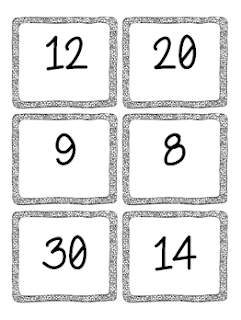
Game boards (16):


This includes 16 different game boards (meant for partners but can be played individually), bingo suggestions and factor cards. Teacher and student instructions are included! They are priced at $4 each for all 26 pages :)
I'm pleased to announce my new math centers, Factor Bingo & Multiples Bingo are available here on TpT! Students have to be strategic with the placing of chips in order to win. They are my 79th & 80th products :)
I laminate my game boards so I can use expo markers to mark off pieces, but you can easily use chips, counters, etc in your classroom.
Number cards (24):

Game boards (16):


This includes 16 different game boards (meant for partners but can be played individually), bingo suggestions and factor cards. Teacher and student instructions are included! They are priced at $4 each for all 26 pages :)
Sunday, October 6, 2013
Math and Food
Whenever possible and appropriate, I try to bring food into the classroom. Students are automatically more engaged in the lesson and it's a great motivator (if you don't do your best, you don't get the treat).
One of my favorite things to do is use Hersey's kisses as a concentration game for math. I use the white version of these:

I put the stickers on the bottom of the candies. I use multiplication facts for my fifth graders, but you can use any operation depending on your students' ability level. I put the product on one candy and the equation on another.

Students put the candies face down and play concentration. It's a great center for holidays or special occasions.
The prep work takes about twenty minutes and I'd recommend writing on the stickers prior to placing them on the candy.
(ELA connection: You could do Greek and Latin roots or affixes where students match the affix with the meaning)
I plan to do something like this around Halloween because the students will most likely expect candy so at least there is an academic purpose!
One of my favorite things to do is use Hersey's kisses as a concentration game for math. I use the white version of these:
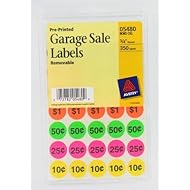
I put the stickers on the bottom of the candies. I use multiplication facts for my fifth graders, but you can use any operation depending on your students' ability level. I put the product on one candy and the equation on another.

Students put the candies face down and play concentration. It's a great center for holidays or special occasions.
The prep work takes about twenty minutes and I'd recommend writing on the stickers prior to placing them on the candy.
(ELA connection: You could do Greek and Latin roots or affixes where students match the affix with the meaning)
I plan to do something like this around Halloween because the students will most likely expect candy so at least there is an academic purpose!
Tuesday, October 1, 2013
New TpT products: figurative language and multiplication
In school, we've been working on figurative language during the intervention portion of the day.
To help my students, I created the following centers:
This one is a sort for similes and metaphors. Students work together to separate phrases into similes or metaphors. There are 26 examples and students can check their work with the included answer key!

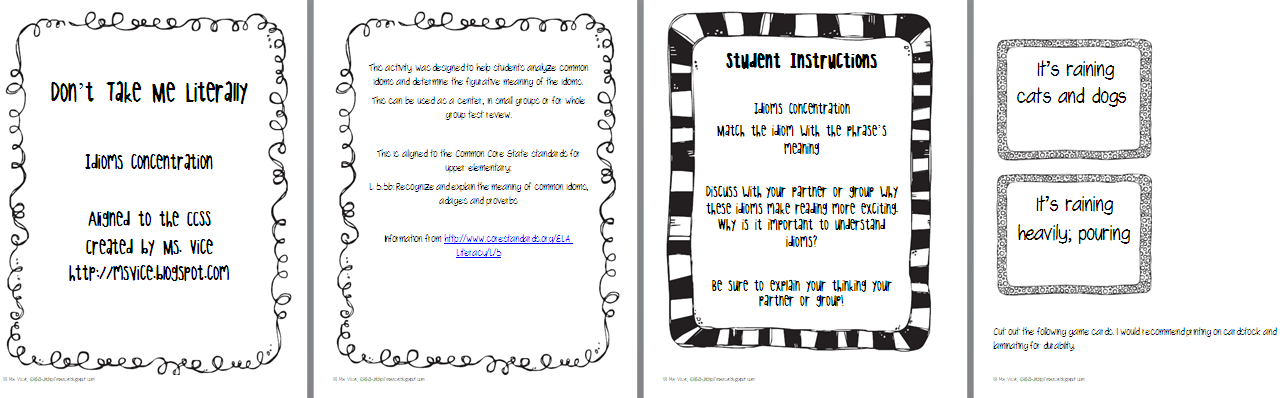
This one is idioms concentration where students have to match the common idiom with its figurative meaning. AT 33 pages, it's quite a steal!

This final one is a 33 page math center where students must match the multiplication problem with the strategy they'd use to solve that problem. The focus is not on the product but rather the strategies to get the answer. Some problems can be solved mentally, some with landmark or friendly numbers, some with estimation and some with traditional algorithm, lattice or box methods. The problems lend themselves to some great discourse and discussions with students.

I hope your students enjoy as much as mine do!
-Ms. Vice
To help my students, I created the following centers:
This one is a sort for similes and metaphors. Students work together to separate phrases into similes or metaphors. There are 26 examples and students can check their work with the included answer key!

This one is idioms concentration where students have to match the common idiom with its figurative meaning. AT 33 pages, it's quite a steal!
This final one is a 33 page math center where students must match the multiplication problem with the strategy they'd use to solve that problem. The focus is not on the product but rather the strategies to get the answer. Some problems can be solved mentally, some with landmark or friendly numbers, some with estimation and some with traditional algorithm, lattice or box methods. The problems lend themselves to some great discourse and discussions with students.

I hope your students enjoy as much as mine do!
-Ms. Vice
Thursday, September 26, 2013
Terrific Thinking Thursday
Our school is using Number Talks for math to boost our students' number sense, working understanding of mathematical concepts and critical thinking. The philosophy behind Number Talks aligns perfectly with Investigations, which we are using as a tool to guide our standards-based instruction and assessment. Through hands-on learning and discourse, our students are learning how to interact with math rather than memorize and regurgitate information.
Our grade level has tweaked our number talks:
Monday: This is our traditional number talk. A problem is displayed on the board, students solve mentally then raise their hands to share their answers. Emphasis is given to strategies and explaining their thinking.
Tuesday: Ten minute math from Investigations. We are starting with quick images where students are looking for patterns, which is supporting the 8 math practices.
Wednesday: Word problem Wednesdays. We are moving away from the traditional circling of the number and choosing an operation robotic routine. Instead, we are focusing on criticial thinking and strategies.
Thursday: Terrific Thinking Thursdays! We display a deceptively simple problem and let students solve individually before sharing out whole group.
Fridays: Fast Facts Fridays. Students are working on their individual goals for fact fluency (multiplication and division) in a fun, game-like way with their shoulder or face partner.
Since it's Thursday, here is an example of today's problem:
The problem states "You have $2.75. What coins could make this amount?"

None of my students gave me an answer invoving dollar bills. There were actually more answers they came up with later and I was impressed they used half dollar coins in their answers. Not bad for eight am :)
Wednesday, August 7, 2013
Math Centers Bundle
Since I teach my math in small groups, my students need a center to keep them engaged and on task when they're not with me. We don't have enough iPads or computers to go around, so I compiled my dozen favorite math games for students to play. I bundled these centers and you can grab the 20 page packet here.
These games require very little teacher prep beyond gathering supplies (cards, dice and for some, candy) and printing the materials. They can be scaffolded and incorporate any operation(s) depending on the grade level. Some can even be sent home as homework to practice with students.

My students, which were almost all English language learners and about half had individual education plans, excelled at these. I rarely had behavior issues because they knew if they were off task, that meant they were choosing silent book work instead.
Hope your students enjoy these stations as much as mine do!
Sunday, August 4, 2013
Math Anchor Charts and Ideas
I love great math ideas.
Here's an easy center to make, it just requires sharpies, a plastic bag, some patience and old water bottle lids (yay upcycling!)

This center can easily be differentiated for any grade level depending on the operations that are used. For fifth grade, I would use parentheses and all operations signs. This would be great for making algebraic expressions, practicing multiplication and division, finding unknown values and using decimals to show place value.
Students could easily bring in lids to help you collect the supplies.
With the Common Core, fifth graders have to review geometric shapes and classify them into a hierarchy. This is a great example of an anchor chart that could help students:

Before we go into 3D shapes, I would review 2D shapes on the geoboard. Most classes have a set of the old plastic boards and rubber bands, but there is a great free app on the iPad that allows students to virtually manipulate geoboards. As a bonus, you can expand the board from the traditional 5x5 to a much larger 10x10 board, allowing for more room to make shapes. This app could be used as a formative assessment where you call out a shape (ex, right scalene triangle) and students make one to show you.
Plus, there are different colored rubber band options with the app :)
This is a great freebie I found on another teacher's blog:

I've used it in my classroom and it's a great center to review number sense.
You can also use cups to review place value:

For a review of area and perimeter, you can use graph paper, markers and dice for this easy game of war.

Students roll the dice, then create the corresponding array. Students must strategically place their array on the grid and try to stump their partner. I like that this is a nice model of how repeated addition and multiplication are the same.
This can easily be differentiated for lower grades by having students add the dice rather than multiply them.
This is another great (priced) TpT center that my students enjoy:

Plus, it's pink and polka-dotted! Grab yours here for a buck!
Happy math time!
You can also use cups to review place value:

For a review of area and perimeter, you can use graph paper, markers and dice for this easy game of war.

Students roll the dice, then create the corresponding array. Students must strategically place their array on the grid and try to stump their partner. I like that this is a nice model of how repeated addition and multiplication are the same.
This can easily be differentiated for lower grades by having students add the dice rather than multiply them.
This is another great (priced) TpT center that my students enjoy:

Plus, it's pink and polka-dotted! Grab yours here for a buck!
Happy math time!
Subscribe to:
Posts (Atom)