Showing posts with label word work. Show all posts

Thursday, August 7, 2014

Bulletin Board Ideas for next year

I get to be creative again with my bulletin boards!

In high school, I was class vice president. (Vice for Vice, see how well that campaign worked out?)  At Arizona State, I was a RA/CA (community assistant) with Residential Life.  This month marks year six of teaching.

So I've spent a lot of time with bulletin boards over the past decade(s).  This is a good thing...because I love them.  I love making them cute and showing off student work.

I'm at a new school, which means I can recycle old bulletin board ideas for a new audience!  This minimizes my prep work and well, who doesn't love that?

(I've also included the Common Core State Standards that I'll be teaching/assessing with each bulletin board.  You can read more about the standards here)

September

I was thinking some sort of Harry Potter themed "word wizards" display with types of syllables.  I don't know how much phonics instruction has been given in the past, but I like to start phonics instruction with going over the six types of syllables.  By knowing how to break apart words, students will get to practice reading those larger multisyllabic words.  They'll also get practice looking for affixes and roots, which aids in their comprehension.  I'm thinking some sort of foldable where they break apart their own names and justify the syllable types underneath.  I'll add a written component about how this helps them as readers, so they have to justify their thinking.  I'll also have them find words from their own novels to break apart as well, thus giving them some ownership.


CCSS RF 5.3a, L54b

October

By this point, we should be editing and revising our written pieces with Being a Writer.  I will do a mini-lesson on dead (zombie) words.  For those not in the know, these awful words like to pop up in fifth grade writing samples.  These words belong in primary writing samples, but have no business in upper elementary!  Zombie words include transitions such as first, next, last.  Zombie words are dead words that just keep reappearing.  I'm sick of said.  I'm sick of reading "good" and "bad".  We need more alive words!

So I'll reuse this idea (mainly the drawings...those took a while!):


To make this bulletin board more rigorous, I'll display their final drafts with copies of their rough drafts underneath.  That way, viewers can see that writing (like learning) is a process.  They'll be able to see authentic student work that has been revised and edited with the purpose of eliminating dead (zombie) words.

CCSS W52d, W53c, W54, W510, L52e, L56

November

By this point, my students have hopefully finished several novels, making my theme work bulletin board an appropriate choice.  Given that November is full of three day weeks, this would be an easy writing/reading project that students could finish at home.

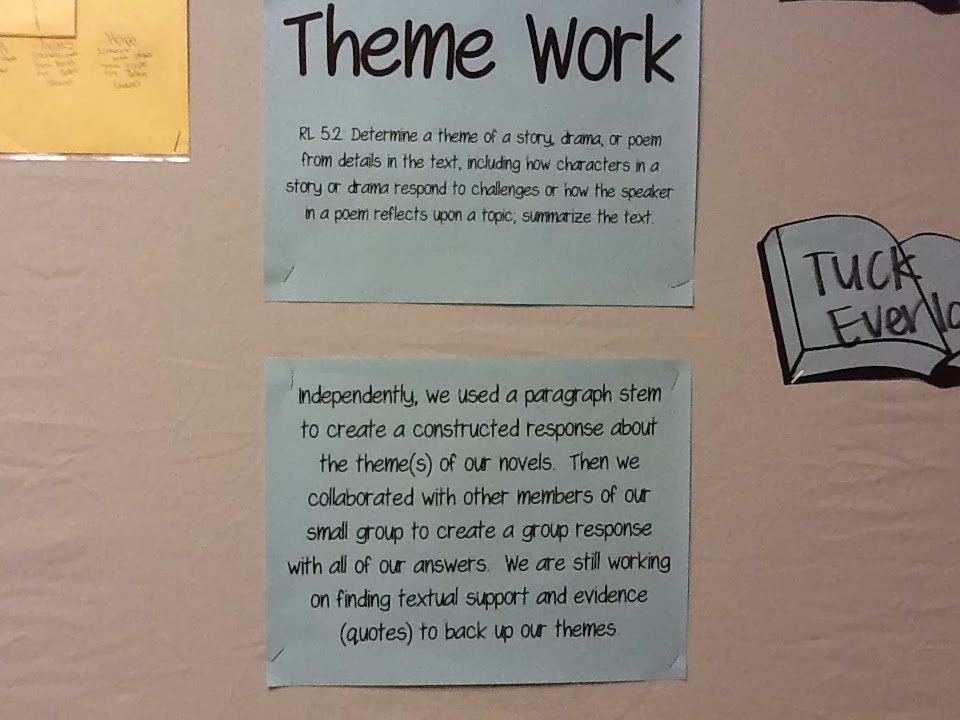


I'd have them compare two novels within the same genre, focusing on how the author reveals the theme through characters' actions.  This would be guided at first, but then students would write independently.  Since I don't think I'll be doing full novel read alouds, I'd probably model this with poetry and have them practice with novels.  I'm hoping to have students that have read the same books so they can bounce ideas off of one another.  I'm also fully aware they might not be ready for this yet and my November bulletin board will become March's instead.

RL 5.9, RL 5.2

December

I haven't made my long range plans yet, but I can safely assume that by December, we've covered figurative language.  Most likely several times.

Which means a bulletin board all about idioms!


Since I assume many of my students will be English Language Learners, explicitly teaching figurative language is crucial.  I can even have them find examples of figurative language in their text, thus allowing for an opportunity to not only practice quoting accurately but also justify their thinking with a written response.  (Or a typed response, we'll incorporate technology as well!)

RL 5.1, L5.5a, L5.5b

January

"What's Your Problem?"

Yes, time for a math bulletin board.  I will give them a solution and they have to come up with appropriate, reasonable questions that would yield my answer(s).  This ties in with the eight mathematical practices and would have students use a variety of models and strategies to defend their questions.  This would be easily differentiated and I could have those fast finishers come up with a second problem.  This could easily be a spiral review of concepts where I could strategically differentiate based on which domain students need the extra practice.

CCSS: most of the math ones :)

SMP: 1, 2, 3, 4, 5, 6
(Rigorous math activities should use most, if not all, of the 8 math practices...just an FYI!)

February

I'm torn.  I have two ideas for February, both holiday-related...ish.

The first: book crushes


Students would use a Venn Diagram to compare and contrast two characters (their book crushes).  They would write a written response about both characters, using evidence from the text(s). 

RL 5.3, RL 5.1, W59a

The second idea: persuasive letters to George


(graphic organizer (by Ginger Snaps) and mentor text)

By now, I hope we've covered both persuasive writing and the American revolution.  I'd have students examine a historical view point and write a letter to either King George or General George Washington.  Students can choose to be loyalists or patriots and choose which leader they're writing to. I'd push the higher kids to pick a less popular perspective or to write from a neutral perspective.  This would incorporate informational texts, quoting accurately, persuasive writing, perspective of the narrator, and a bit of research.

CCSS RI 5.1, RI 5.3, RI 5.4, RI 5.6, RI 5.7, RI 5.8, RI 5.9, W51  (plus history & civics/government standards)

March

Mad Scientist March has a nice ring to it...

I know we are rolling out the Next Generation Science Standards (NGSS), so I'm not entirely sure what this will look like.  I know my new coaches mentioned going to lots of trainings and researching our school's science options before picking these green boxes.  I'm excited to learn more about NGSS and STEM :)

Perhaps this is where they could display their own inquiry projects and scientific proposals?

April and May...TBD. 

Maybe bookopoly again?


 I planned out eight months worth of bulletin boards...I think my brain can safely shut down for the evening.

What are your bulletin board ideas for next year?

Saturday, March 15, 2014

Word Work lessons

Since I have the upper half of the grade level for small group reading, I focus on word work rather than phonemic awareness.  My students aren't learning to read, they're readers.  So our focus is on those irregular word patterns and nuances in the English language that must be explicitly taught to students (especially my English Language Learners).

We've worked on irregular past tense verbs and silent letters, so I created power points.  Our word work is only 5-10 minutes per reading block (sixty minutes) because that's what my students need.  Word work and fluency practice takes no more than fifteen minutes (combined) so the remaining forty five minutes are spent reading, writing, publishing, blogging, sorting, creating, analyzing, comparing, contrasting, or meeting with me for our literature circles.

I've posted my weekly lessons on TpT for a dollar each.  You can edit them if you don't like the font I used or you can download the free font here.

Happy reading!

Saturday, March 1, 2014

That time has come...

For the first six months of the school year, I ran my small groups with ease.

Okay, not ease per say, but with a relatively stress-free mindset compared to the rest of my day. 

 I knew where to go for my weekly fluency passages (reading A-Z), I had a list of must do's to choose from based on what standards we were working on in whole group and what grade level assessment data revealed.  I've changed up our "word work" a few times, but am now using this great resource:


Based on my notes from our daily fluency practice (and my RCBM progress monitoring), I select what focus skill we'll be using for the week.  So far we've done irregular past tense verbs, silent consonants and soft & hard c.  Next week we're looking at stressed and unstressed syllables.

Over the past several years, I've meticulously created teacher guides for my novels.  Through the amazing generosity of supporters on donorschoose, awesome sales on Scholastic, thorough searching at second hand bookstores, Amazon's fast shipping and shamelessly using my teacher discount at both Borders and Barnes and Noble, I have established a decent classroom library, filled with multiple copies of some great books.  I try to have at least six of each, so I can use these novels with a small group.

However, with twelve small groups, I've arrived at the day I've dreaded.

Some of my groups are ready to read novels I haven't had the time to meticulously prepare...which means I have extra homework!

Granted, reading is by no means a chore.  I love reading!

However, while I'm reading the novel my students are, I'm carefully taking down vocabulary words, writing comprehension questions (with answers so I don't forget), picking out specific parts for a close read, brainstorming homework questions and more.  It takes a long time for me to prep a teacher guide so that I feel confident doing the novel with a small group.  I'm not one of those teachers that can just sit down and read the book with them, I want to be ahead of them so I know if the answers they're giving are correct.

Last week not one, but three of my groups finished their novels and selected new ones that I haven't read yet.  So this weekend's homework is reading at least the first part of these books:


"Who Could That Be at This Hour?" (the first of 4 novels in Lemony Snicket's All the Wrong Questions series, a quasi-prequel to the Series of Unfortunate Events)


The Lost Hero by Rick Riordian.  Darn, more adventures at Camp Half-Blood!


They selected this book because they noticed the Newbery Award on the cover and concluded it must be a good novel.  How can you argue with that logic?

I figure I won't finish all of them by Monday, but I can at least get part way through and stay a few chapters ahead of them!

(On the bright side, novel guides for these three books will be available within the coming month on my TpT site!).

On that note, I say goodbye for the weekend and am off to read!

Thursday, January 30, 2014

Student Input

Since we are doing affixes and Greek & Latin roots during our whole group reading classes, I decided we needed to revise what we're doing in our small groups.

However, deciding what we need for word work isn't entirely up to me.  I'm not in their brains and I wanted to make sure our 5-10 minutes of phonics/word work was well spent in our small groups.

So I asked both periods a series of questions and had them respond with what they wanted and needed:


By allowing them to have input, they feel more of a sense of ownership in our small groups.

It's not my classroom, it's our classroom.

Sunday, January 12, 2014

Word Work

We've been working on affixes and roots, so here's a snapshot of one of our weekly activities:


They identify the word parts (including the base word) and discuss how the word parts work together to make meaning.  They're doing a really good job with it!  You can snag a sample of our word work ppt here!

Friday, November 1, 2013

Multi-syllabic words

Batter Up!

We didn't acknowledge Halloween in my classroom.  Quite frankly, the behavior of some of the students didn't lend itself to a celebration and many students don't celebrate the holiday, so we avoided it all together.

Instead, I celebrated Boston's win :)

I used this adorable baseball themed center, made by Katie Appel and available for FREE here for my intervention block.


We blended through the multi-syllabic word cards, identified syllable types (CLOVER) and played with a partner.  It was a fun sports-themed center and definitely worth downloading!

Happy reading :)

Saturday, October 26, 2013

Word Work

I've switched up how I'm doing the layout of my small groups for reading.  Because we switch students, there's the awkward minute or so transition time that is lost instructional time.

So instead of waiting for everyone to come in, get settled, get out their fluency passages and charts, then give me a thumbs up to begin, we are going to start with affixes instead.

We have our ongoing anchor charts for affixes, but I'm going to start explicitly teaching them next week.

I decided to review ones they should be familiar with (re, un, s, es), then go through the rest of the year with roots & affixes.

My planned schedule is this:

Mondays: introduce prefix, suffix, practice with a few words of how the affix changes the meaning, add to anchor chart

Tuesday: review affixes, go over non-examples and any helpful hints.  This week, they need a quick mini-lesson on what happens if a word ends in y (change to i) and when to add es (ch, ss, x or sh) or just add s to make a word plural.

Wednesday: word sort (prefix, suffix, both, neither)

Thursday: decoding multisyllabic words: Isolate the affixes, chunk the rest of the word into syllables (identify with CLOVER), practice blending through

Friday: encoding: adding affixes to change the word's meaning

I made my template and posted my first one on TpT, which you can download for just a buck!  I did make the template with the swagger font, which you can snag for free here.  I made it editable, so you can change the font & the words if you'd like!

Thursday, October 17, 2013

Clicks and Clunks

This week, our school's power (vocabulary) word is strategy.

In honor of this, I'll share about one of my new favorite strategies: "clicks and clunks".

I'm aware this is in no way a new strategy and is taught in numerous teacher prep courses.  However, it's new to me :)

I read about it in my beloved CORE source book:


And it's really "clicking" with my students.

(By the way, I googled for an image of the CORE book and my own image from a prior blog post came up...weird moment.)

Basically, it's a formative assessment where students analyze thier own learning.  They share what's "clicking" in their heads and what is "clunking" (not making total sense).

We talk about the importance of being honest and talk about why things are clunking.

I have my students give me fist bumps on their way out the door and share their clicks/clunks with me.

Yesterday, one student told me that our weekly phonics skill (/s/, /sh/, /z/) was clunking with her because she was confused about the letters.  Using this clunk, I explained in a different way during our word study this morning and she got it :) 

 (Hopefully others did too but since she specifically told me that was a clunk, I wanted to help her with it)


Speaking of clicking and clunking, here are mine for the day:

Clicks:

Almost all of my students are making growth on RCBM for Aimsweb for their oral reading fluency and words per minute.  One that went down had a very honest conversation that he wanted to try reading without using his finger as a place holder to see if he really needed it.  Turns out, he does need to keep track of his place with his finger but more importantly, he realizes that it's a strategy he needs to use because it helps him. 

Some of my students have grown over forty words since their beginning of the year benchmark.  Yes, you read that correctly. 40 words. In a minute.  They're almost at their end of year ambitious goals.

Clearly our daily repeated reading, buddy coaching and fluency stations are working!

Clunks:

Voice levels still aren't where they need to be.
Our server was down today: no access to my documents, my premade lessons, my email or the internet.  We made the best of it but it was frustrating being without technology.

Happy Friday! (almost...)

Sunday, October 6, 2013

#61 en-, em-, -tion "build a word" on TpT

Today I posted product #61 on TpT!  

It's a word building activity (named build a word) for en-, em- and -tion affixes.  

In this 28 page center, students will independently or collaboratively build multi-syllabic words using syllable cards and these affixes.  They can record their answers on the provided answer sheets or in their interactive notebooks.  

I know my students do really great at these stations and love playing "word detective" or "word builder". 

Utilizing affixes and roots is part of the Common Core State Standards (RF 5.3a for fifth grade) and I am impressed with what a difference 5-10 minutes of word work a day can  make with my ELL students!

Hopefully your students love this center as much as mine do!

(More stations to come with this same format!)

Saturday, September 28, 2013

Our small groups

I love my small group discussions about novels.

It's a little tricky to manage 12 groups and they're still a little loud at centers, but it's a work in progress.


Here is our daily schedule for small groups:


Yes, making sure I set the timer is the first task! I need my small kitchen timer to hold me accountable to time :)

Here are some of our updated "keeping track of character charts":


I love how well they're doing with pulling out crucial details to see how characters develop over the course of the novels.

We also got our copies of Tuck Everlasting! Thank you donors :) I can't wait to use them with my young readers!


Our updated reading board, now that we've established what we are working on in class:


I also created folders for each novel:


Inside are various novel-specific thinking maps for them to glue into their small group reading notebooks to organize their thinking, make predictions, look for figurative language, etc.

To help with many of our word work and phonics centers, I created a smaller version of CLOVER to help students remember how to identify syllable types:


Happy reading!

Saturday, August 10, 2013

New Centers on TPT: prefix and suffix sorts

While preparing for my small reading groups, I began thinking about word work.  For my group of fifth graders, our phonics is more focused on affixes, roots and multisyllabic words rather than vowel teams and blends.  So I made a concentration game for word work, focusing on prefixes.  Then I made one for suffixes.  Then I started making one for roots, but realized I had been way too productive for Saturday morning and turned on Netflix instead :)


You can grab these mega centers here at my TpT store.

Each is $2 and includes 28 pages (what a steal!).

After sorting and matching, you can have students write in their word work notebooks about how prefixes impact a word's meaning as well as make their own.

Hope your students enjoy this center as much as mine do!
-Ms. Vice