Showing posts with label science. Show all posts

Wednesday, August 23, 2017

Eclipse Mania

Like most of the country, we were swept up in Eclipse Mania this week.  (Funny how we don't doubt scientists about the eclipse, but attack them on everything else....hmmm....)

 The Thursday before the eclipse, I sent home permission slips from the school in regards to watching the eclipse (with proper eye wear of course).  Not all of the permission slips were returned by Monday, which caused some tears from my third graders.

Another member of my grade level managed to acquire 29 pairs of viewing glasses, so my class got to go out in smaller chunks.  I must say I love being part of a team that shares and values collaboration.

Las Vegas weather (rain, go figure) made viewing the eclipse rather difficult, so we live streamed from NASA instead.


My students loved seeing scientists of all genders, races, and ethnic backgrounds.  I didn't point it out, but it was heart warming to hear "hey, he looks like me!".  Diverse role models are important. 


We did have specials at 10:15, so I simply paused the live stream and we continued when they were back from music (thanks You Tube!).


We acted out the earth and moon's rotation around the sun, discussed important science vocabulary words, and set up our science notebooks.  We practiced making diagrams like scientists:


I didn't plan to devote two hours of my teaching day to the eclipse, but I'm glad I did.  By the time the next eclipse rolls around, my sweet third graders will be high school seniors.  That's a little terrifying to think about.

Sunday, June 21, 2015

Book Reviews

Over the past few years, I've had the opportunity to participate in several book studies with the focus on improving my craft as an educator.  Here is a synopsis of those books:


Questions, Claims, and Evidence


This book really helped me shift perspectives for science instruction.  Essentially, this guided me through setting up my students for success and shifting away from teacher driven science experiments.  Instead, this is replaced with student created extension inquiry projects and helping them write about science.

Building Academic Vocabulary (Marzano)


Even after reading this, I struggle with vocabulary instruction.  It's the highest of the big five components of literacy (phonemic awareness, phonics, fluency, and comprehension being the other four).  It's crucial, especially for my ELL (English Language Learners).  I feel successful with teaching academic vocabulary when it's content specific (i.e. math, science, and social studies) but struggle when it comes to what words to teach whole group. I'm wary of just choosing a list and going from that.  I tend to teach words that are associated with the novels I'm using and more specific lists with my RTI group.  I want to empower my students to monitor their own vocabulary acquisition and give them the space to share these words with their peers. 

I haven't quite decided how this will look in my classroom, so stay tuned!


Waiting for Superman


I led this book study at my previous school...and it didn't go very well.  Part of it was because I was leading it, not an administrator.  Part of it was because I was still quite idealistic about how teaching should work because I had just finished my first year in the classroom and thought I knew everything.  This book, while an interesting read, doesn't give enough credit to the teachers who are working really hard to change the system.

Read, Write, Lead


I was really excited to read this book as part of a book study.  My group was assigned chapter five, which is all about principal leadership.  While I have no issues with my administrators popping in my classroom on a frequent basis, this was a cause of major concern for some of my colleagues.  The chapter also talked about celebrating teachers and students, which I don't think is done enough.  This was my big take away from this book is that while programs and standards may (and do) change, good teaching is consistent.  Good teachers are reflective, collaborative, innovative, and push one another to do better.  

Number Talks


This gem isn't really a book review but rather an opportunity to share that this is a wonderful book that should be used wherever possible!  While the first few weeks of number talks are rocky, especially if students aren't familiar with the format, the pay off, if done consistently, is amazing.  For the past few years, my students have left my classroom with a strong understanding of number sense and problem solving strategies.  This book is a large part of the reason why.  It's worth the money if your school district doesn't provide this resource. 

Up next?  I'll be diving into Love and Logic for some new strategies to use with my whole class.  I also borrowed The Tough Kid Tool Kit to gain some new tips and tricks for dealing with difficult students.  I had a particularly troubled one last year that gave my whole school lots of headaches, but I'm glad next year that kiddo will get the services that are needed.  

What books would you recommend?  Which ones were educational game changers?

Sunday, May 10, 2015

Guest Speaker

As difficult as it is for me to admit, I'm not an expert on everything.  So when it came to teaching about mixtures and solutions, we have some basic supplies but for my munchkins, this wasn't enough.

I invited one of my close friends Katie in to be a guest speaker. She holds a degree in chemistry and works at a local titanium alloy plant.

She prepared a power point and several basic experiments for the fifth graders.  She was gracious enough not only to speak to my class, but the other four classes as well.


She went over mixtures and solutions, demonstrating how mixtures can be separated out again into their separate entities while solutions can't.


Oil and water (with food coloring) as well as lemonade packets and water:


My students were super excited when they learned they were able to then drink the lemonade afterward!

Thanks Katie for coming to play science with our fifth graders!


Saturday, April 18, 2015

A state of emergency

This past week, my fifth graders were supposed to take the SBAC test, which is an online version that replaces the traditional paper and pencil standardized test.


Since we were testing in the classroom, we spent weeks going over laptop procedures to get them ready. We talked about how to properly plug in the mice and headphones, how to carry the laptop, how to remove the laptop from the charging cart, how to tell if you need to plug the laptop in, how to set up the splitter and ethernet cords since we didn't want all the laptops pulling from the school's wifi.  My students were assigned cart-wrangling jobs and everyone knew their testing number, since it corresponded with the bag of mice, headphones, and laptops.  We went over the procedures for logging into laptops, logging into the test, all the web 2.0 tools (highlighting, clicking, hovering, typing, etc) that are imbedded in the test and necessary to pass.  We went over all these procedures more than once until every child knew what to expect.

I spent hours of instructional time practicing for THE TEST.

We read Testing Miss Malarkey and were adopted by another class, who provided us with cute treats the morning of the test.  


We had a pep assembly at the local high school to talk about test anxiety and get them ready.

I spent several hours after school covering all my anchor charts, since my room was the testing zone and had to be within protocol.  And as a friendly reminder, teachers aren't paid over time, so all this necessary prep was done on my time since I can't climb on desks while teaching--that's rather frowned upon.


We, almost painfully, problem solved every possible "what if" scenario...except for the big one.  

What if the test doesn't work?


We used splitters to problem solve for the wifi bandwidth.  The rest of the school was asked not to use the pod computers during testing time.  We did a practice run as teachers to create the testing window  and select all the various buttons we'd need to click in order to properly set up the test for the students.

We created a schedule, rearranged preps and lunches for the entire school.  We have three grades that need to test, but only three classes can be testing at a time (two on the laptops, one in the lab).  Some of our students need smaller groups or accomodations, but all that was worked into our perfect schedule.  There was time for make ups and no tests were scheduled for Mondays.

However, none of that matters.  Tuesday, the morning of the test, the SBAC server failed.

Not just for our school.  Not just for our district.  For the entire state.

Correction, for three states.


On a side note, system issues also briefly took out curriculum engine (where we have our online lesson plans) and interact (our email server).  Good times!

 
To say I'm disappointed with the SBAC corporation would be an understatement.  They had years to hype this test and get it ready.  We asked, time and again, for practice runs.  They failed to adequately deliver the standardized test.

The line from the media report is that they experienced technical difficulties due to a "spike in student participation."  

Students logged in, during the testing window, to take the test...shocker.  This in no way should have been a surprise.

We lost the entire week. Testing is "scheduled to resume on Monday" but we'll see.

So the tough decision was made to rearrange some of the other testing...which means my students had twenty four hours notice that they'd be taking the science component of the old CRTs (paper pencil version of the standardized test) on Friday.  Both sections of the test.

This component of testing was originally scheduled for the middle of May.  

They weren't ready.  We weren't ready.  We have a guest chemist coming in next week to talk about mixtures and solutions.  We have a whole force and motion unit planned, since we put our instruction on hold to prepare for the SBAC.  We stopped teaching to prepare for a test that through no fault of our own, and despite our best efforts to prepare them, still didn't happen.

My students did amazing, despite the circumstances.  With grit and determination, they spent the entire day struggling through a test of concepts we hadn't taught.  Some were more prepared then others.  They did their best and I can't ask for more than that.

I'd like there to be some accountability from SBAC.  This situation was ridiculous and unfair to both students and teachers.  There are now discussions at a federal level about repercussions because what happens if Nevada doesn't test? Will we lose federal funding?  What if the test doesn't work on Monday, then what?

I, as an educator, uphold my end of the deal.  I show up to work each day with an optimistic attitude and a desire to inspire, teach, lead, and challenge students to help them become the leaders of tomorrow.  I juggle state mandates and curriculum with the very real emotional and social needs of thirty young individuals.  I provide rigorous, challenging, engaging lessons that lead to connections and real-world applications.  I work tirelessly to make sure my students' needs are met.  Sometimes, I brave this battle with heels.

I did my job. Test makers, do yours.


Thursday, July 3, 2014

Interactive Notebooks

A few days ago, a fellow teacher and former colleague reached out to ask about interactive notebooks.  I've used notebooks for a few years now, each year with more student success, so I figured I'd offer some tips and tricks about implementing notebooks in the classroom.  Hope it helps Mrs. A! (Since this would have been way too long for an email!)

First, what is interactive notebooking?

Basically it's a notebook that students record their thoughts in.  They simply don't copy down information like mindless robots, but rather interact with the material.  They reflect upon it, analyze it, deconstruct it, edit and revise it, modify it, and so forth.  They record their thinking as they work with the material. There are things that are glued in.  There are lots of graphic organizers.  There is probably a combination of pencil, pen, marker, highlighter, tape, glue, and post-its within the pages.  It's a student-built resource that holds the record of their educational journey...and it can become a hot mess if not dealt with using structures and consistency.
Second, why?

You also might want to think about what your end goal is with the notebooks.  Are you using them because it's a school mandate?  Did your site get a huge donation of them and it's now a surprise expectation that these notebooks will be used?  Did notebooking become a buzz word and make its way into your site's school improvement plan?

Hopefully you're using notebooks in your classroom because you want to...but if you're forced to, hopefully this post makes the process a little bit easier.

Is it a place for them to only write down what you say?  Is it a completely free space for them?  Chances are, it's somewhat of both.

For me, notebooks have been a place for them to record their educational journey through different subjects.  The notebooks aren't for me, I've mastered fifth grade content.  The notebooks are for students.  It's a place for them to not only record the "big ideas," but make meaning as well.  It's a place for them to build a glossary of terms and record how characters change over time.  It's a place for them to model math strategies and show a problem several ways.  It's a place for them to write their thoughts and peer edit on drafts.  It's a place for them to annotate their thinking on close reads for poems and write their reactions to specific events in their novels.

It's their place to show their learning.  Like young minds, notebooks are best when used frequently.

Before using notebooks, some things to consider:

1) How many notebooks will you want your students to use?  

I recommend one per subject because I think it prepares my students for middle school, but it's ultimately it's a teacher decision that should be made prior to implementing notebooks in the classroom.  While I like one subject per notebook, I know other teachers have used the multi-subject notebooks.  Others have done two subjects in one notebook, starting one subject at the beginning and the other from the end and working forward.

2)  What type of notebooks do you want your students to use?

While you don't have complete control over what families bring in, you can ask for different types of notebooks for different subjects.  Last year we asked for both spiral and composition notebooks for different subjects.  

If possible, have the whole class use the same type of notebook for each subject.  In a perfect world, they'd all have the same color too...a teacher can dream!

Spiral notebooks: We used these for math, writing, and small group reading.

We used these because math problems or writing prompts frequently span more than one page and spiral is easier for students to flip to the next page and keep going.  The pages also easily rip out if students need to turn in work or collaborate with peers.

**teaching tip** Make sure students know the pages will be ripped out for an assignment prior to starting the task, that way they don't accidentally rip out something they needed to keep.

Floppy journals (usually provided by the school): We used these for word study (phonics, syllable types, Greek and Latin roots, etc).  If floppy ones aren't available, I'd use a composition notebook for this subject.

I cut these in half using the paper cutter at school but rumor has it Staples, Lowes, or a hardware store will cut them in half for you!


Composition notebooks: We used these for (whole group) reading and science.  

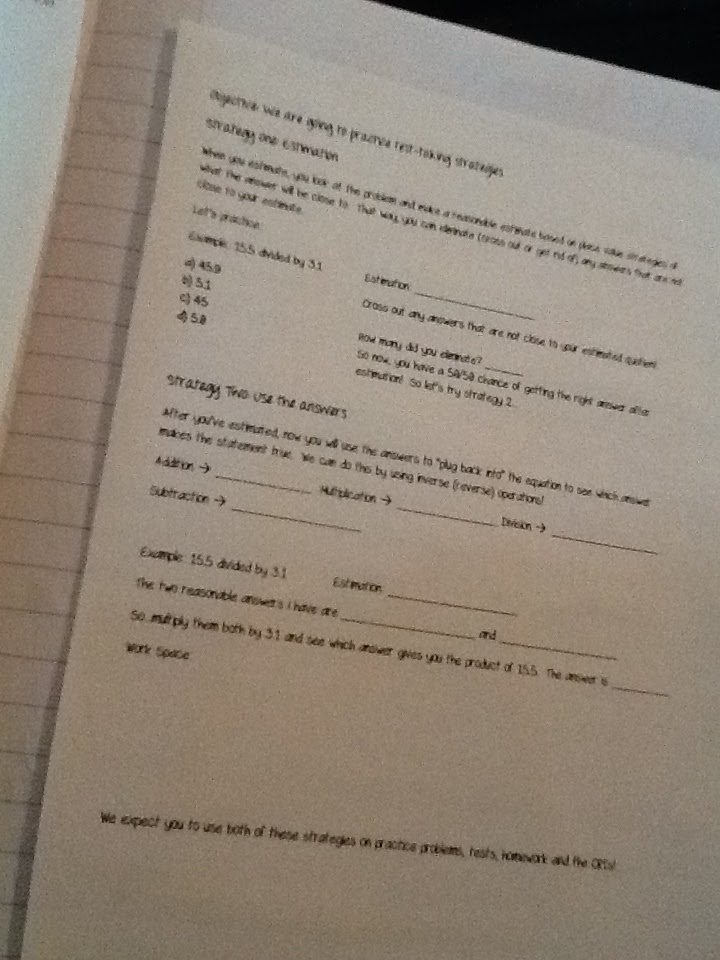
We used these because they were larger (we took more notes in these subjects) and the pages didn't rip out as easily.  They also held up better to gluing in graphic organizers such as these:


My inserts can be anything from FCRR character charts to closed notes for science to a poem we are going to use for a close read.  My general rule of thumb is if there is a precise drawing or copying the information will take them more then 5 minutes, I type it up and prepare it myself.  I usually prepare these on 1/2 size sheets so there's no overlap, but for some of my special ed students, I make a full size sheet and have them fold it in half to glue in.

I do go over my gluing procedures with them the first week of school because even fifth graders need reminders.  I expect them to put a large X in the middle and trace the edges of the paper before passing along the glue stick.  I have them show me with their fingers how we glue before they even touch glue sticks.  This does help eliminate their innate desires to coat the entire backside of the paper with globs of glue.  Hey, I'm not made of money to continually buy glue sticks! 


3) Organization of the notebooks

Before implementing notebooks, you'll want to decide how you want them organized.  I usually spend time the first week setting up notebooks with my students, modeling under the ELMO (document camera).  Whenever I have students take notes, I model in my own teacher notebook.  While this is time consuming, it's nice to have an accurate model for students who are absent.  Plus it's nice to have to reflect upon lessons to make the necessary tweaks!

Questions to ask yourself:
 
Are you going to have students number pages?  Does each side have its own page number or will both sides of the page have one number?  Will they use both sides of the page?  It's best to have this figured out before you model setting up notebooks with students.

Are you going to have your students keep a table of contents?


How often will they update the table of contents?  Will they do it as part of a lesson closure or during the opening?  I recommend writing the topic in together and acknowledging that the students' page numbers will not all be identical.

Will you have them color code their notebooks? Read more about this idea here


4) Model, model, model

I model writing in my notebook whenever I have students copying notes.  I do a lot of T charts where I have my notes (teacher input) on one side and students record their thinking (student input) on the other.  I model writing in the table of contents, I model making sure I'm on the right page, I model making sure I'm in the right notebook.  I then have them check in with their shoulder or face partner and give me a thumbs up to ensure that everyone is where he or she needs to be.

Frustrating and redundant? Absolutely at times, but it's worth taking a few extra moments to make sure everyone is on the same page (literally).

I prepare a lot of my lessons on smart notebook and I don't necessarily want my students copying down every single word I've typed.  To help them learn to decipher the important information, I will highlight the "must have's" that go on the teacher side.  We then discuss the information and I let them "chew" or "talk it out" with their table teams.  I then allow them reflection time to record their thoughts on the right hand side of their notebook (student input side).  From there, we'll come back together and I'll ask for volunteers to share what they put on the right hand side, thus allowing me to do a quick check for understanding and gauge the room.  After 1-2 students have shared, I'll do an informal check for understanding with hand signals (based on the student's response):

Thumbs up: We wrote basically the same things.

Thumbs sideways: We were close but I had a few things different.

Thumbs down: We didn't really have anything similar.

During this time we also talk a lot about how this notebook is their resource.  They might need to write down a lot of information for them to make meaning of concepts and that's okay.  They might need to draw diagrams. That's okay.   I make sure to model different strategies to help them determine how they like to take notes.


5) Procedures 

Before starting notebooks, you'll want to think through procedures and "what if?" situations.

What will you do if students leave their notebooks at home?

I usually have them copy on a blank piece of paper to glue or staple into their notebooks later.


What if a student is absent?  

I have a peer write for them.  Since I use Kagan groupings, there is (ideally) a higher student in each table group.  That student usually writes pretty quickly, so when he or she is done with his/her notebook, I have that student copy for the absent peer.  

Since my students don't all write at the same speed, I usually have them discuss the ideas in a whisper while their classmates are finishing up writing.

What if a student is in the restroom?

I try not to have more than 2 students out at a time, but I'll have them pass their notebooks to a peer to write for them while they're gone.  After a few weeks, students are pretty good at realizing which of their peers can write legibly and quickly for them.  I do have them pass their notebook to a peer at their same group to save time.  (You know, the looking around the room for their best friend, the slow walking to the best friend, the not-so-silent giggles with the best friend, then the same process on the return from the restroom...no one has time for that!  Pass it to a neighbor and go do your thing kiddo!)

The inevitable "what if I run out of room?" question from the students will occur.  I must have answered this on a weekly basis for my fifth graders, but I simply have them turn to the backside or next page and keep going.

6) What goes in the notebook?

You've thought about what type of notebooks you want and how they'll be used in the classroom.  Now comes the fun part...what the heck goes in them.

Well, the content naturally varies by subject matter and age.  Having only taught fifth grade, I can speak about elementary notebooks with much more authority then high school ones.

Reading

For our reading block, we separated into three sections: phonics/word study, whole group (skill/strategy) and small groups (differentiation).  

Phonics: (5-10 minutes a day)
We started the year going over what makes a syllable, going into the six types of syllables, reviewing long and short vowel sounds, reviewing verb tenses, irregular words, and going over the nuances of the English language (when Y becomes I and so forth) before moving into affixes (prefixes and suffixes) and Greek and Latin roots.  At my previous school, almost all of our students were English Language Learners (ELL) and I had an inclusion classroom, so several of my students were special ed.  We couldn't start with fifth grade standards (affixes and roots) because we needed to fill in their knowledge gaps.  So we reviewed K-4 phonics content during the first twelve weeks.  Did my previous administration agree with this choice? No.  Did we have great growth in Aimsweb because the students were getting daily practice on strategies to read multisyllabic words? Yes.  That did get them off our backs. 

For phonics, we introduced the skill on Monday, did a closed sort Tuesday, did an open sort Wednesday, used fill in the blanks on Thursday and did a quick check on Friday.  We read aloud words with the skill both in isolation and in paragraphs daily.  This phonics time was our warm-up.

In their notebooks, they'd record the skill name, the rule(s) and examples/non-examples.   For ELL students, the non-examples are extremely important.  They'd also write down their sorts and do their quick checks.  

Whole Group Reading (30 minutes)

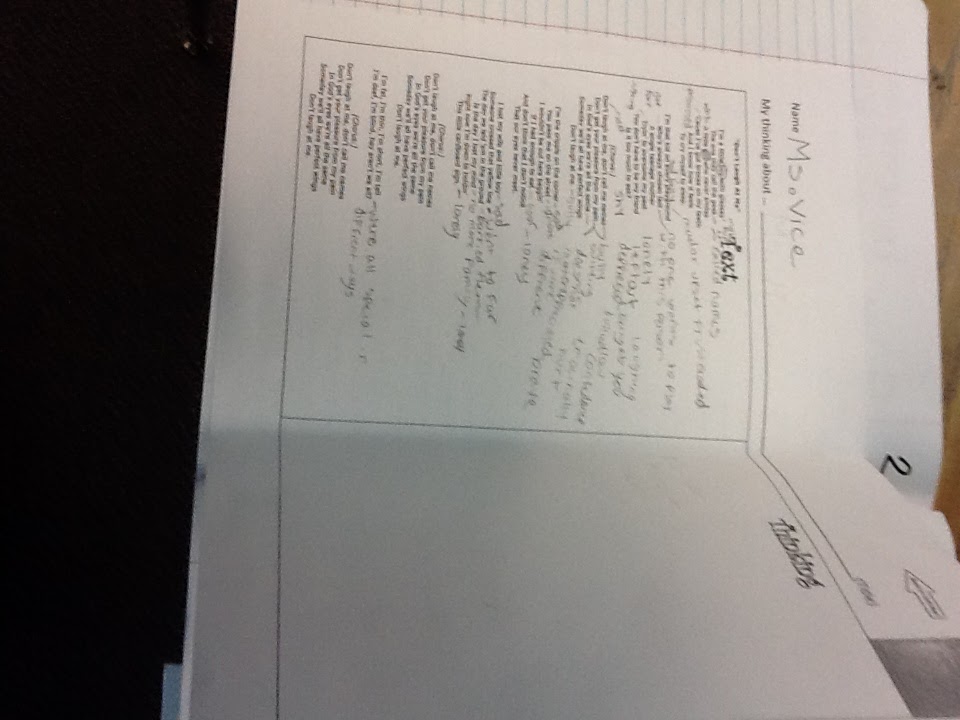
We glued in mentor texts (usually poems), graphic organizers, table of contents, copies of chapters, scanned reader's theater pages, etc.  We wrote over the mentor texts, a lot, taking note of character changes and author's word choice.  Here are some snap shots:


Theme reference chart 

\

New Colossus mentor text 


Example from phonics notebook 


Example of reader's theater script (they were learning the components) 


K/W/L (know, want to know, learned) chart and circle map all about components of literature


mentor text with student thoughts underneath  


 what makes a reader (making meaning and internalizing goals for the year)


 Keeping track of characters in our novel The Lightning Thief 


Table of contents for The Lightning Thief 
 

Phrasing activity (left) and overview of Greek gods (right)
 

Leaving space underneath a poem to record additional thoughts


mentor text (poem) that can be flipped up to record thoughts


Table of Contents to help students organize their notebooks


Steps for comparing and contrasting settings, so students can refer back during guided practice


 Text and places for them to record their thoughts


Example of an FCRR foldable 


Fluency guides


homework ideas


modeling what should be recorded


Creating T-charts for debates


Annotating their thinking


Graphic organizers (brightly colored so they can easily be found) with places for students to put their own examples

Small group reading: (1 hour)
We glued in fluency rubrics and character charts.  Much of their SG notebooks were dedicated to written responses about their characters.  I'd assign the groups chapters and their homework would be to respond to these questions by our next meeting date.  I had the higher half of the grade level, so they were able to handle this task.  They also did a lot of their must do activities in their notebooks.


Math

For math, this is where they'd copy down the vocabulary and work through problems with me.  I like to print problems on sticky labels for them to work on collaboratively.  We also made foldables for vocabulary.


Note taking guide for students to explain their thinking 


Science

We glued in glossaries for our science notebooks and diagrams, which students labeled and explained.  I made them a graphic organizer for their wonderings so they could eventually create their own science inquiry questions.

 
Making maps of our classroom

Writing

We made a FANBOYS foldable and did some sorts (revising vs. editing) in their notebooks, but these were mostly for their quick writes and drafts.  We used post-its with peer editing and different colored pencils when revising and editing.


Notebooks can be a daunting task but when taken slowly and used daily with students, they are a great place for students to make meaning of their learning.  As a teacher, you are guiding them to create their own reference materials and take charge of their understanding of the topics.  You are providing them with a place to navigate the content and challenge their previously held conceptions.  Yes, notebooks can be a lot of work...but it's worth it.

Any other tips and tricks fellow teachers?  Mrs. A, I hope this helps!

Good luck!