Showing posts with label fluency. Show all posts

Monday, September 1, 2014

Day 5

I made it to Friday!  


I did start my morning with duty...I'm not a fan of the gate.  I picked up my kiddos, took them off to Art, then planned math with another teacher in my grade level.  We had a grade level meeting yesterday and split up who is planning what subject.  This is an adjustment for me. Instead of planning everything, I'm planning one subject, writing up super explicit lesson plans, and making the copies for the grade level.  So far, I'm liking it!  I still read over their lesson plans and put my own flair on them, but it's nice that collaboration and team work is the norm for my grade level.

After I picked my kiddos up from specials, we jumped right into math.  For our number talk, it's "fact Fridays" where I gave them their first timed multiplication test.  

Last year my grade level split up multiplication and division facts into "easy", "medium", and "hard" facts.  We made 3 different versions of each test and would give them a chance every other week.  Today they had 3 minutes to do the easy multiplication ones.

Easy facts: 1, 2, 5, 10
Medium: 3, 4, 9, 11
Hard: 6, 7, 8, 12

Of those, about 6 of my students passed their easy facts on the first round.  I'll be making a tracker to glue in their notebooks and a brag wall similar to this:


For them to sign off when they pass each level.  Granted, this is a third grade standard, but many of my students don't have these facts mastered (yet!).  We'll alternate testing and practice weeks.

From there, I had them compare notes on what a good mathematician is before adding their thoughts (on post-its) to our chart:

 
'

We also went over the first math practice (make sense of problems and persevere in solving them).  I had them record it in their math notebooks with sticky labels and added the chart to the wall.  I didn't want to put up all 8 without going over them because then students have no connection to what's on the wall.


I also raided another teacher's classroom and found the rods I was looking for!  I modeled that the rods and units represent tens and ones in this case, but made it clear this won't always be the situation.


I had the table teams model 43-29 for me using the manipulatives and they did a pretty good job.  I think most of our math this year will be hands-on because there are some major gaps to fill.  However, after talking with my grade level, I'm not the only one who feels this way so that's nice we're all wanting to give them meaningful practice to help make sense of numbers.


In science, they finished exploring the mystery bags and we had a conversation about all the skills they practiced.  They did a really good job with their team building task.

In writing, they finished their final drafts (which I accidentally left at school...Wednesday problem).  In reading, they took their STAR test to place them for AR and worked on building their stamina in silent reading until everyone was done with writing.

From there, I modeled the importance of previewing a text, again using The Lightning Thief as my mentor text.  I jumped right in and read, without modeling metacognition or stopping to think aloud parts.  A few pages in, they were confused (as they're supposed to be).

We talked about strategies that good readers use, one of them being to preview the text.  What this means is they need to look at the front and back covers, as well as the table of contents, to formulate an idea of what the text is about.  

I then had them practice with a book of their choosing, modeling on a post-it.

We reviewed phrasing and went over rate, adding to our charts in our notebooks.  We'll go over expression and accuracy next week.  We'll also go over buddy coaching and have some fluency practice before we take our beginning of the year Aimsweb benchmarks.

With the bell approaching, they did their classroom jobs and I sent them on their way with this:


They o-fish-ally survived their first week! It's Labor Day weekend and we have a staff development day Tuesday, so I won't see them again until Wednesday.  

One week down!

(On a side note, I did have to write my first citations and lock myself out of my room on Friday. I also forgot to send home last year's CRT scores, so I stapled apology notes to parents and those scores will go home Wednesday.  There were definitely moments of frustration on Friday, mainly due to me forgetting things...so a nice relaxing birthday dinner with B at Red Robin was so deserved!)


Happy birthday to me! (day 4)

Day 4

I really didn't get much done before school because people kept popping into my room to wish me happy birthday, which I thought was very sweet.  My new grade level brought me balloons and cupcakes, along with decorating my room.  Wasn't expecting that from a team I've worked with for basically a week, but it's great to feel so welcomed.

In math, we talked more about persevering through problems, did our number talk, then I introduced them to one of my favorite math games 20 wins.  Basically they are placing digits (0-9) into boxes and trying to make a square equal 20 with any operations.  For the first day, I modeled with me against them before letting them try with a partner.


We came back together and talked about strategies that were used:


While they played, I walked around making observations.  For the most part, my class seemed very comfortable with addition strategies.  A few groups tried multiplication to make 20.  They'll play again tomorrow and their weekend homework will be to play with a family member.  I don't think I'll have much trouble getting them to want to play math games.

What they don't realize is how much math they're doing.  Yes, they're adding for the most part. But they're also thinking strategically and looking for patterns with numbers.  They're having to predict what their partners might do and prevent that from happening.  They're using multiple operations, practicing order of operations, and often times trying several different strategies until they can make 20.  I love tricking them into learning!

After that math fun, we went over phrasing with fluency.  I had them do a sort with their table teams to pre-assess them and for the most part, they know what fluency is so I'm not starting instruction from the beginning.  Of the four components of fluency (rate, expression, accuracy, and phrasing) I decided to model one.  If I modeled all 4 in one day, they'd be bored and probably confuse the components.  I'd rather go a little slower to make sure they've all got it.

I modeled several different times (incorrectly) and had them give me feedback.  They did a really good job with picking out the errors.  We made a chart together in our notebooks before moving to the carpet for today's skill lesson.

I modeled metacognition, which is thinking while reading, using The Lightning Thief.  The first time I read, I modeled great fluency.  Afterward, I asked them how I did to which they responded great!  Then I let them in on a secret: it's not enough to just read the words.  You've got to think about what you're reading.

I modeled again, this time tapping to the book whenever I was "in the text" and tapping to my head, modeling a think-aloud, whenever I was practicing metacognition.  I had two students keep score:


We talked about how we have to think while reading.  Some of them got it, some didn't.  That's okay, it's day 4.  We've got time. 


We also went over what it means to be a good reader, which was part of their homework:


I'm trying to color code my anchor charts (reading being teal) to help my students.  We'll see how long I can keep up this goal!  I had them brainstorm independently, talk as a table team, then add their thoughts on post-its.

In writing, they're continuing to work on their letters to self.  In science, they're having a great time with the mystery bags.  I also had them draw pictures of what a scientist is:


Then we had the conversation that women can be scientists too, since many drew men.  I talked about how I am a scientist whenever I step into the kitchen.  I am a chemist, hoping my ingredients combine the way they're supposed to.  I have to be accurate in my measurements and ensure my oven is preheated to the proper temperatures.  I test my experiments by eating them :)  I also shared that of the real chemists I know, the highest ranking ones are women.  This was very surprising for them but part of my job is to destroy their gender stereotypes about scientists.

All in all, it was a great day.  My biggest concern so far is I've had to move one student's desk twice already, but I think that's just an adjustment back to school and realizing my expectations of listening to instructions the first time they're given.  

Four days down!


Thursday, July 10, 2014

Ms. Vice's boot camp, day 1

I had my first tutoring session with my third grader today.  She's adorable and loves learning, which is a nice change.  Her mom brought me data from her last report card and talked about what books they should get from the library.  It was so nice to see a positive family focused on school!

We read two passages on Helen Keller and set up her reading notebook.  We made a graphic organizer and talked about strategies.  She did really well!

We are going to meet on Mondays, Wednesdays, and Fridays for an hour and a half.  It's time to dig into my very unorganized guest bedroom (teacher closet) and find some fluency activities and reading games!

Saturday, March 22, 2014

These are my students, round 3

Our awesome counselor started an after school peer support system with our fifth graders.  Her goal is to have some of the higher students help the struggling students with organizational skills and academics.  The program is a few weeks old but our counselor is receiving lots of positive feedback from the students.  Having a peer assist them privately after school is ideal because one, it's not a teacher so they feel they can connect better without feeling frustrated and two, it's a private support system where no one has to know.  As far as the rest of the grade level is concerned, it's a homework club...which is partially true.

One of my students from my small groups was assisting another student with his fluency.  He was giving him productive feedback as we've practiced, but then privately asked our counselor this:

"Should I model first, so he can hear what good fluency is like? I've been working on my phrasing."

I love that it's ingrained in them to model a skill or strategy first so that students know what is expected.  Considering I model different skills daily, I'm glad the importance of this explicit instruction is sinking in with my students.

Another one of my girls not only made her peer mentee a homework folder to keep himself organized, but she also assigned him homework.  Yes, she found her old fluency practice passages and instructed him to read them nightly and keep track of his errors.  Furthermore, she created a survey for him about his strengths and weaknesses so she could better assist him.  She also wouldn't accept "reading" as his answer for what he was struggling with.  Oh no, she flat out told him to "be more specific". I'm not sure he appreciated it, but I sure did!

This must be what mothers feel like.  

My students are verbatim, echoing things I say on a nearly daily basis.  They are internalizing the need, as a teacher/mentor, to provide positive, concise feedback, model strategies, help with organizational structure and be reflective about one's own learning.

I've created little minions.  I couldn't be more proud that not only are they willing to help their peers, but they have productive strategies to do so.  I love that they're willing to help their peers succeed as well.  High fives for team work.

Saturday, March 15, 2014

Word Work lessons

Since I have the upper half of the grade level for small group reading, I focus on word work rather than phonemic awareness.  My students aren't learning to read, they're readers.  So our focus is on those irregular word patterns and nuances in the English language that must be explicitly taught to students (especially my English Language Learners).

We've worked on irregular past tense verbs and silent letters, so I created power points.  Our word work is only 5-10 minutes per reading block (sixty minutes) because that's what my students need.  Word work and fluency practice takes no more than fifteen minutes (combined) so the remaining forty five minutes are spent reading, writing, publishing, blogging, sorting, creating, analyzing, comparing, contrasting, or meeting with me for our literature circles.

I've posted my weekly lessons on TpT for a dollar each.  You can edit them if you don't like the font I used or you can download the free font here.

Happy reading!

Wednesday, March 12, 2014

AM reward

In our SWAG competition between AM and PM, the AM has won again.  This time, they had a half hour of free board game time.  The timing worked out perfectly because we lost twenty minutes of our hour to an assembly, so after fluency there was only time to meet with one group (and cover everything we needed to).

Reward snapshots:


Many of my games were generously funded by friends, family, and strangers on donors choose.  Thank you again for continued support in my classroom!

(The Series of Unfortunate Events board game was perhaps my favorite find ever! I found it at Bookman's, a used bookstore in Arizona.  I didn't even know it existed until one magical spring break!)

I love watching them get so excited about comprehension and reading games!

Sunday, March 9, 2014

FCRR Shout Out

I've blogged about FCRR before and it's a wonderful free resource for literacy stations.  I love that it's broken up into grade level bands (K-1, 2-3 and 4-5) as well as into the big 5 components of literacy instruction (phonemic awareness, fluency, vocabulary, phonics and comprehension).  They've also revised many of their student activities to align with the Common Core State Standards, which is also extremely helpful.

I've used the stations with my intervention groups and during my small groups.  I especially like the fluency stations at the beginning of the year when I'm explicitly teaching the four components of fluency (accuracy, rate, expression and phrasing).

Since it was reading week last week, I took advantage of the lax schedule (we had assemblies and Discovery Education testing as well) to play some reading games with my students (when they weren't being pulled to make up missed assignments, since the trimester ended Friday). 

One of the stations they played was "fact and opinion football":


I had a group of football fans fully entertained for a good twenty minutes.  When they ran out of cards, I had them make up their own statements for the group to guess.

The second station was "incredible inferences":


(Yes, my classroom rug is polka dotted...that's just how I roll!)

I used counters from our math kit as pieces, but you can use virtually anything. I'm pretty sure almost every teacher I've met has some sort of kit of pieces.

They had a great time with these reading games and I liked the skills that were reinforced. I know many of my students struggle with getting past the literal words in the text, so this was a fun way for them to practice "digging deep" and making meaning of the text.  They're getting there with inferences!

Happy reading :)

Saturday, March 1, 2014

That time has come...

For the first six months of the school year, I ran my small groups with ease.

Okay, not ease per say, but with a relatively stress-free mindset compared to the rest of my day. 

 I knew where to go for my weekly fluency passages (reading A-Z), I had a list of must do's to choose from based on what standards we were working on in whole group and what grade level assessment data revealed.  I've changed up our "word work" a few times, but am now using this great resource:


Based on my notes from our daily fluency practice (and my RCBM progress monitoring), I select what focus skill we'll be using for the week.  So far we've done irregular past tense verbs, silent consonants and soft & hard c.  Next week we're looking at stressed and unstressed syllables.

Over the past several years, I've meticulously created teacher guides for my novels.  Through the amazing generosity of supporters on donorschoose, awesome sales on Scholastic, thorough searching at second hand bookstores, Amazon's fast shipping and shamelessly using my teacher discount at both Borders and Barnes and Noble, I have established a decent classroom library, filled with multiple copies of some great books.  I try to have at least six of each, so I can use these novels with a small group.

However, with twelve small groups, I've arrived at the day I've dreaded.

Some of my groups are ready to read novels I haven't had the time to meticulously prepare...which means I have extra homework!

Granted, reading is by no means a chore.  I love reading!

However, while I'm reading the novel my students are, I'm carefully taking down vocabulary words, writing comprehension questions (with answers so I don't forget), picking out specific parts for a close read, brainstorming homework questions and more.  It takes a long time for me to prep a teacher guide so that I feel confident doing the novel with a small group.  I'm not one of those teachers that can just sit down and read the book with them, I want to be ahead of them so I know if the answers they're giving are correct.

Last week not one, but three of my groups finished their novels and selected new ones that I haven't read yet.  So this weekend's homework is reading at least the first part of these books:


"Who Could That Be at This Hour?" (the first of 4 novels in Lemony Snicket's All the Wrong Questions series, a quasi-prequel to the Series of Unfortunate Events)


The Lost Hero by Rick Riordian.  Darn, more adventures at Camp Half-Blood!


They selected this book because they noticed the Newbery Award on the cover and concluded it must be a good novel.  How can you argue with that logic?

I figure I won't finish all of them by Monday, but I can at least get part way through and stay a few chapters ahead of them!

(On the bright side, novel guides for these three books will be available within the coming month on my TpT site!).

On that note, I say goodbye for the weekend and am off to read!

Saturday, February 15, 2014

A week in small groups

I spend 1/3 of my day doing small groups for reading.

My 12 groups range from DRA 40-70 and are split up by both DRA level and students' interests.  My afternoon group also has all the fifth graders in GATE/TAGs (advanced course work for gifted & talented), so I have to make sure to never schedule their group meeting days on Tuesdays or Fridays.  I also had to group them in the same 3 groups for this reason.

When they meet with me, we do close reads of important parts of the passage, go over comprehension questions, zoom in on vocabulary and work on predictions and inferences.  Lately they've been running more of their small groups, which is awesome.

We have daily word work and fluency practice.  I have to RCBM two kids a day (fluency progress monitoring with AIMSweb), so during this time, they read our weekly flueny passage (leveled passages from reading A-Z).  During that time, they coach each other on the components of fluency (rate, expression, accruacy and phrasing) to help each other improve.  By doing the same passage over the course of the week, they practice repeated reading and their accuracy improves over the course of the week.  I get to use this time to progress monitor so I don't fall behind on my case load.  I love that we multi-task and it's not wasted time.  

We have been working on weekly "must do's" as well with the A/E/I/O/U strategy and our science readers.  I chose informational text because they struggle with main ideas and supporting key details.  In fifth grade, they are expected to pick out the main ideas and make connections within text, including scientific ones.  Our science CRTs (standardized tests) are up first on the testing calendar, so I'm utilizing old science content to not only review science material but informational text as well.  If I give them a task, there should be a clear focus!  (Or in my overachieving case, several)

Here are some snap shots of what they're doing when they're not at my kidney table:


Collaboratively adding details about the characters in their novels on their large graphic organizers.


Using fifth grade description cards to analyze characters.


Responding to a post on kidblog.


Referring back to the text for evidence in a written response


Keeping track of characters in a novel


Collaboratively recording information about the novel, including juicy words, character development and settings.

Happy reading!


Monday, December 23, 2013

Just a few of my favorite (FREE) things

In the spirit of the holidays, I've decided to compile a list of some of my favorite free things, all from TpT.

I did not make these products but love using them in my classroom!

Item 1: Schedule Cards


These adorable cards were made by  Cara Carroll and available free here!  She's included so many subjects and they're perfect for almost any classroom.  

Here's a snapshot of them in my classroom:


When combined with green marker and a funky polka dot border, our schedule gets a lot more fun in fifth grade!  Since they have different specials each day, I just use a magnetic clip to keep them organized.

Item two: Star Wars fluency posters

I'm a nerd, I'll embrace it.  There are superhero and Star Wars things all over my classroom.  I'm not ashamed of it :)

So when I found these adorable freebies:


I literally squealed in delight!  Then of course, forwarded the link to my grade level because who wouldn't want R2D2 helping out their students?

This gem was made by Jane Loretz and is available here on TpT.  Use the force to go snag yours.

Item 3: Grammar Cheat Sheet

I struggle with teaching grammar, especially to my second language learners and inclusion students.  Maybe that's why I love this cheat sheet:


Created by Jen of Hello Literacy and available here, this cheat sheet is a great reference.  I have students place a copy in their writing binders as a resource.

Item 4: Bookmarks

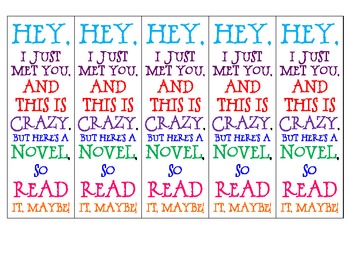
While Carly Rae's song may be a little dated at this point, I still love these free bookmarks:


Available here and made by Kathryn, my students get a kick out of these.  Anything to encourage reading, right?

Item 5: Author's Craft

Another great freebie from Jen at helloliteracy!  


It goes great in our reader notebooks :)

What freebies would you add to the list?

Sunday, November 10, 2013

FCRR

One of my absolute favorite websites for free literacy centers is FCRR.org.  Funded by the Florida Center for Reading Research, the student activities are not only broken up into grade level bands (K-1, 2-3 and 4-5), but broken into the big 5 (phonemic awareness, phonics, fluency, comprehension and vocabulary).  Furthermore, because it wasn't awesome enough, the centers are fairly straight forward, almost everything you need is included and they're organized in a logical, straightforward manner.  (What isn't included is die, pieces, etc but those are easy to find).

Plus, they're aligned to the Common Core State Standards!

These are great for reteaching standards, literacy stations and interventions.

In a perfect world, I had my centers printed on different colors of card stock to distinguish fluency from comprehension and so forth.  It started out this way...but then I ran out of card stock.

Since that organizational strategy didn't work, I stuck to printing my lower level stations (2-3) on bright yellow card stock so I'd be able to quickly differentiate without students knowing.

They're accustomed to groups getting different colored stations (so I can easily pick up the forgotten pieces & put them where they go), but they don't always realize the colors signal the different ability levels.

Happy reading!


Tuesday, October 29, 2013

Small groups in action!

I love small group reading :)

I feel like I'm a literacy specialist since so much of my day is spent with literacy:

9-9:40: phonics, whole group reading
9:40-10:40: small group reading
10:40-11:25: writing
11:25-11:55: science
12:30-1:05: intervention/extension block (fluency, comprehension and vocabulary)
1:05-2:05: small group reading 

Here are some snapshots of our centers:

Blogging:

My students are using kidblog to respond to one another online:


Snapshot of our afternoon blog:


They're doing such a great job!

Reader's theater:


They're doing a Greek mythology passage this week :)  I love that they picked one that aligns to our grade level read aloud, The Lightning Thief. We're also going on a field trip next week to see a performance of Jason and the Argonauts

Our new centers, based on the novels they just finished:


All are available on TpT!

We're also doing our weekly affixes:


On Tuesdays I challenge them to find non-examples of this week's affixes.  Today, it was words that appeared to start with un- or re- and end with -s or -es that were non-examples of these affixes.  They did a good job at coming up with ideas.

Since both of my groups (AM and PM) finished Hatchet, I had them compare their anchor charts:


They did a good job with picking out the same big ideas from the novel and analyzing how Brian developed over time.

Since I don't have enough books for both groups, one is reading The River while the other is reading Brian's Winter with the idea they'll switch when they're done.

We also looked at how the cover illustrations had changed over time:


They were highly amused by the early 90's version :)

My students are so excited about our books and that's just awesome.

Saturday, October 26, 2013

Word Work

I've switched up how I'm doing the layout of my small groups for reading.  Because we switch students, there's the awkward minute or so transition time that is lost instructional time.

So instead of waiting for everyone to come in, get settled, get out their fluency passages and charts, then give me a thumbs up to begin, we are going to start with affixes instead.

We have our ongoing anchor charts for affixes, but I'm going to start explicitly teaching them next week.

I decided to review ones they should be familiar with (re, un, s, es), then go through the rest of the year with roots & affixes.

My planned schedule is this:

Mondays: introduce prefix, suffix, practice with a few words of how the affix changes the meaning, add to anchor chart

Tuesday: review affixes, go over non-examples and any helpful hints.  This week, they need a quick mini-lesson on what happens if a word ends in y (change to i) and when to add es (ch, ss, x or sh) or just add s to make a word plural.

Wednesday: word sort (prefix, suffix, both, neither)

Thursday: decoding multisyllabic words: Isolate the affixes, chunk the rest of the word into syllables (identify with CLOVER), practice blending through

Friday: encoding: adding affixes to change the word's meaning

I made my template and posted my first one on TpT, which you can download for just a buck!  I did make the template with the swagger font, which you can snag for free here.  I made it editable, so you can change the font & the words if you'd like!

Tuesday, October 22, 2013

Syllables

We have been working on decoding multisyllabic words this week during our word study.

Well, day.  Monday was the only day we actually have word study since today was parent/teacher conference day, tomorrow is a field trip, Thursday is staff development day and Friday we are celebrating Nevada day and have no school.

I'm revising my small groups next week to start with blending through multi-syllabic words with a focus on specific affixes and roots.  We'll start with blending and word study, that way when students come in a minute or two late, they don't miss fluency and buddy coaching.

Our word attack strategy:


We also reviewed where to break apart syllables:


And hung this near our CLOVER chart:


Happy word work!

Thursday, October 17, 2013

Clicks and Clunks

This week, our school's power (vocabulary) word is strategy.

In honor of this, I'll share about one of my new favorite strategies: "clicks and clunks".

I'm aware this is in no way a new strategy and is taught in numerous teacher prep courses.  However, it's new to me :)

I read about it in my beloved CORE source book:


And it's really "clicking" with my students.

(By the way, I googled for an image of the CORE book and my own image from a prior blog post came up...weird moment.)

Basically, it's a formative assessment where students analyze thier own learning.  They share what's "clicking" in their heads and what is "clunking" (not making total sense).

We talk about the importance of being honest and talk about why things are clunking.

I have my students give me fist bumps on their way out the door and share their clicks/clunks with me.

Yesterday, one student told me that our weekly phonics skill (/s/, /sh/, /z/) was clunking with her because she was confused about the letters.  Using this clunk, I explained in a different way during our word study this morning and she got it :) 

 (Hopefully others did too but since she specifically told me that was a clunk, I wanted to help her with it)


Speaking of clicking and clunking, here are mine for the day:

Clicks:

Almost all of my students are making growth on RCBM for Aimsweb for their oral reading fluency and words per minute.  One that went down had a very honest conversation that he wanted to try reading without using his finger as a place holder to see if he really needed it.  Turns out, he does need to keep track of his place with his finger but more importantly, he realizes that it's a strategy he needs to use because it helps him. 

Some of my students have grown over forty words since their beginning of the year benchmark.  Yes, you read that correctly. 40 words. In a minute.  They're almost at their end of year ambitious goals.

Clearly our daily repeated reading, buddy coaching and fluency stations are working!

Clunks:

Voice levels still aren't where they need to be.
Our server was down today: no access to my documents, my premade lessons, my email or the internet.  We made the best of it but it was frustrating being without technology.

Happy Friday! (almost...)