Showing posts with label theme. Show all posts

Wednesday, December 31, 2014

Teaser Tuesday


Sometimes my insomnia is beyond frustrating, but sometimes it yields exciting new classroom ideas.  I'm thankful it's the middle of winter break and I don't really have anywhere to be until around noon tomorrow because my brain simply will not shut off.

I have a million ideas bouncing around in my head for the new year.

I have my next bulletin board picked out.  They're going to write constructed responses about the themes in their latest novel.  We're going to type these responses, thus giving extra computer practice for those who need it.  

I will then take the two novels that we've read as a class (Esperanza Rising and The Lightning Thief) to model comparing and contrasting how the authors arrive at similar themes (family, loyalty, bravery) using the characters. (CCSS/NVACS RL 5.9.  Yes, we've renamed the Common Core Standards the Nevada Academic Content Standards for well, in my humble opinion, ridiculous reasons.)  

I'm excited to start using music for transitions in my classroom, especially at the end of the day.

I'm excited to start teaching more mapping skills, geography, earth science, and most importantly, the return of the map:


Oh yes, we'll build it up again from scratch.  There was a disagreement within my grade level about how to approach maps.  I understand the idea of starting with the 13 colonies, but I also stand by my approach of teaching regions.

We're going to start with what they know: Nevada.  From there, we'll do the surrounding southwestern states.  We'll talk about things these states all have in common and I'll introduce the concept of a region.  From there, we'll explore the other states in a quasi-reverse Westward Expansion kind of way.  We can also connect the map with the settings from Esperanza Rising and The Lightning Thief, which will bring in an exciting literary aspect.

But perhaps the idea I'm most excited about shall be called Teaser Tuesday.

I'll take fifteen minutes or so after lunch to read aloud the first chapter or two of a book.  Read alouds are a pretty common thing in my fifth grade classroom, but here's the new twist: It'll be a mystery.  I'll have the book cover and title hidden.  I'll read just enough to get them interested and of course, stop at a good part.  From there, I'll have them do a written reflection on whether or not they'll want to continue that novel independently.

I've already brainstormed using the following novels:

Tuck Everlasting
The Giver
Number the Stars
Hatchet
Al Capone Shines My Shoes
The Bad Beginning
Steal Away Home
The Red Pyramid

Any other ideas fellow teachers? Must read novels that are super interesting to ten year olds within the first few pages or chapters?

Tuesday, March 4, 2014

Theme Responses

I noticed on their last written responses were a tad lacking.

So I created a fill in the blank guide for their constructed responses:


I modeled the first paragraph on the smart board so they understood the new format.

I expected a little bit of backlash from them for the length of the response I requested.  Instead, they completely surprised me.  They think this response flow sheet is the greatest thing ever.

They're treating it like madlibs and writing pages and pages.  They're going back to the text for evidence and finding the specific quotes that support their answers.

Happy reading!

Tuesday, November 19, 2013

New anchor charts!

Here are some of our updated anchor charts:

Theme and constructed responses:


Affixes:


Greek & Latin Roots:


Inflectional Endings (phonics):


I need more wall space!

Saturday, November 16, 2013

RACE strategy

During our intervention part of the day, I've been working with students on subtracting decimals to the thousandths, figurative language, theme and poetry.

We moved into working with constructed responses and one of my favorite strategies is RACE:


RACE stands for:

Restate the question.  Students use words from the question to formulate their opening or topic sentence.  This helps them to focus their answer.

Answer the question(s) that are asked.  For our district, constructed responses tend to have several parts and it's important for students to answer all portions.

C: Complete sentences.  Students need to remember the rules of grammar, spelling, etc when writing their responses.  We went over that one sentence does not suffice.

E: Evidence your answer, twice.  This helps them with main idea and key supporting details, as well as quoting accurately or inferring details from the passage.

New Colossus

In whole group reading, we are loosely following another school district's long range plans and mentor texts.  They did a good job with spiraling and using authentic literature & informational text for the Common Core State Standards.  

We worked on poetry and many students were struggling with identifying theme, looking for figurative language and summarizing stanzas.

So their must do this week involved the poem New Colossus.  I picked this poem because it is challenging and within the 5-6 band of suggested poetry.  

Each day they read the poem independently with a different purpose.  Thursday they compared notes with a neighbor and Friday we talked about it as a class.  

Here are some snap shots of their note taking:


I think they did a great job.  A few figured out the poem was about the Statue of Liberty, but once I revealed that, there were quite a few "a ha!" moments, or as we call them, brain fireworks. 

I then had them reread the poem, this time looking for clues that the poet used to reveal the subject of the poem.

They had a lot of fun with it, so I think I'll make a poetry station where they glue in poems & practice this strategy.  I'll type up a list of what I expect for each read through and have them switch marker colors each time they read.  By doing one marker color per read/per purpose, it holds them accountable to all the steps without them even realizing it :)

Happy reading!


Friday, November 8, 2013

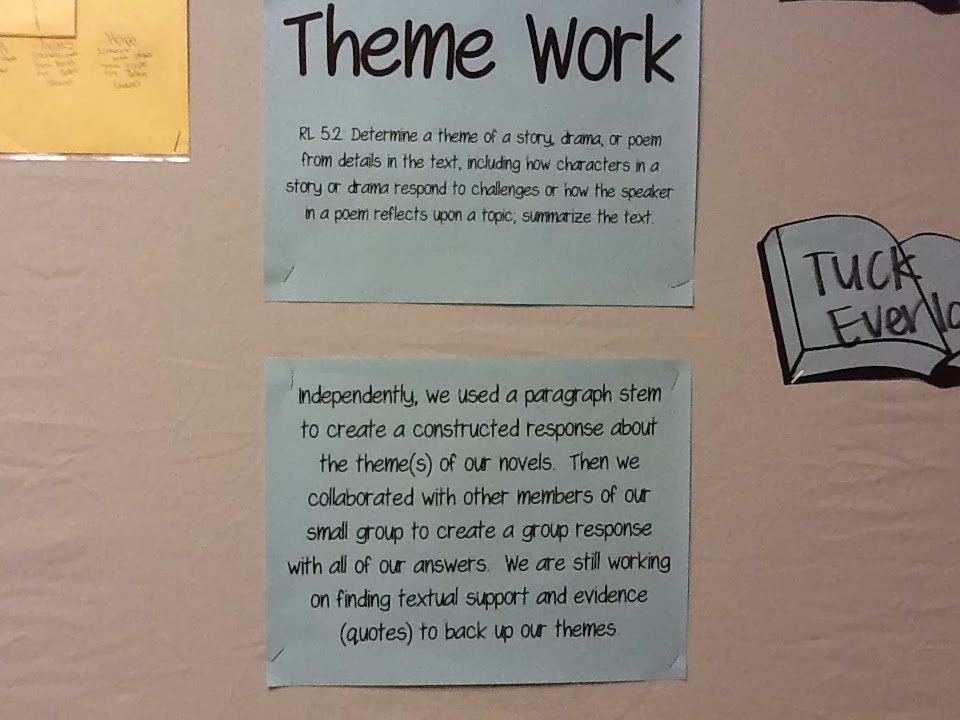
Theme Work

This week we reviewed theme in small groups.  I gave my students a paragraph stem (read previous post here) and they independently wrote their responses on post-its.


From there, they combined their responses to make a group response (above).

These became my new bulletin board:


A nifty fourth grade teacher helped me come up with the witty name:


I also added a picture of our anchor chart and put cut outs of our novels to provide others with the necessary back ground knowledge (you know, of what books we read!)


I think they did a great job at picking out themes from their various novels.  Our next challenge will be finding the quotes that support their answers and adding more details!

Friday, November 1, 2013

Casey at the Bat

This week we read Casey at the Bat and after days of reading and re-reading this poem, we are done!  Here is a snapshot of some of my students' work:


We take our learning very seriously and are getting ready for our academic futures with lots of interaction with our text!  It's not enough to read the poem and answer questions, we dug much, much deeper.  We discussed the text structure of poetry, found examples of figurative language and rhyming patterns.  We looked at how the mood changed over time and how Casey was portrayed (as a hero).  

We summarized the stanzas, looked for themes and backed up our themes with quotes and evidence from the poem.

Then today we watched this school tube clip to analyze how the poem is similar and different from its multimedia counterpart.  

Next week as an extension (and because we need a little more practice with poems), we're doing Casey's Revenge.

Happy reading!

Thursday, October 31, 2013

Themes & Poetry

This week we are working on poetry.  Specifically, we're reviewing text structure, figurative language, theme and summarizing a poem.  We're also working collaboratively to summarize the stanzas, identify characters' feelings, locate shifts in mood and practice note taking on the text to become more engaged readers.

We used the poem Casey at the Bat this week and broke it up into a 3 day unit.  The first day was the "I do" where I modeled the skills we're working on, the second day we did as a class and the third day they did part with a partner and the rest for homework.


Then I re-read the entire poem, thus modeling the importance of re-reading for information.  We then referred to our theme chart:

(You can grab it here as part of a TpT bundle!)

We did Casey at the Bat not only because it's a recommended text, but it's also because I'm a Boston Red Sox Fan :)
Today, in honor of Halloween, we are doing the same process with Edgar Allen Poe's The Raven.

I know it will be a little tricky for some students, but it's a fun challenge and it's festive!

In small groups today, we're also trying a new collaborative strategy for writing a constructed response.  Since many of them have finished their first novel, we are going to look for the theme.

I made them a guide for their CRs:


They're going to write independently on a post-it today and tomorrow combine 3 or 4 people's post-its into one group response. I'm excited to give this new strategy a try!

Next, here's a student working on our affix sort, a new process I'm trying this week.

We did Wednesday's activity yesterday of sorting affixes.

You can download your own copy here!


We also have our new centers ready to go!


Friday, October 25, 2013

new stations

New stations are posted on TpT!

The first one is a survival sort. 

I created this one to go along with multiple novels that have survival as a theme.  I created this to go along with Lois Lowry's The Giver and Number the Stars; Suzanne Collin's The Hunger Games, Catching Fire, and Mockingjay novels as well as Gary Paulsen's Hatchet, Brian's Winter, Brian's Return, The River and Brian's Return. Students work together to sort descriptions into various categories: emotions, shelter, dangers, etc.  My students love playing this center and as an extension, coming up with new cards to add to our sort.  I love when they are invested in our activities.

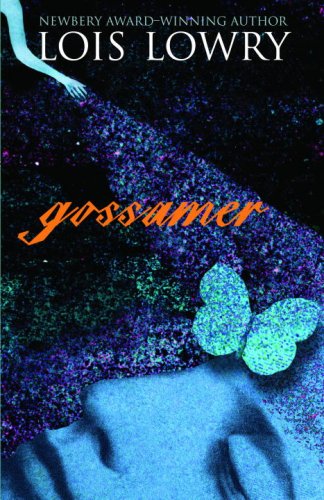
The second one is responses to literature for Lois Lowry's Gossamer.


In this station, students draw from over 20 different response to literature cards based on the novel.  Students will respond to the literature, then discuss their answers with their partner or small group.

This supports the CCSS RL 5.1 (quoting accurately) and W 5.9a (response to literature) standards.

Centers one and two are available NOW!

I'm currently working on the next two, which should be available by Sunday.

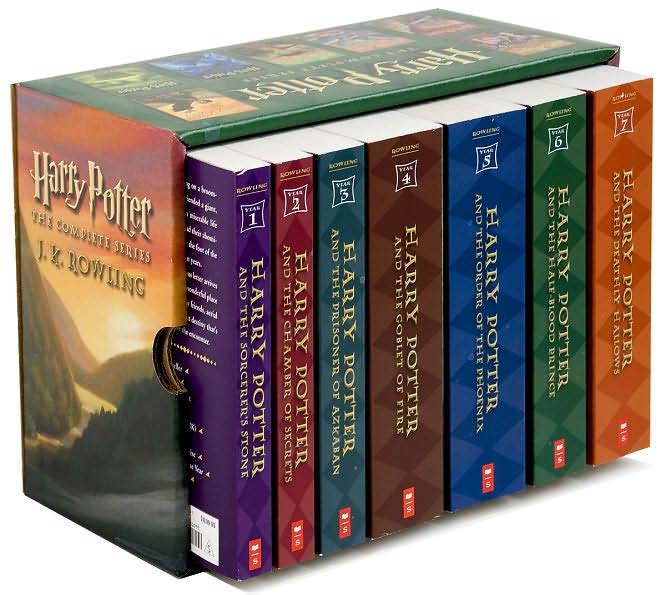
The third station is based on the Harry Potter novels.  

Students will have to sort descriptions into the characters that are being described.  The center includes descriptions for all the novels and has an "I don't know this yet" section so students can use this sort for any of the seven novels.

This epic sort comes in at thirty five pages and is quite the steal!

The fourth station is also based on Harry Potter, but has students sort descriptions for the houses of Hogwarts.  

Enjoy!

All of these stations are available on my TpT store.  Again, the first two are up now and the second two will be available by Sunday night :)

 If you purchase the products, thank you!  Please consider rating them as well :)

Friday, October 11, 2013

Week 7

This week in whole group reading, we were working on main idea, supporting details, alternative perspectives and inferencing.

We used the passage "we were here, too" (grab it for free here) and the kids did a great job.

First, we made a list of people we associate with the American Revolution:


 I was really proud of my students for acknowledging that slaves were important.

They read the passage with their table teams:


They also were working on their metacognition and recording their thoughts and predictions on paper:


They did a really great job with this activity :)

They were also shocked to learn that George Washington had slaves, but we talked about the historical context and how he treated his slaves.  I think I blew their minds with that fact though!

They are also working on fluency passages in small groups as a station/center:

One person watches the timer (the passage is to be read for one minute).
One person reads.
The other listens and provides meaningful feedback in the form of buddy coaching.


They have made some great growth on their words per minute (WPM) for their Aimsweb RCBM probes!

Also in stations, they were working on sorting different scenarios into survival elements:

(The groups that did this are reading Hatchet and Hunger Games, so survival is one of the themes of their novels)


Students then analyzed my sort and added suggestions on how to improve it or add cards to sort.

I like that they help me improve my centers and then have more input, thus more investment :)


(As a side note, you can see one of my polka dot rugs and my polka dot center bucket in these images...I love polka dotted things!)

Tuesday, July 30, 2013

Posters, Round 2

As much as fire code will let me, I plan to cover my classroom in anchor charts that I make with my students.  I'll take pictures of our anchor charts and make notebook sized copies for my students. There will be anchor charts for phonics, writing, reading skills, science terms, vocabulary words, read alouds, the works!   However, I will be making a few of these posters about norms and expectations. I love these cute ideas from pinterest:


I love that this stresses the importance of learning :)

I don't know what book this teacher is using, but I love the anchor chart:

I really like the evidence component because it focuses on RL/RI 5.1.  For those readers not well versed in the Common Core State Standards, both these anchor strands require students to quote accurately and use inferences, which is nicely supported by this anchor chart's structure.

This is another great anchor chart with quoting:


This one is great too!

Here's a great TpT freebie:


This poster does a wonderful job at reframing what it means to fail:


Failure is part of trying. It doesn't mean it defines students, it just means there is more to the journey.

This one perfectly illustrates the 8 math practices, but in student friendly language:


(From this blog)