Showing posts with label 8 math practices. Show all posts

Tuesday, November 17, 2015

Where was admin?


I had a beautiful conversation erupt during math time today.

Here was the problem:


They were solving with a partial products array (they're not quite ready for traditional or standard algorithms for multiplication) and a very loud, very passionate conversation erupted.  One student argued that having the "zero tens" row in the second factor (409) wasn't necessary.  Another passionately disagreed.  

Soon, I lost the whole class to this beautiful, loud conversation about if zero is a value or simply a place holder.  

Did it need to be represented? 

Could it be skipped? Always?

I reeled them back in after about five minutes of debate, much to the horror of the original instigators who hadn't successfully defended their perspectives.

What a beautiful, natural example of the math practices coming to life.


Now, where was admin?! That would have been a lovely example of math discourse in the classroom for my end of year evaluation.


Saturday, August 15, 2015

Math Training, Day 1

I get really excited when grade level specific trainings are offered in my district.  I get even more excited when they're in math (an area I want more professional development in) and when one of my dear friends, Mrs. B, is one of the trainers.  She's a wealth of information and I love learning new things from her.

I signed up for the three day training (Friday, Monday, Tuesday) with two other lovely ladies from my grade level.

Naturally, the school where the training is held is on the other side of town, so Mrs. H and I carpooled, which meant I saw her lovely face at 6:03 am.  Yes, that early.  The training was 7am-1pm.

Day One:

We got to the other side of town early (no traffic on a Friday morning, which is somewhat of a miracle).  We got there, found a table with three open seats (so our grade level could sit together) and once we were nice and settled, were told to move closer.  Sigh...I have perfect vision. I can see from the back of the room!

After we moved, the training started.  Here are the highs and lows:

Highs:

We learned some new strategies for teaching multiplication of fractions with manipulatives (washi or highlighter tape for models).

We got some tricky word problems that really require students to think. I'm excited to use them the first week of school.

We learned about some cool new virtual manipulatives, like this and this!  My favorite parts? Not only will it cut down on the frustration I feel when making models to demonstrate fraction by fraction multiplication, but they are both free.  

Lots of the information wasn't new, but rather reaffirmed that what Mrs. H and I did last year when planning math was appropriate for students.  We'd rather give them fewer problems but make them thoughtful, real world application questions that they struggle with to build perseverance. 

Not related to the training, but my grade level went out for a wonderful lunch at the Mac Shack afterward!  Gourmet mac and cheese? Yes please. 

Lows:

It's frustrating that when we are in a major budget crisis, the school district makes some questionable decisions.  i have absolutely no problem with teachers receiving extra pay for attending extra trainings outside of contract hours.  However, I took a pay cut and my insurance increased, but new hires get a $4,000 hiring bonus?  There are at least 22,000 employees in the school district, including a pretty competent math department, but they flew a presenter in from Florida.  So not only does the school district pay the presenting fees, but also lodging and food.  Plus the training is Friday & Monday, so the weekend has to be covered as well.  Isn't there someone already on pay roll who lives here that could have been paid to do the training?

We sat for six hours.  We didn't get to use the manipulatives til around 11 am, which meant four hours of sitting and listening.  I wouldn't do that to my students, so don't do it to teachers.  It was very obvious the two main presenters were used to sitting in offices all day by how they ran the training.  I need to move! I don't do well sitting still.

I ran out of food.  I brought snacks, then ate them quickly because I was bored of sitting.  I got hangry and I'm not ashamed to admit it.

We were promised two 15 minute breaks and only got one.

Our Tuesday training was cut, due to budget (?).  I was looking forward to the extra money, but after sitting through Friday's, I'm glad there's only six hours left.  Plus it means I have Tuesday to work in my classroom!

I'm hoping Monday's training is better.  We are supposed to be broken up into smaller rooms with our schools, so we'll see...


Sunday, November 23, 2014

Detour

Sometimes the best teaching moments detour from the lesson plan.

We had this Engage NY activity sheet to give:


3 problems.  The time slated for this independent practice was ten minutes, then they were to go work independently in a textbook that's older than them.

That's not what we did.

I had them work collaboratively at their table teams.  I had them include written explanations of their thinking and justify their answers.  I had them show their work multiple ways.  It got a tad noisy, but they were all engaged.  It's amazing how the simple act of giving them markers and butcher paper turns an otherwise mundane activity into a lively discussion and collaborative activity.


When they were done, I had them do a gallery walk and critique the other groups' presentations, thus highlighting math practice #3.  

Did this activity take way longer than it was slated to? Yes (but it still fit within our math block).  Did they gain so much more from one another than they would have by silently working then going over the answers? Yes.  

Was it worth detouring from my lesson plan? Absolutely.

Friday, November 21, 2014

But...that was intentional...

It's okay to disagree with a fellow teacher.  It's okay to not want to deliver a lesson the same way as another teacher. It's okay to put your own spin on things.  Some things should be the same (the assessments, the vocabulary, the definitions), but we aren't going to teach the same way.  That's okay. I have a difficult time following instructions or lesson plans verbatim, even when I'm the one who wrote them.  Don't get me wrong, I am always meticulously prepared for my day.  I just also take advantage of teachable moments.

However, I do get a little frustrated when it seems almost every instructional decision I make is questioned.  I've got a lot of background working with special ed kiddos and with the pacing of units.  Things are sequenced intentionally to help students make connections between background knowledge and new content.  The use of manipulatives (hands-on materials) during the first few days of a unit is quite necessary.  Students, even my fifth graders, need the concrete examples to investigate a concept.  They need experience in the concrete before moving to representational and abstract understandings of content.

We are starting division on Monday.  The standards quite explicitly state do not teach the standard long division algorithm. This is not to be introduced until sixth grade because students don't have the number sense nor mathematical understanding to reason through what is occurring.  

Here it is, straight from our professional development department:


I'm not really sure how much more clear this could be, but there were still debates about what it means.  

The first few days in our math unit has a lot of investigation by the students.  I'm giving them a bunch of paper clips to sort into smaller groups.  Some problems will divide evenly, some won't.  

I want them to tackle it. I want them to struggle.  Some kids will count those 48 paper clips into the groups one at a time, driving their partners bonkers in the process.  Some will make the connection to multiples and give away larger groups.  Some will use their multiplication facts to estimate the quotient.  Some will see division as repeated subtraction while others will see it as repeated addition up to the dividend.  

That's okay.

I want my students to understand what they're doing.  I want them to make connections.  I want them to discover how division is related to the other operations and take ownership over their strategies.

My math unit is scaffolded intentionally.  The first day is exploration.  The next introduces vocabulary terms, goes over making sense of the problems (hello math practices), and has student generated strategies.  Direct instruction doesn't begin until day 3 after students have had ample time to investigate sorting and making groups with paper clips and cubes.  From there, we'll move to hundreds grids and talk about regrouping.  We'll make the connection from the physical orange flats, rods, and cubes to the paper versions and drawings, thus moving from concrete to representational. From there, we'll move into number based strategies that build upon other operations, powers of ten, place value, and multiples.  Again, scaffolded from representational drawings and grids to strictly numbers (abstract).  There's a plan.  It took hours to design, but I'm really excited about it. The plan, which spans thirteen instructional days, scaffolds so students will feel successful and anticipates common misconceptions.

However, another teacher entirely disregarded the plan...and told me about it, gleefully.  She had them try one problem with manipulatives and then gave them the algorithm.  I'm so disappointed and feel sad for her students.  I'm sad they lost the opportunity to make their own discoveries. I'm sad they lost the chance to feel ownership over the concept. I'm sad they lost the opportunity to have a meaningful struggle with the tasks.

Her justification? They'll learn it next year and she's doing the sixth grade teachers a favor.  Besides, the standard algorithm is just faster.

I'm aware it's faster.  Faster yet? Whipping out my phone and using its calculator function.  But what's the point in that?  What do they learn when they're just handed the short cut?

I'm standing my ground on this one. My goal is not to teach math.  Yes, you read that correctly.  My goal is not to teach math.

My goal is to have my students understand math.  I want them to know what they're doing, why they're doing it, what happens to their numbers, and why their problem works out mathematically.

I'm making critical thinkers and problem solvers, not robots.  I'm aware it takes more time, but this mindset also encourages stronger students and that's my ultimate end goal.

Monday, November 3, 2014

Thankful, Day 3

The thankfulness continues.


Day 3:

I am thankful to be in a profession where I have the opportunity to constantly learn new things and try new strategies.  I am thankful to be at a school where I can learn from others. I'm thankful for my grade level and for the support I receive from the other math chair.

Today I presented on math strategies for staff development.  It went fairly well and others were appreciative of new strategies and planning time.

Side note: I didn't teach math last year.  The two years prior to that? I taught stations in an inclusion classroom with the special ed kiddos.  Before that? A traditional classroom.

However, I've attended lots of math trainings over the past few years because I didn't want to fall out of practice.  I guess they've paid off!

As frustrating as these math trainings are, I do appreciate that I have the opportunity to attend them to learn more information (and be paid to learn).

Monday, September 1, 2014

Day 5

I made it to Friday!  


I did start my morning with duty...I'm not a fan of the gate.  I picked up my kiddos, took them off to Art, then planned math with another teacher in my grade level.  We had a grade level meeting yesterday and split up who is planning what subject.  This is an adjustment for me. Instead of planning everything, I'm planning one subject, writing up super explicit lesson plans, and making the copies for the grade level.  So far, I'm liking it!  I still read over their lesson plans and put my own flair on them, but it's nice that collaboration and team work is the norm for my grade level.

After I picked my kiddos up from specials, we jumped right into math.  For our number talk, it's "fact Fridays" where I gave them their first timed multiplication test.  

Last year my grade level split up multiplication and division facts into "easy", "medium", and "hard" facts.  We made 3 different versions of each test and would give them a chance every other week.  Today they had 3 minutes to do the easy multiplication ones.

Easy facts: 1, 2, 5, 10
Medium: 3, 4, 9, 11
Hard: 6, 7, 8, 12

Of those, about 6 of my students passed their easy facts on the first round.  I'll be making a tracker to glue in their notebooks and a brag wall similar to this:


For them to sign off when they pass each level.  Granted, this is a third grade standard, but many of my students don't have these facts mastered (yet!).  We'll alternate testing and practice weeks.

From there, I had them compare notes on what a good mathematician is before adding their thoughts (on post-its) to our chart:

 
'

We also went over the first math practice (make sense of problems and persevere in solving them).  I had them record it in their math notebooks with sticky labels and added the chart to the wall.  I didn't want to put up all 8 without going over them because then students have no connection to what's on the wall.


I also raided another teacher's classroom and found the rods I was looking for!  I modeled that the rods and units represent tens and ones in this case, but made it clear this won't always be the situation.


I had the table teams model 43-29 for me using the manipulatives and they did a pretty good job.  I think most of our math this year will be hands-on because there are some major gaps to fill.  However, after talking with my grade level, I'm not the only one who feels this way so that's nice we're all wanting to give them meaningful practice to help make sense of numbers.


In science, they finished exploring the mystery bags and we had a conversation about all the skills they practiced.  They did a really good job with their team building task.

In writing, they finished their final drafts (which I accidentally left at school...Wednesday problem).  In reading, they took their STAR test to place them for AR and worked on building their stamina in silent reading until everyone was done with writing.

From there, I modeled the importance of previewing a text, again using The Lightning Thief as my mentor text.  I jumped right in and read, without modeling metacognition or stopping to think aloud parts.  A few pages in, they were confused (as they're supposed to be).

We talked about strategies that good readers use, one of them being to preview the text.  What this means is they need to look at the front and back covers, as well as the table of contents, to formulate an idea of what the text is about.  

I then had them practice with a book of their choosing, modeling on a post-it.

We reviewed phrasing and went over rate, adding to our charts in our notebooks.  We'll go over expression and accuracy next week.  We'll also go over buddy coaching and have some fluency practice before we take our beginning of the year Aimsweb benchmarks.

With the bell approaching, they did their classroom jobs and I sent them on their way with this:


They o-fish-ally survived their first week! It's Labor Day weekend and we have a staff development day Tuesday, so I won't see them again until Wednesday.  

One week down!

(On a side note, I did have to write my first citations and lock myself out of my room on Friday. I also forgot to send home last year's CRT scores, so I stapled apology notes to parents and those scores will go home Wednesday.  There were definitely moments of frustration on Friday, mainly due to me forgetting things...so a nice relaxing birthday dinner with B at Red Robin was so deserved!)


Happy birthday to me! (day 4)

Day 4

I really didn't get much done before school because people kept popping into my room to wish me happy birthday, which I thought was very sweet.  My new grade level brought me balloons and cupcakes, along with decorating my room.  Wasn't expecting that from a team I've worked with for basically a week, but it's great to feel so welcomed.

In math, we talked more about persevering through problems, did our number talk, then I introduced them to one of my favorite math games 20 wins.  Basically they are placing digits (0-9) into boxes and trying to make a square equal 20 with any operations.  For the first day, I modeled with me against them before letting them try with a partner.


We came back together and talked about strategies that were used:


While they played, I walked around making observations.  For the most part, my class seemed very comfortable with addition strategies.  A few groups tried multiplication to make 20.  They'll play again tomorrow and their weekend homework will be to play with a family member.  I don't think I'll have much trouble getting them to want to play math games.

What they don't realize is how much math they're doing.  Yes, they're adding for the most part. But they're also thinking strategically and looking for patterns with numbers.  They're having to predict what their partners might do and prevent that from happening.  They're using multiple operations, practicing order of operations, and often times trying several different strategies until they can make 20.  I love tricking them into learning!

After that math fun, we went over phrasing with fluency.  I had them do a sort with their table teams to pre-assess them and for the most part, they know what fluency is so I'm not starting instruction from the beginning.  Of the four components of fluency (rate, expression, accuracy, and phrasing) I decided to model one.  If I modeled all 4 in one day, they'd be bored and probably confuse the components.  I'd rather go a little slower to make sure they've all got it.

I modeled several different times (incorrectly) and had them give me feedback.  They did a really good job with picking out the errors.  We made a chart together in our notebooks before moving to the carpet for today's skill lesson.

I modeled metacognition, which is thinking while reading, using The Lightning Thief.  The first time I read, I modeled great fluency.  Afterward, I asked them how I did to which they responded great!  Then I let them in on a secret: it's not enough to just read the words.  You've got to think about what you're reading.

I modeled again, this time tapping to the book whenever I was "in the text" and tapping to my head, modeling a think-aloud, whenever I was practicing metacognition.  I had two students keep score:


We talked about how we have to think while reading.  Some of them got it, some didn't.  That's okay, it's day 4.  We've got time. 


We also went over what it means to be a good reader, which was part of their homework:


I'm trying to color code my anchor charts (reading being teal) to help my students.  We'll see how long I can keep up this goal!  I had them brainstorm independently, talk as a table team, then add their thoughts on post-its.

In writing, they're continuing to work on their letters to self.  In science, they're having a great time with the mystery bags.  I also had them draw pictures of what a scientist is:


Then we had the conversation that women can be scientists too, since many drew men.  I talked about how I am a scientist whenever I step into the kitchen.  I am a chemist, hoping my ingredients combine the way they're supposed to.  I have to be accurate in my measurements and ensure my oven is preheated to the proper temperatures.  I test my experiments by eating them :)  I also shared that of the real chemists I know, the highest ranking ones are women.  This was very surprising for them but part of my job is to destroy their gender stereotypes about scientists.

All in all, it was a great day.  My biggest concern so far is I've had to move one student's desk twice already, but I think that's just an adjustment back to school and realizing my expectations of listening to instructions the first time they're given.  

Four days down!


Friday, August 29, 2014

Day 3

Day 3.

Also known as the day I pissed off most of my students, on purpose.

I didn't plan to irritate them.

We did our number talk and it involved a subtraction problem with lots of regrouping.  After walking around and seeing my students' answers, I noticed about half of them got the answer right. Others were having calculation issues or subtracting from left to right and getting all confused.

So I started the problem and asked what my next step was (it was regrouping).  The answer I got was to add a "1" to the one's place.  I asked if I was adding one or ten. I was told one.  I asked where this one came from. No one could tell me.

Face palm.  This does not bode well for math this year.

So we stopped solving the problem.

I gave them a two digit subtraction problem instead: 51-37.  Almost all of them got it right with the algorithm.  I saw one student try with a number line (yay!).   Then I modeled the problem with manipulatives (rods and cubes).


I explained that when we are regrouping, I'm not adding numbers out of no where.  I'm taking a set of ten from the next place value and redistributing them.  I wish I had these to use to show them actually breaking apart a set of ten:


But alas, I don't.

I gave them another problem to solve, both numerically and with a picture.  Most of them got it right using both ways.

Next week we'll go back to larger place values.  We'll also use manipulatives because they don't have enough hands on experience with making groups.  I've got some large gaps to fill!

After math, I asked them how they felt using this system:


Most of what I got in response was this:


They aren't there yet.  They told me they need more practice.  I told them good.  

I got a lot of confused faces.

I told them that in math, they aren't going get the concept on the first day. I told them I'm going to require multiple ways of thinking about the problem.  I told them they're going to have to prove they understand what is happening with the math, not just show me the right answer.

Many of my higher students are not happy with this challenge.  

To them, I say good. They'll be better off in the long run.  I had some grumpy math faces today!

Thursday, August 21, 2014

Math Training, days 4 & 5

Days four and five of the math training continued to be focused on the operations, this time with a focus on division and decimal place value.

The traditional algorithm is not taught until the sixth grade.  So all the cutesy "don't monkey swing backward" sayings...don't.


Just say no. 

They teach a mindless procedure and quite frankly, what's the point in that?  The goal is to help understand math, not just do math.

The conversations focused on helping build an understanding of math for teachers, so this content would transfer to students.

I'm excited to teach math again. I'm now on the math committee which is slightly amusing because I haven't taught a traditional math block in a few years.  It must be time to dust off those cobwebs!

Monday, August 11, 2014

Math training, day 1

First, it was difficult to get up at 5:30 this morning.  Second, I didn't factor in nearby construction, so I just barely made it to my 7 am training.  I wasn't late, I just wasn't my normal five to ten minutes early.  Because I was late by my own standards, I had one of the last choices in seating which meant I was stuck in a set facing the back of the room.  I've got a bit of a neck cramp from turning my head around all day.  All those minor factors aside, I shook off my frustration and settled in for six hours of learning.

That's when I learned this training is five days, not four.  I had planned to go into my new school Friday to start setting up my classroom.  There's also a school tour and it sounds like that's the day my administration is going over all of the details about our school.  Good thing I have two close friends also starting at my school so I can get the info :)

I like the ladies I'm sitting with and the instructors are friendly and knowledgeable.  Two of the other ladies at my training are at my former coach's school so I shared how lucky they are to have her guidance.  

Then the math activities started.  Now, I've been to a lot of trainings over the past five years.  I like learning and new strategies.  90% of what was covered today I've heard before.  Now I could be grumpy about this, or I could be fortunate that I've had some great mentor teachers and coaches who've already shared this information.  I'm choosing the second option and going to focus on the new information I learned today.

One of the videos we watched was a middle school Number Talk.  Most of the time the videos are focused on elementary, so it was nice to see a change.  The teacher set the norms for the problem: (123-76)

1. Don't solve traditional algorithm
2. You may write down numbers, but you need to try this in your head
3. Thumbs up when you've got the answer (standard Number Talks procedure)

The teacher then allowed for think time.  Instead of asking for the answer, he asked what is know about the answer.  I'd never heard this question phrased and I will definitely be using it in my classroom.

The students responded that the answer was positive and less than 100.  Another student estimated the answer to be close to fifty based on his rounding (125-75).  

From there, the teacher asked for strategies for solving and answers.

I loved how this simply question gives students a daily opportunity to practice estimating and reasonableness. I like that this wording helps them think critically about the problem but I'm not the one telling them what to think.

I'm embracing the mindset of being their math coach, not their math teacher


I want them to make mistakes. I want them to make their own discoveries.

Now, it's time for homework before day 2 tomorrow!


Thursday, August 7, 2014

Bulletin Board Ideas for next year

I get to be creative again with my bulletin boards!

In high school, I was class vice president. (Vice for Vice, see how well that campaign worked out?)  At Arizona State, I was a RA/CA (community assistant) with Residential Life.  This month marks year six of teaching.

So I've spent a lot of time with bulletin boards over the past decade(s).  This is a good thing...because I love them.  I love making them cute and showing off student work.

I'm at a new school, which means I can recycle old bulletin board ideas for a new audience!  This minimizes my prep work and well, who doesn't love that?

(I've also included the Common Core State Standards that I'll be teaching/assessing with each bulletin board.  You can read more about the standards here)

September

I was thinking some sort of Harry Potter themed "word wizards" display with types of syllables.  I don't know how much phonics instruction has been given in the past, but I like to start phonics instruction with going over the six types of syllables.  By knowing how to break apart words, students will get to practice reading those larger multisyllabic words.  They'll also get practice looking for affixes and roots, which aids in their comprehension.  I'm thinking some sort of foldable where they break apart their own names and justify the syllable types underneath.  I'll add a written component about how this helps them as readers, so they have to justify their thinking.  I'll also have them find words from their own novels to break apart as well, thus giving them some ownership.


CCSS RF 5.3a, L54b

October

By this point, we should be editing and revising our written pieces with Being a Writer.  I will do a mini-lesson on dead (zombie) words.  For those not in the know, these awful words like to pop up in fifth grade writing samples.  These words belong in primary writing samples, but have no business in upper elementary!  Zombie words include transitions such as first, next, last.  Zombie words are dead words that just keep reappearing.  I'm sick of said.  I'm sick of reading "good" and "bad".  We need more alive words!

So I'll reuse this idea (mainly the drawings...those took a while!):


To make this bulletin board more rigorous, I'll display their final drafts with copies of their rough drafts underneath.  That way, viewers can see that writing (like learning) is a process.  They'll be able to see authentic student work that has been revised and edited with the purpose of eliminating dead (zombie) words.

CCSS W52d, W53c, W54, W510, L52e, L56

November

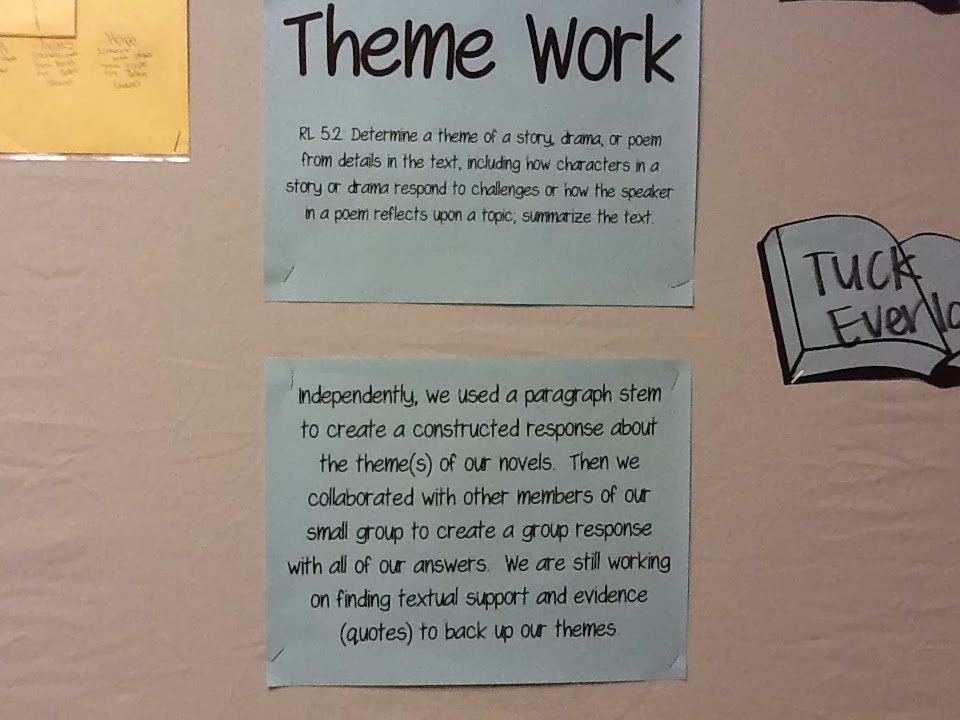
By this point, my students have hopefully finished several novels, making my theme work bulletin board an appropriate choice.  Given that November is full of three day weeks, this would be an easy writing/reading project that students could finish at home.


I'd have them compare two novels within the same genre, focusing on how the author reveals the theme through characters' actions.  This would be guided at first, but then students would write independently.  Since I don't think I'll be doing full novel read alouds, I'd probably model this with poetry and have them practice with novels.  I'm hoping to have students that have read the same books so they can bounce ideas off of one another.  I'm also fully aware they might not be ready for this yet and my November bulletin board will become March's instead.

RL 5.9, RL 5.2

December

I haven't made my long range plans yet, but I can safely assume that by December, we've covered figurative language.  Most likely several times.

Which means a bulletin board all about idioms!


Since I assume many of my students will be English Language Learners, explicitly teaching figurative language is crucial.  I can even have them find examples of figurative language in their text, thus allowing for an opportunity to not only practice quoting accurately but also justify their thinking with a written response.  (Or a typed response, we'll incorporate technology as well!)

RL 5.1, L5.5a, L5.5b

January

"What's Your Problem?"

Yes, time for a math bulletin board.  I will give them a solution and they have to come up with appropriate, reasonable questions that would yield my answer(s).  This ties in with the eight mathematical practices and would have students use a variety of models and strategies to defend their questions.  This would be easily differentiated and I could have those fast finishers come up with a second problem.  This could easily be a spiral review of concepts where I could strategically differentiate based on which domain students need the extra practice.

CCSS: most of the math ones :)

SMP: 1, 2, 3, 4, 5, 6
(Rigorous math activities should use most, if not all, of the 8 math practices...just an FYI!)

February

I'm torn.  I have two ideas for February, both holiday-related...ish.

The first: book crushes


Students would use a Venn Diagram to compare and contrast two characters (their book crushes).  They would write a written response about both characters, using evidence from the text(s). 

RL 5.3, RL 5.1, W59a

The second idea: persuasive letters to George


(graphic organizer (by Ginger Snaps) and mentor text)

By now, I hope we've covered both persuasive writing and the American revolution.  I'd have students examine a historical view point and write a letter to either King George or General George Washington.  Students can choose to be loyalists or patriots and choose which leader they're writing to. I'd push the higher kids to pick a less popular perspective or to write from a neutral perspective.  This would incorporate informational texts, quoting accurately, persuasive writing, perspective of the narrator, and a bit of research.

CCSS RI 5.1, RI 5.3, RI 5.4, RI 5.6, RI 5.7, RI 5.8, RI 5.9, W51  (plus history & civics/government standards)

March

Mad Scientist March has a nice ring to it...

I know we are rolling out the Next Generation Science Standards (NGSS), so I'm not entirely sure what this will look like.  I know my new coaches mentioned going to lots of trainings and researching our school's science options before picking these green boxes.  I'm excited to learn more about NGSS and STEM :)

Perhaps this is where they could display their own inquiry projects and scientific proposals?

April and May...TBD. 

Maybe bookopoly again?


 I planned out eight months worth of bulletin boards...I think my brain can safely shut down for the evening.

What are your bulletin board ideas for next year?

Wednesday, March 5, 2014

SBAC practice

During our intervention block we've been working on testing strategies and math.

We pulled practice SBAC questions.  Students work independently on the problem(s) before sharing their strategies with a partner. 

We also work through the problem together:


I love how much they're getting into the math review!  They don't see it as pointless math problems, but rather real world puzzles which adds an element of fun.  They like these meaningful math challenges and I like hearing them share their strategies with one another.  

Wednesday, February 12, 2014

Word Problem Wednesday

For our number talks, we switch up the focus each day.  Today's was a word problem:


We are working on critical thinking.  I let them use dry erase markers on their desks to solve the problem:


And they loved it!  I liked that I saw a variety of strategies being used (pictures, numbers, etc).  They really enjoyed writing on their desks! (My little rebels)

Saturday, February 8, 2014

New (math) Strategy

During our intervention block this week, we've been using Discovery Ed testing to review previously taught math standards.

I had them using white boards & markers last week so I decided to switch it up. 

Each group got scratch paper and every student got a different colored marker (for accountability purposes).

I'd pose the problem on the board and they'd start working independently on solving.  Pretty standard procedure in a classroom.

However, I switched it up by having them rotate their papers at my whistle.  They had to jump right in and work on continuing how their neighbor had started solving...which wasn't necessarily their strategy.


I liked that this strategy stressed solving the problem different ways.


We switched a few times, then they discussed the strategies as a group.  I love when they can engage in such meaningful math discourse and model their thinking a variety of ways.

I'm thinking about trying this strategy next week with written responses as well.  Or perhaps as a quick write to warm up for writing.

There's something extra fun about using markers in the classroom.  The students are so much more engaged, which is wonderful.  Bring back the joy!