Showing posts with label informational text. Show all posts

Sunday, March 8, 2015

Things I love about my classroom

A fellow teacher, former coworker, and adorable new mom Katie posted about her favorite things about her classroom in her blog, which inspired me to do the same.


Scholastic Book Orders

I love how excited my students get for the book orders.  I love that teachers get free coupons and reward points based on the parent orders, so I get to stock up on new books for my students.  This year I've noticed they're obsessed with the "Who was..." series, which is great!  I've read a few of these informational texts and they're very student friendly.  If you're looking for books on a specific person, I'd try here first.


Plus every few months or so, Scholastic includes coupons for the students.  If they spend $10, they get a coupon for a free book (under $5).  It's a pretty nice way to encourage reading.  Plus the prices are cheaper than local stores, which is always a bonus!


Class Competitions

We are a Reading Rangers school and use AR to gauge students' comprehension on their independent reading books.  We are in a competition within the grade level for the highest engage time and the highest percentage. 

However, this competition isn't enough for my students.  We have additional competitions within our classes and across the grade level.  Our current one is a race to 50 passing tests (85% or above) between the girls and the boys.  However, the catch for this one is that any time someone scores less than 80%, that team loses a point.  The kids are loving it!

Other successful competitions include:

-race to 100 100%s
-race to 100 points (each book is assigned a different point value depending on it's complexity and length)
-table team percentages

What competitions do you have with your students?


Class Dojo

I joined the class dojo train late this year, so I am currently only using it as a reward for reading rangers.  For each 100% students earn, they get 2 points.  85 or 90% gets 1 point, filling a badge earns 3 points, and graduating earns 10 points.   They are motivating one another to be in the top five, which is excellent.

Next year I will be using this exclusively as my classroom behavior system.  As helpful as the card system is, I'm over it.  With class dojo, I can reward specific behaviors.  More importantly, I can easily share the information with my students' families, which increases our home-school connections. 

Plus, it's free!

Our Anchor Charts

I haven't done the best job at posting pictures of all our anchor charts (there are a lot!) but I am proud of them.  I make them with the students and they have mini-versions in their notebooks for reference.  This year I stepped it up and have them color-coded.

Teal: reading
Yellow: foundational skills (fluency, phonics, word parts)
pink: math
white: novels

I love that my students have internalized that these are a resource designed to help them learn.  They often ask to go up and look at the charts for clarification (success!).

I ended up just stapling them on top of one another since we're out of space.  I don't have any cutesy inspirational posters up, but still ran out of wall space!  

Classroom Library 

For the first time in my teaching career, I had to level my library.  I used the reading rangers program to level my library (school mandate) but I went beyond that. I grouped my library by genre in adorable book buckets:


I've had a little bit of backlash because it's not organized by fiction/informational text or by point value.  For me, it's more authentic for readers to pick a book a book based on the topic instead of the length.

The Map


I love the map.  I love the postcards.  But more importantly, the map is getting my students so excited about geography and the other 49 states.  We are able to make connections with literature and informational text by linking the postcards with the locations named in books.  They are getting excited about colleges and starting to think about their options for their future. 


What are your favorite parts about your classroom?

Friday, June 20, 2014

What? You've Never Seen This?

Now that it's summer break, I have time to reflect upon yet another year in the classroom.  This year was my most challenging yet and for that, I am grateful. 

I have some definite face-palm moments in my classroom.

Sometimes I forget that things I assume are common knowledge just...aren't.

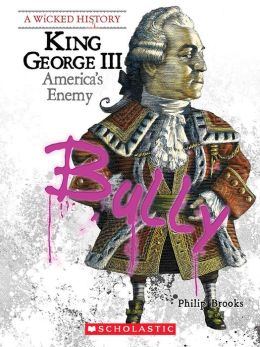
The first of many, many moments was when I had to clarify that kings and queens do actually exist.  We were reading informational text on the American Revolution, which naturally included a discussion on King George III.  This was our mentor text:


They really enjoyed reading and analyzing this passage, although the language and vocabulary did provide some stumbling blocks.  However, through discussion, I realized that many of them were confused.  They knew the passage we were reading was true and based on facts because it's informational text (hallelujah they've got that down), but were "clunking" on the king label.  They didn't realize that kings and queens were real.  So after a quick discussion that included yes, kings are real and no, dragons aren't, they seemed to be more okay with the topic.  

Apparently they then all went out to recess and informed the other fifth graders, thus ending their confusion as well.  Kings did (and do) exist.  Glad that's cleared up.

Second, some didn't realize World War Two actually occurred at all, much less (potentially) within their grandparents' lifetime.  We were reading Number the Stars and I set the necessary historical background.  We looked at some maps (okay Google Earth...it's much more interactive) and took a virtual field trip of Copenhagen.

Then some of my higher students, who have read Number the Stars earlier in the year made the connection that wait, this was based on true events.  Another made the connection to some video game, which sparked a class-wide discussion.  Next time, I think I'll start with the video game reference since that made a lot more sense to many of them.

Live, learn, and teach on!

Friday, May 2, 2014

Narrative Informational Writing

In whole group reading, we've been working on narrative informational texts.  This concept was a tad difficult for our students to wrap their brains around.

The text is informational and designed to provide facts to the readers.  However, the text is also written as a story.  These texts aren't literature because the characters and settings are real people.

We used historical passages from the American Revolutionary Era to help students with this concept.  We chose this because students were already familiar with some of the key historical players and we could incorporate social studies content.

When students were reading, they also had to analyze the text to determine the text structure.  They made organizers in their notebook and I used the social studies readers. 


 I split the class into groups and gave them different sections to read.  


After giving them time to struggle with the text, they met with another group to compare answers.  For the most part, both groups came up with the same answers.


They did really well with this concept! 


Sunday, April 13, 2014

Tech Tip: Video Streaming and Notetaking

With the Common Core standards, the integration of technology is crucial for students.  We have been reading informational text about monarch butterflies so I was thrilled when I found a video on Discovery Education about the topic.

I wanted my students to be accountable during the video so I had them set up a T-chart to take notes.  On one side, they wrote information directly from the video.  This included facts and information they saw or heard.  On the right side, they recorded their reactions to the information presented in the video.

I think they did a great job with our new strategy: 


Another tip I tried was showing the video twice.  The first time, they focused on the content.  The second time, they focused on the note taking portion and vocabulary words.  

They really liked the strategy and I can't wait to try it again!

Friday, April 4, 2014

Informational Texts

With the Common Core State Standards, there is an emphasis on informational text.  For elementary school, the split is 50/50 on informational text and literature.  As students move into middle and high school, the amount of instructional time increases in order to prepare students for the upcoming complex texts.

Reading literature and reading informational texts require different skills from readers.  Reading literature requires students to think about narrative elements, keep track of characters, make predictions, etc.  Informational texts tend to require students to keep track of complex ideas, analyze how events or persons are interrelated and understand how text structures lend themselves to 

In order to support this, we have been reading different articles on Monarch butterflies:


Students have been keeping track of ideas and text structures.  They're working collaboratively to read and analyze the text.


Here they are looking at different text features about Monarch Butterflies.

They did such a great job with this task!  They read a Time for Kids article and two other informational passages on the migration patterns of Monarch Butterflies.  We looked at cause and effect and my students did a great job with explaining how events in a passage go together.  Next week we'll watch a short video clip from Discovery on migration patterns, thus tying in that multimedia element.

I love when they're so excited about what they're learning :)

Sunday, March 9, 2014

Text Features Sort

While it was a tad time consuming to create, one of my students' favorite centers is my text features sort.  I cut up a few copies of an old Time for Kids magazine and cut apart the article.  I glued the text features on different colored pieces of paper and laminated them (for durability).

My students had to put the articles back together with their text features (captions, pictures, titles, maps, etc).  It was a challenge and they had to read the informational text to figure out what features went with each article.


Happy reading!

Saturday, February 15, 2014

A week in small groups

I spend 1/3 of my day doing small groups for reading.

My 12 groups range from DRA 40-70 and are split up by both DRA level and students' interests.  My afternoon group also has all the fifth graders in GATE/TAGs (advanced course work for gifted & talented), so I have to make sure to never schedule their group meeting days on Tuesdays or Fridays.  I also had to group them in the same 3 groups for this reason.

When they meet with me, we do close reads of important parts of the passage, go over comprehension questions, zoom in on vocabulary and work on predictions and inferences.  Lately they've been running more of their small groups, which is awesome.

We have daily word work and fluency practice.  I have to RCBM two kids a day (fluency progress monitoring with AIMSweb), so during this time, they read our weekly flueny passage (leveled passages from reading A-Z).  During that time, they coach each other on the components of fluency (rate, expression, accruacy and phrasing) to help each other improve.  By doing the same passage over the course of the week, they practice repeated reading and their accuracy improves over the course of the week.  I get to use this time to progress monitor so I don't fall behind on my case load.  I love that we multi-task and it's not wasted time.  

We have been working on weekly "must do's" as well with the A/E/I/O/U strategy and our science readers.  I chose informational text because they struggle with main ideas and supporting key details.  In fifth grade, they are expected to pick out the main ideas and make connections within text, including scientific ones.  Our science CRTs (standardized tests) are up first on the testing calendar, so I'm utilizing old science content to not only review science material but informational text as well.  If I give them a task, there should be a clear focus!  (Or in my overachieving case, several)

Here are some snap shots of what they're doing when they're not at my kidney table:


Collaboratively adding details about the characters in their novels on their large graphic organizers.


Using fifth grade description cards to analyze characters.


Responding to a post on kidblog.


Referring back to the text for evidence in a written response


Keeping track of characters in a novel


Collaboratively recording information about the novel, including juicy words, character development and settings.

Happy reading!


Tuesday, February 11, 2014

A/E/I/O/U Strategy

It's always best to try to stay one step ahead of these lively students, so I'm continually looking for new strategies.

I adapted one of Discovery Education's strategies for my classroom.  I'm keeping their name of "A/E/I/O/U".  

While reading our science readers, they had this task:


Write about:

One A ha! moment (something new and exciting)

One emotion envoking moment (curiosity? confusion?)

One interesting fact

One oh? moment  where they learned something new

One uh? moment where some new piece of information was "clunking" with them (not making sense).

We did 2 different passages this week and they did a fairly good job at adapting to the new strategy!


Thursday, November 28, 2013

More text structures

Now that our fifth graders have learned about text structures, we're having them work in table teams to read various articles or old copies of Time for Kids to determine which type is used.

They had a guided organizer in their notebooks that they're adding to as they discover the structure of different articles.


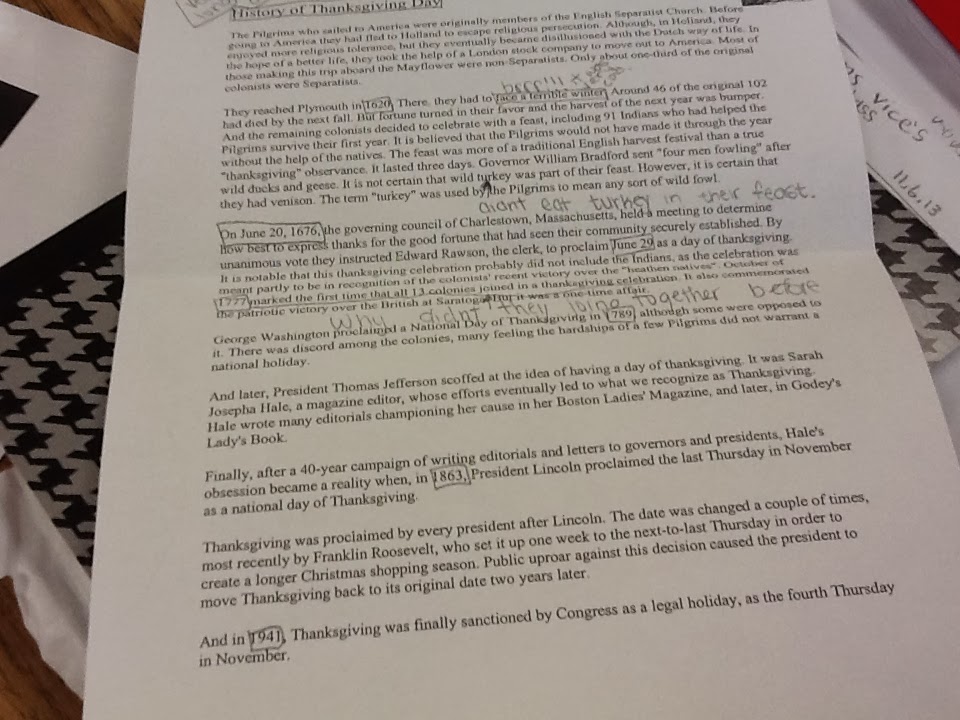
They did a really great job with modeling their thinking and working with their partners.  We read The Scoop on Dino Poop, Jack Roosevelt Robinson and several different articles on the history of Thanksgiving.

We had them compare & contrast the text structures.  Monday we'll write a guided group constructed response about the text structures :)

Sunday, November 24, 2013

Text structures

We spent last week and this upcoming week working on text structures with our students.

We used this great resource from FCRR.org on text structures where students had to sort paragprahs into the categories of informational text.


We also looked at the five types: description, compare & contrast, cause & effect, sequence/chronology, and problem & solution.

Since my students mix up problem & solution with cause & effect, I used a little help from my iPad to clarify the difference: 


I have a clear cause (the angry birds) and then the effect(s) are when the structure falls down and the pigs die because of the birds.


In candy crush, I have a problem and if I'm stumped, the game gives me recommended solutions (game hints).

We're still working on text structure next week with reading different informational articles and analyze them for their purpose and text structure, but they're doing a good job with it :)

Friday, August 9, 2013

Vocabulary Ideas and Notebooking

After attending the Mickelson Exxon Mobil Teacher's Academy last summer and numerous professional developments since then, the messages of the importance of academic vocabulary and students needing to notebook was obvious in almost every single one.  Here are some great examples of notebooking with students.

Vocabulary:

This would be great for power words at our school and encouraging students to use academic vocabulary.  You could keep a running total on the board.

This foldable is great for prefixes & suffixes.  You can stress how the affixes change the meaning of the word.


This bulletin board is cute, but I would modify it to be "roots" since Greek & Latin roots are explicitly stated for upper elementary in the Common Core State Standards.  


This is a cute idea for decomposing words.  Students could cut the words apart and sort them as partners. They could also practice blending multisyllabic words when they reconstruct the words.  Additionally, they could notebook about how affixes and roots work together.

This idea I'm pretty sure is mentioned in the CORE Sourcebook (a must have!) as a strategy to help students synthesize information.  It's great for literature and informational text.

Another great idea with post-its:

Here is a great example of notebooking for primary students:

This foldable is great for a language mini-lesson, especially for English language learners!


Here is a great way to teach "shades of meaning" with academic language:

Gluing a ribbon to the inside back cover of notebooks will serve as a bookmark and help students quickly get back to their last page.

I like that this anchor chart has pictures to help clarify meaning for students.

Here's a great visual for notebooks:


I like that it places equal importance on teacher and student contributions.  The point of notebooking is for students to make meaning of what they're learning and track their educational journey. 

Notebooks aren't for teachers.  They are for students to take ownership of their own learning.

Monday, August 5, 2013

Small Group Reading

Small Group Reading

Our school is fortunate enough to subscribe to Reading A-Z, which provides all sorts of great resources.  I am a fan of the leveled fluency passages, which I started using last year for timed repeated reading at the start of my small group reading block.  Students would whisper read for one minute, keeping track of their errors and charting their own progress.  As the week progressed, they would see their scores rise and begin to internalize why they should read at home both silently and aloud.

However, I noticed that not all of my students were being honest and accurate, so I've tweaked my plans to have them buddy read and buddy coach this year.  They will work with a partner (a new one each month who is in a different reading group) and provide feedback  for improvement.

I've used the Reading A-Z leveled readers for science lessons on heredity and genetics.  This topic isn't really covered in our text book, so we utilize this instead.  Students explore Punnet Squares, examine their own dominant and recessive traits, the works.  I like that the books have chapters, lots of informational text and plenty of text features to make the concept accessible to all my students.

I've used the books in small groups but didn't like how I would print fifteen pages (per student) and end up throwing them away.  Then I saw this idea on pinterest:

For some of the higher level books (W and up), I can print the books and keep them separated by reading level with different colored duct tape (which happens to be in the dollar bin at Target, score!).  That way the books can be used over and over again.

I also like this poster because even as fifth graders, they still need some reminders of what they're supposed to be doing.

 I'm excited for a new group of readers!

I also love doing things like this as easy rewards for my readers!


I can't wait for a new school year and a new group of readers!

Happy reading!