Showing posts with label data. Show all posts

Wednesday, June 18, 2014

CRT Data

Confession:

I rarely check my work email over the summer.

I deleted the app from my phone and since I'm not in my new school's system yet, I don't see much of a point to log in daily only to delete spam and teacher coupons (looking at you Lakeshore). 

I saw my (former) principal post on Facebook that not only were CRT (Criterion Referenced Test) scores in, but she was excited about the results.  So naturally I asked to see the fifth grade data because well, I'm a numbers nerd!

I was at my new house painting so I figured I'd check the data in a few hours.  Well, my grade level beat me to the analysis part.  In a matter of minutes, I had six texts from my former grade level sharing their excitement about particular students.  

While I'm sure I'll get official reports with the break down of each class, I couldn't wait.  My insomnia got the best of me and sure enough, I was up at four am crunching numbers and making graphs.  I couldn't be more pleased with my class results and know that I didn't accomplish this feat alone.  It took our entire grade level working tirelessly, together, for ten months to achieve these results.  For those at my school who did not approve of our quasi-departmentalization experiment, I'd like to waive this data in their faces...but I won't...because I am a professional.  

I had the privilege of working alongside some of the most inspirational fellow teachers.  I will miss being able to pop into their rooms and the amazing collaborative mindset we all shared.  For various reasons, we are all starting at new schools and collectively represent third, fourth, fifth, sixth, and special education.

Math

(I didn't teach math besides our intervention block and number talks, so these scores are due in a large part to the amazing effort of my two neighboring teachers.  Well done ladies! I trusted that my students were in very capable hands each and every day.)


I'm a visual person, thus the graph.  Here is my class data for math:

1 student exceeded
22 students met standards
3 students were approaching
6 students were emerging


Science

We shared students for science and I taught the FOSS Landforms kit four times before getting my own class back for CRT prep.  When my homeroom wasn't with me, they were with my fellow teachers learning about environments, mixtures and solutions, force and motion, as well as variables.  We broke our year into four seven week rotations and started switching the third week of school.  We didn't switch right away because we wanted to set up science notebooks and go over the scientific method with our homeroom classes.  

Our rotations ended about two weeks before the science CRTs, so we used that time to incorporate Discovery Ed video streaming into our reviews.  We also practiced taking notes from multimedia presentations, a valuable skill they'll most definitely need in middle school.  However, we did this with the Magic School Bus videos and they did an amazing job.

Here is my class science data:


Numbers wise,
6 students exceeded standards
17 met standards
6 students were approaching standards
3 students were emerging on science standards

I'm quite pleased with my little scientists!


Reading

If you are new to my teaching blog, know this: I love reading.  I love discussing books with my students and watching them fall in love with literary worlds.  I love watching their excitement when they learn more about the world around them from informational text and seeing them become self-motivated to learn more by reading more is simply wonderful.  

I broke my reading data into two groups: my small groups and my whole class.

I had the higher half of the grade level for small groups, so naturally these numbers are expected to be more in the meeting category.  My job for small groups was to push these fluent readers to become more critical thinkers.  


Numbers wise,

23 students exceeded standards
28 students met standards
7 students were approaching
2 students were emerging

I'm quite pleased with my small groups!

For my whole class, which is inclusion, here are my results:


7 students exceeded standards
13 students met standards
4 students were approaching
8 students were emerging (of these 8, all were either students with IEPs or in the RTI process and still made growth over their previous scores)


I'm thrilled with my students' performances.  Did they all meet standards? No.  Did they all make growth? Yes.  

With my data analyzed, I can emotionally bid this past school year adieu.  I did my best.  I taught them strategies and how to think critically.  They learned and proved their knowledge on these tests.  It is time for a much needed, relaxing summer.

Thursday, November 28, 2013

tracking writing

I've toyed with a variety of strategies over the years of how to keep track of my writing conferences.  I know some teachers utilize their iPads, but I guess I'm just a fan of an old school strategy:


Using a notebook, I put tabs down the side for students, allotting 2-3 pages for each.  I write notes in the front cover about who needs what mini-lessons and form flexible small groups from there.

I start the beginning of the year with them analyzing themselves as writers.  When they meet with me for the first time, they share their strengths, weaknesses and about their favorite piece of writing.

I try to conference with a few students a day but I like my notebook strategy because I can easily share the data with my writing co-teacher.  We can both hold conferences without having to worry about iPad passwords :)

Plus it's easy to see their progress over the year!

Thursday, September 26, 2013

Well, that was out of the blue

I want to believe that I am a good teacher. I know I love my job (most days) and I know I love watching students learn (all days).  It's been a rough year and I haven't felt super supported at school.  I know we took a hit last year in terms of standardized assessments and test scores, but I truly didn't think mine were that bad.  In fact, they weren't bad at all.  My students made growth and did all of them reach their goals? No.  But did they all show improvement? Yes. 

I've been a little frustrated with hearing about how fifth grade's scores went down drastically (19%).  It wasn't my class.  It wasn't 2 of my fabulous neighbor's classes because they worked just as hard and provided some amazing learning opportunities for their students.  I learned so much from them last year and I continue to learn from them now.

Today, out of the blue I got an email from a researcher.  He has a PhD so I'm going to assume he knows what he's doing in terms of assessments.  Here was the gist of his email:

"In my analysis, your students did exceptionall well, including the ELL and special education students. I would like to talk about your experiences and see what resources you used."
Bam.  I want to gloat about this to those that have been a tad harsh this year, but instead I'll just share my excitement here.  I know I did my job as a teacher. I know they all learned and made growth.  More importantly, I know I got them excited about inquiry and learning.

He wants to specifically discuss Discovery Education and the resources I used since I'm a DENstar and he's looking at the Discovery Launch into Teaching assessments.

Honestly, I used Discovery's resources mostly for science which wasn't reflected on those assessments.  We did a lot of video streaming and discussion prior to the CRTs and my students did awesome on their science tests.  (In addition to reading and math!)

So I hope this means I can stop hearing about test scores and negativity.  Fifth grade may have gone down drastically, but that was not my data.  I will be accountable to my test scores and students' growth.  

Do I believe that one test determines what a student learned in one year? No, absolutely not. But it's what we have and what I have to use, so I will take an honest look at the data.  My data looks pretty solid and I'm proud of my students' growth.  Numbers don't lie.


Saturday, September 7, 2013

Writing Portfolios

This year I'm having my students keep track of their writing with portfolios.

During the first week of school, I had them fill out a "me as a writer" sheet so I could start to plan out mini-lessons based on their needs.

I read through their writing struggles and made a list:


Luckily, a lot of these concerns are addressed in the CCSS so my instruction can be both standards-based and data-driven.

From there, I found a stack of manila file folders and stapled their sheets inside.

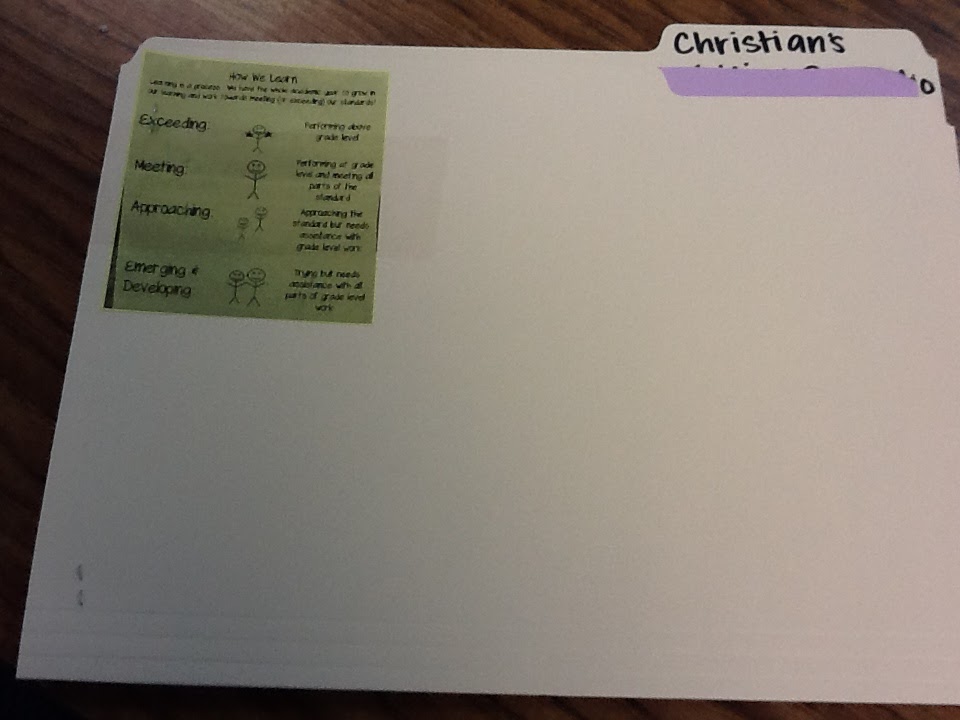
I then added a picture of this chart


about growth and mastery of standards to the outside of their folder:


For durability, I added some packing tape to make sure the growth chart was staying put!

Inside, I stapled a double sided chart of the common core writing and language standards so they could see exactly what we're working on:


We will talk about SMART goals after our diagnostic constructed responses this week.  Students will then generate their own writing goals, which will also be stapled into their portfolios.

Their portfolios can double as privacy shields during independent writing time for assessments.

I made a wordle out of their list of struggles with writing:


At least we have a very comprehensive list!  Plus, the largest issue of "big words" we are tackling right away with explicit phonics and syllable types :)

I turned that wordle into part of my bulletin board, but more on that later!

Friday, August 9, 2013

New data ideas and encouraging students

With the school year fast approaching, it seems I'm spending lots of time on pinterest looking up new ideas to make my life easier and be a better teacher.  Here are some new ideas that I found that I'm super excited to try:

Idea One:
Data folder for me:


This would be great for small groups so that I can share the information with the rest of my grade level.  

I use a notebook for writer's conferences but wanted to have a different system for small group notes.  

I think I could also use this for conferencing with my own homeroom about AIMSweb progress monitoring.  

I think I would color code this by small group and include labels (teacher name, IEP students, etc).  

I think I would need to keep it by my small group table so I consistently write in it but I like the simplicity of this.


Second idea: 
student praise


This ties in perfectly with praising students for making progress and meeting their individual goals.  It could be used for acknowledging AIMSweb, IEP or improvement on standards based assessments.

Plus, I could make it with polka dot or chevron borders :)
Or make several different ones and give students a choice of which one they'd want to wear.  
(Football one, soccer one, polka dot one, one with book border, chevron pattern, etc)

Granted, this might only work for my extrovert students but it's still better for the environment than printing lots of sticky labels for students to wear and pick at all day long.

Monday, July 29, 2013

data tracking

At my school, it is a requirement for transparent data for students and teachers.  I'm not a fan of data walls because I don't think it is helpful for special ed students to see themselves in red all the time.

Instead, I am a fan of data folders where students track their own growth and progress.  I found this on pinterest:

I think it needs to be placed on my students' data folders.  Academics is a journey and there are small, meaningful steps that students will take toward mastery of a concept.  It's a process :)

Here is a very rough copy of the poster I made for my classroom explaining what mastery of standards mean.


At our school, we don't have grades.  Instead, we assess mastery of the Common Core with standards-based assessments.  We are moving toward SBAC online testing, but that will be coming up in the next few years.  

For a student to exceed standards, which isn't possible for all standards, they must meet all components of the standard in addition to a working knowledge of the next grade level's knowledge targets.  

For example, knowing and using the 26 letters of the alphabet would be mastery of a standard.  There is not an option to exceed standards because there simply aren't additional letters to learn.  In contrast, multiplication in fifth grade includes whole numbers to the thousands as well as  fractions and decimals.  To exceed standards, students could attempt larger problems and explain their thinking in a variety of ways.

In our district, we have broken down the common core into four categories of learning targets:

1. Knowledge: This is the basic level of what students must know about the standard.  As the lowest form of Bloom's Taxonomy or DOK (Depth of Knowledge), students are recalling facts and regurgitating information.  This is frequently regarded as a DOK 1 question.

2. Reasoning: Students must apply the knowledge targets on a task or question.  This can be done in multiple choice or short answer format.  We tend to have students justify their thinking (ELA) or explain their work (math) to show their understanding of the material.  When they justify their thinking for reading passages, it is an expectation that they quote accurately from the passage to reveal the basis for their argument.  These are frequently regarded as DOK 2 questions.

3. Product: Students must solve more complex problems, create a product or write an extended constructed (written) response to explain their thinking.  These are more in depth and regarded as DOK 3 or 4 questions.

4: Performance: Performance tasks are rare in elementary school, but that doesn't mean they don't exist.  Students combine their information, usually from multiple standards, to complete a given task.  It usually is a synthesis and analysis, which is a DOK 3 or 4 level activity.

For students to master a standard, they must meet all of the knowledge, reasoning and performance or product tasks (if applicable). 

If students are missing part of the reasoning question or cannot fully complete the product, they do not master the standard.  Instead, they are approaching, which means they understand parts but need more guidance toward independent mastery.

For emerging students, that means they are still developing their working understanding of the material and need assistance to complete tasks to grade level expectations.

We have many chats in the classroom about how education is a journey and reassessment happens frequently.  I've said it before, but what I love about the Common Core State Standards is students are given until the end of the year to demonstrate mastery.  I'm no longer confined to trimesters or quarters to jam in content, but rather have the flexibility to reteach and blend concepts together.  I'm not teaching theme in isolation, I'm teaching theme while examining elements of poetry, figurative language and text structure.  A lesson or unit might take a few weeks, but we've hit RL 5.2, RL 5.5 and language standards for figurative language by blending concepts together for more authentic learning.

In addition to the class poster that "mistakes are proof that you are trying", I am a fan of this one as well:

It's okay not to know. It's not okay not to try.