Showing posts with label place value. Show all posts

Tuesday, November 17, 2015

Where was admin?


I had a beautiful conversation erupt during math time today.

Here was the problem:


They were solving with a partial products array (they're not quite ready for traditional or standard algorithms for multiplication) and a very loud, very passionate conversation erupted.  One student argued that having the "zero tens" row in the second factor (409) wasn't necessary.  Another passionately disagreed.  

Soon, I lost the whole class to this beautiful, loud conversation about if zero is a value or simply a place holder.  

Did it need to be represented? 

Could it be skipped? Always?

I reeled them back in after about five minutes of debate, much to the horror of the original instigators who hadn't successfully defended their perspectives.

What a beautiful, natural example of the math practices coming to life.


Now, where was admin?! That would have been a lovely example of math discourse in the classroom for my end of year evaluation.


Monday, September 8, 2014

Marathon Days

With the third week of school steadily approaching in a few hours, I finally feel like I've had a moment to breathe.

The first week of school is always jammed packed with teaching procedures, establishing classroom culture, setting up notebooks, and integrating fun activities.  I think I did a pretty good job of that this year, but man was I tired!

Luckily we had a three day weekend (Labor Day) followed by a staff development day.  

However, I think my grade level (myself included) tried to plan a week's worth of instruction into three days.  It didn't go very well.

We overplanned, which was far better than the alternative.  We had a conversation about clarifying our expectations and I think this week will go better.  There were two 12 hour days, one of them due to my date with the copy machine and the other due to open house.  By Friday afternoon, a rather unpleasant migraine hit and I was beat.

My students must have been feeling it too.

I had a low turn out to open house, but I appreciate those families that did come.  One wanted to have a conference, which we held after school on Friday.  Because the open house was shortly after school ended, our administration bought us dinner so we wouldn't be hangry.  (Side note, hangry = hunger plus anger. I suffer from this affliction frequently) The fact that dinner was Olive Garden was a delightful bonus!  We had three rotations and a fake announcement about a staff meeting was made at the end to get the parents to clear out so we could go home on time.  It's so nice to be at a school where I feel administration has my back.  I got home and was most definitely asleep by 7:30 that Thursday night.

Friday, 4 of my students were absent. Two more went home in the afternoon from being sick and a third left for early dismissal.  GATE kids were gone and there was an announcement about turning off the technology because the server was getting too hot.

So, with a third of my class being gone, I made a judgment call not to teach the writing plans.  Yes, it puts me behind. But it didn't make sense to me to teach new material without my students.  I am more than happy to teach if a few are gone (obviously, we do this daily) but when I have ten students out of the room for various reasons...that'd be a lot of reteaching.

So instead, we built up our reading stamina with an extended silent reading time.  I got through all my conferences for Reading Rangers and my students all set up their data folders.  

With the remaining time, I started reading aloud The Lightning Thief. I had my class split up into 4 categories and keep track of character details while I read.  They did a pretty good job of listening for information about Grover, Mr. Brunner, Percy, and Mrs. Dodds.  I haven't explicitly taught this standard, nor did I have them make a graphic organizer.  I just wanted to see how they'd do and I was pleasantly surprised.

My weekend was spent looking over their pre math tests, which confirmed what I saw in classroom observations.  I had a rather long math training Saturday morning, but lunch with my mentee made it better.  I texted frantically with another teacher as we tag-teamed the math lesson plans for the week, which was a lot of prep work.  I'm pleased with the end result because I think it's broken down enough the students will grasp the material.  Add in some laundry, some football, and some napping and that was my weekend!

Week three brings a counseling lesson, the start of Aimsweb, hopefully getting at least my teacher iPad (for Aimsweb), modeling fluency and buddy coaching with Reading A-Z passages, place value, our Native American reading/writing unit, and possibly a schedule change for rainy weather.

Sigh.  I've had some marathon days.  I'm ready for things to calm down and me to be more on a schedule.  I've been getting to work early and staying late. I'd prefer to do only one of those!

Bring it on week 3!

Monday, January 6, 2014

Division Strategy

With the Common Core State Standards, traditional "long" division isn't taught until sixth grade. 


 Because this strategy relies on an algorithm with no concept of place value, it is no longer taught in elementary school.  

  While this was a struggle for some of my colleagues within my school district, we were fortunate enough to have an awesome coach last year who helped us with different division strategies that helped build students' number sense and relied on place value.

One of my favorite strategies was recently featured by NCTM on their website :)


Not only is this strategy  easy for families to understand because it does look similar to the traditional algorithm but it helps students make the connection that division is subtracting in equal sized groups.

Happy dividing!

Saturday, December 14, 2013

Multiplication Strategies

For the intervention part of the day, we've been working on multiplication.  The fifth grade standard says students have to solve using the US standard algorithm, but we are stressing multiple ways to calculate the product.

I give my students a warm up problem, have them work independently for a few minutes, then share with a neighbor how they solved the problem.  If the group got different answers, they work together to solve it again, thus practicing their math discourse.  (Also, mathematical practice #3 about critiquing the reasoning of others).

Here's a snapshot of one group's work:


The strategies they typically use are:
1. US standard algorithm
2. British standard algorithm (very similar to US but with more of an emphasis on place value, as seen in the top image)
3. Partial Products
4. Estimation or compatible numbers to check for reasonableness
5. Repeated addition
6. Halves & Doubles
7. Lattice Method

I love that they're focused on the process of finding the answer rather than the one right answer.  It lends itself to much richer mathematical discussions about the value of numbers.

Sunday, August 4, 2013

Math Anchor Charts and Ideas

I love great math ideas.

Here's an easy center to make, it just requires sharpies, a plastic bag, some patience and old water bottle lids (yay upcycling!)


This center can easily be differentiated for any grade level depending on the operations that are used.  For fifth grade, I would use parentheses and all operations signs.  This would be great for making algebraic expressions, practicing multiplication and division, finding unknown values and using decimals to show place value.

Students could easily bring in lids to help you collect the supplies.

With the Common Core, fifth graders have to review geometric shapes and classify them into a hierarchy.  This is a great example of an anchor chart that could help students:


Before we go into 3D shapes, I would review 2D shapes on the geoboard.  Most classes have a set of the old plastic boards and rubber bands, but there is a great free app on the iPad that allows students to virtually manipulate geoboards.  As a bonus, you can expand the board from the traditional 5x5 to a much larger 10x10 board, allowing for more room to make shapes.  This app could be used as a formative assessment where you call out a shape (ex, right scalene triangle) and students make one to show you.  

Plus, there are different colored rubber band options with the app :)

This is a great freebie I found on another teacher's blog:

I've used it in my classroom and it's a great center to review number sense.

You can also use cups to review place value:


For a review of area and perimeter, you can use graph paper, markers and dice for this easy game of war.

Students roll the dice, then create the corresponding array.  Students must strategically place their array on the grid and try to stump their partner.  I like that this is a nice model of how repeated addition and multiplication are the same.

This can easily be differentiated for lower grades by having students add the dice rather than multiply them. 

This is another great (priced) TpT center that my students enjoy:

Plus, it's pink and polka-dotted!  Grab yours here for a buck! 

Happy math time!

Wednesday, July 10, 2013

Mentor Text Ideas

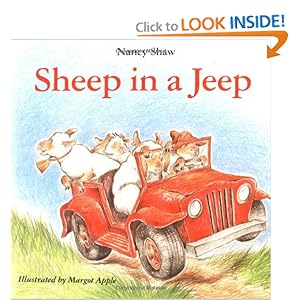
I love using picture books in my classroom. Yes, I know my fifth graders might seem a little old for picture books, but I only pick books with an academic purpose.  Sometimes the purpose is to introduce a concept, other times it is for a mini-lesson.

Here are some of my favorites :)

(Historical Texts)


This is great for discussing historical myths and the American Revolution.  The book talks about John Adams, Paul Revere, George Washington, Benjamin Franklin and Thomas Jefferson.  My students really like the story line and the book provides lots of factual information.  This book is highly recommended :)

This is out of date, but still good to review some of the older presidents:

Just make sure you mention President Barack Obama as well!

This is another great book by one of my favorite authors.


This book addresses the issue of slavery.

(Science Texts)


This is great to review the concepts of force and motion.  I had students follow along with toy cars at their table teams and discuss what would happen next.  We reviewed friction, inertia and Newton's Laws of motions.  Not bad for a picture book!
Bonus: here is the story on you tube :)

This goes great for environments and food chains.

The book lends itself well to discussions and the creation of food webs.


(Writing Texts)


Students not only loved the plot of this story,  but that they could interact with the text by editing for punctuation. After reading this, I displayed the image under the ELMO and my students worked in table teams to return the missing punctuation to the story to add meaning.  They got super excited about editing, which is always a  plus!

This one is great for persuasive writing and students can really relate to the premise!

This cute picture book is great for homophones!

This book looks at the importance of word choice which helps all writers improve!  

This can also work for vocabulary and shades of meaning, both of which are concepts that many students struggle with in the upper grades.

Reading Texts


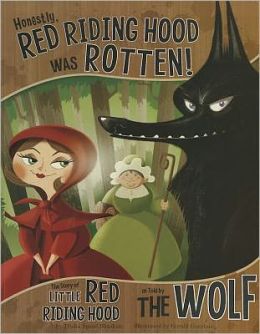
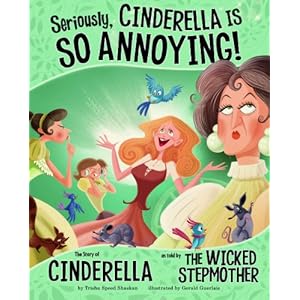
I used these books to discuss alternative points of view and how the narrator's perspective shifts the story (aligning with RL5.6).  These books were highly amusing and prompted my students to want to re-write their own versions of their small group novels.  For example, one group rewrote part of Harry Potter from Draco Malfoy's perspective.  I also loved that there were four different books providing a different mentor text for almost the entire week.  Repeated exposure really helps solidify the concepts!


For helping students make inferences, I'd recommend this book:


Students have some great discussions on this book :)  Bonus, you can review the seasons!

This book serves two purposes, which is great because time is always limited.


You can use this picture book to review text structure as well as punctuation.  I love when reading and writing align!

The next books are great for vocabulary acquisition, which is part of the Common Core State Standards:


The importance of vocabulary in a fun way :)


This book is sure to inspire your class (or school) to have their own vocabulary parade!  For more information, visit the author's website here.

To review the importance of using reference materials, I'd recommend:


Just make sure your students know not to eat books :)

This gem is self explanatory

but still works as a great review for genres.

Math

Place Value:


This book nicely combines science visuals of the universe and math concepts of place value.  I use this at the beginning of the year to build background knowledge and as a formative assessment to see students' understanding of number sense.

Beginning of the Year Classics

Ms. Nelson is always a classic!

I read this book in the first few days of school (while wearing a black dress of course!) and discuss classroom rules.  It's a great introduction to classroom norms and community building.

I love this author and this book does a great job of addressing different student learning styles.

We discuss that learning is a journey and some students just need more time than others.

To help students deal with their emotions appropriately, I always read

during the first week of school.  Students then brainstorm ways that they can deal with their own terrible, horrible, no good, very bad days.  I took the concept of an Alexander day one step further by making Australian flags.  If students are having one of those days, they simply place a flag on their desk to indicate to others that they are feeling sensitive.  My students really responded well to the idea and didn't abuse the flags.  Here is another example of a teacher using the flag concept:


We also read

and discuss the importance of individuality.  Plus it's a great way to apologize to students for accidentally mispronouncing their names!

Another great read for social responsibility and classroom rules is:

I'd highly recommend this book because it forces students to look at their own behavior and accept responsibility...a social skill that often needs fostering :)

This is slightly juvenile, but does a great job at stressing the difference between tattling and informing.

We all want safe classrooms, but students also need to learn to solve some of their own problems.

I love this book not only to briefly review land forms, but also to reinforce norms for listening and speaking:

Students often have volcano-like mouths but this book helps highlight the importance of taking turns.


What suggestions would you add?
-Ms. Vice